How to Vet Deck Builders in Cincinnati: 8 Qualifications to Verify First
Most homeowners comparing deck builders in Cincinnati worry about the same thing: getting oversold, steered toward the wrong material, or stuck with a crew that disappears after the deposit clears. That worry is fair. The fix is not reading more review roundups; it is verifying a short list of qualifications before you sign anything. This checklist covers the eight things to confirm, in the order a careful homeowner would check them, so you can compare two or three quotes with confidence instead of guesswork.
The stakes are higher than most people assume. According to the International Association of Certified Home Inspectors, as many as 60 percent of the roughly 45 million decks in America have safety issues, and about 90 percent of deck collapses trace back to ledger board connection failures. A deck is a structure attached to your house, not a weekend carpentry project. Vet the builder like it matters, because it does.
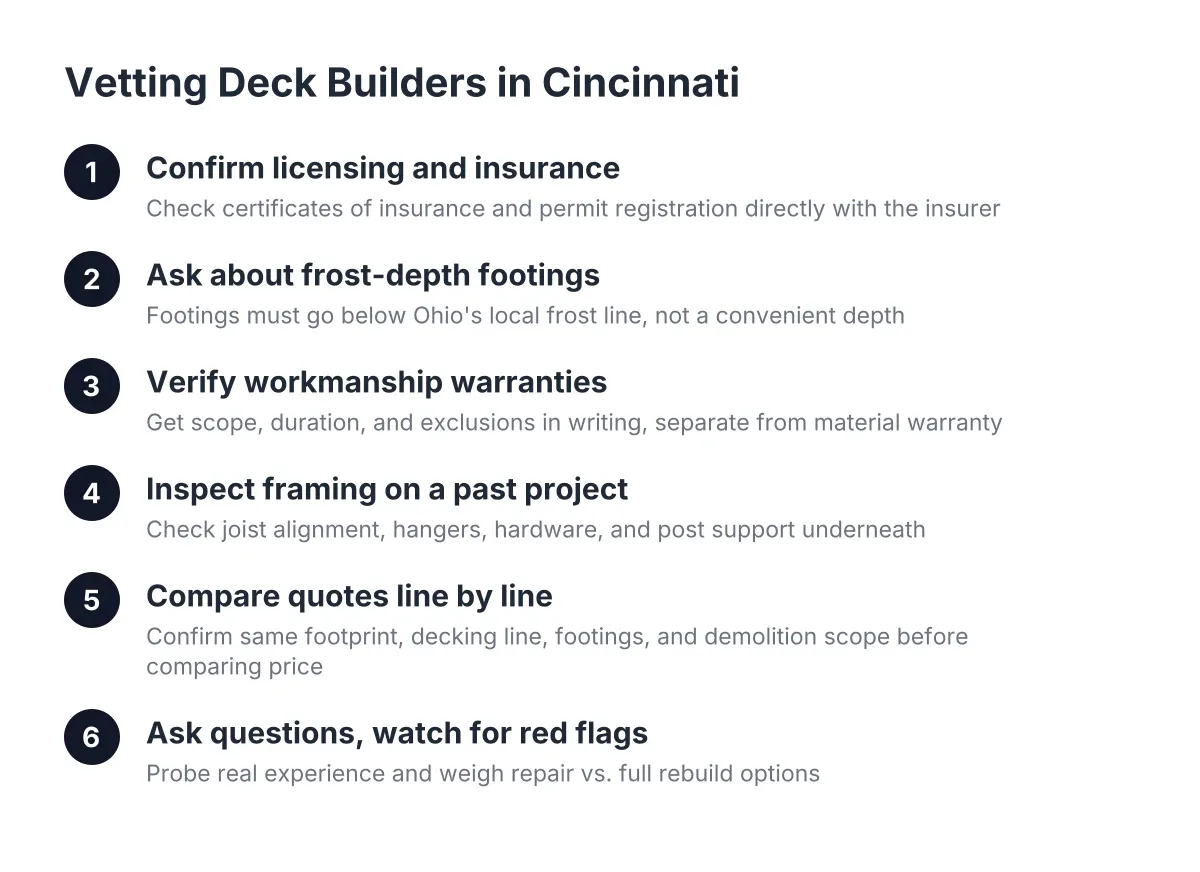
1. Confirm Licensing and Insurance Before Anything Else
Any deck contractor you consider should carry general liability insurance and workers compensation coverage, and should be registered to pull permits where you live. Ask for certificates of insurance directly, not a verbal yes, and call the insurer to confirm the policy is active. If a worker gets hurt on your property and the builder has no coverage, the claim can land on your homeowner's policy.
In greater Cincinnati, permit requirements vary by jurisdiction. Hamilton County and the individual cities each have their own process, and a legitimate deck builder will know which office handles your address and will pull the permit under their own name. A contractor who asks you to pull the permit yourself, or suggests skipping it, is shifting liability onto you. Treat that as a dealbreaker, not a negotiation point.
2. Ask How They Handle Ohio Frost-Depth Footings
Footings are where Cincinnati deck projects succeed or fail. Ohio's freeze-thaw cycles heave shallow footings out of the ground over a few winters, which is why structural footings must be dug below the local frost line rather than set at a convenient depth, a point Decks.com makes about any structural post. Ask every builder you interview how deep they dig, how they size footings for your deck's load, and whether they ever bring in a structural engineer for heavier builds like a hot tub platform or multi-level deck. When assessing builders working on deck projects in Cincinnati, pay close attention to their footing specifications and practices.
The answer tells you a lot. A builder who talks specifics about footing diameter, soil conditions, and inspection timing understands the foundation phase. One who waves it off with "we've always done it this way" is a red flag, because mistakes at the footing stage get harder to correct with every board that goes on top. Improvised shortcuts, like resting posts on surface pier blocks for an elevated deck, contribute to the structural failures inspectors find later.
3. Verify Workmanship Warranties in Writing, Separate from Material Warranties
A fair deck quote separates two warranties: the manufacturer's warranty on the decking itself, and the builder's own warranty on labor and workmanship. Composite products like Trex and TimberTech carry long manufacturer warranties, but those cover the boards, not a ledger that was flashed wrong or a railing post that loosens in a year. Ask each contractor what their workmanship warranty covers, how long it runs, and get it in the contract.
Be cautious with vague promises. "We stand behind our work" means nothing on paper. You want the scope, the duration, and the exclusions written down. In addition, ask what happens if the company cannot honor the warranty; a builder with an established local presence in Cincinnati is easier to call back in year three than a crew working out of a truck with an out-of-state plate.
4. Inspect Framing Quality on a Past Project, Not Just the Photos
Anyone can show you a gallery of finished decks shot from the good angle. The craftsmanship story lives underneath. If you can visit a past project or an active job site, look under the deck: joists should be aligned and level, hangers and hardware should be the right type and fully nailed, beams should have solid post support, and span distances should look consistent rather than stretched.
Details on top matter too. Picture-frame borders with hidden or plugged fasteners, clean miters, and consistent board gaps separate a professional build from a rushed one. Composite systems often include matching plugs that hide screw heads on border boards, according to Trex, and quality-minded crews use them. Some builders also tape the tops of pressure-treated joists as an extra moisture barrier, a practice TimberTech describes, which extends frame life even though treated lumber resists rot on its own.
5. Compare Deck Quotes Line by Line, Not by the Bottom Number
A deck quote comparison only works if the quotes describe the same project. Before you judge the price, confirm each bid specifies the same footprint, the same decking line and railing style, the same footing approach, and whether demolition of the old deck is included. A low bid that excludes haul-away, permits, or railing can end up costing more than the complete one.
Here is what a complete deck building quote should itemize:
- Decking material by brand and line, with the specific color (Trex decking colors vary widely in price tier, so "composite" alone is not enough)
- Framing lumber and hardware, including footing count and depth
- Railing system and stairs
- Permit fees and who pulls the permit
- Demolition and disposal of an existing deck, if applicable
- Workmanship warranty terms
- Payment schedule tied to project milestones
If one of three quotes is dramatically lower, ask why before you celebrate. The difference usually hides in footings, framing lumber grade, or a missing scope item rather than in generosity.
6. Ask the Questions That Expose a Builder's Real Experience
The best questions to ask a deck builder are the ones a salesperson cannot bluff through. Keep the list short and specific to your project. For a screened-in porch or deck-and-patio combo, ask how they tie the roof structure to the house, how they transition the deck to the patio grade, and how your yard's slope affects the design. For a multi-level deck, ask how they frame the level changes and where the extra footings go.
Suppose you are a homeowner in Anderson Township with a sloped backyard, picturing a deck off the kitchen stepping down to a paver patio with a fire pit. A builder worth hiring should sketch how the levels connect, flag where the slope forces design choices, and explain how footing depth changes on grade. If the answer to every question is "no problem, we do that all the time" with zero specifics, keep interviewing. Vague confidence is the most common way homeowners get steered into a build that does not fit their yard.
7. Watch for the Red Flags That Predict a Bad Project
Deck builder red flags tend to show up before the contract, if you know where to look. Most bad outcomes announce themselves early through pressure tactics, vague paperwork, or cash-flow demands that put you at risk.
Walk away, or at least slow down, when you see:
- A demand for a large deposit, say half or more, before any material is ordered
- No written contract, or a one-page contract with no scope detail
- Reluctance to show proof of insurance or discuss permits
- A quote delivered on the spot with heavy pressure to "lock in today's price"
- No physical address or local footprint in the Cincinnati area
- Refusal to provide addresses of past projects you can see
None of these alone proves a builder is dishonest. Together, though, they are the pattern behind most of the horror stories you read in local forums about deck builders in Cincinnati that took a deposit and stalled for months.
8. Weigh Repair, Resurfacing, or DIY Against a Full Professional Rebuild
Not every aging deck needs a full replacement, and not every task needs a contractor. Staining, sealing, and swapping a few surface boards are reasonable homeowner projects. Deck resurfacing, where sound framing gets new decking and railing, sits in the middle and is worth pricing against a rebuild. However, anything structural belongs with a professional: ledger connections, footings, beams, and framing repairs after rot.
The North American Deck & Railing Association estimates about 30 million decks in the United States are beyond their useful life and need repair or replacement. If your deck wobbles, the ledger shows rust streaks or soft wood, or posts have shifted after a freeze-thaw winter, stop using it for gatherings and get it inspected. CPSC data show about 725 injuries per year from collapses of porches, decks, and balconies, per the U.S. Consumer Product Safety Commission, and most of those failures were visible in advance to someone who knew what to check.
What Cincinnati Deck Builders Should Deliver
Verifying qualifications takes a few evenings of calls and one or two site visits. In return, you get a structure built on properly dug footings, a permit file that protects you at resale, and a warranty you can enforce. You also get the outcome that drove the project in the first place: outdoor space you use across seasons instead of a platform you worry about. The National Association of Realtors reports that 81 percent of homeowners say they enjoy their homes more after adding a deck, which matches why most people in greater Cincinnati start this process to begin with.
One honest caveat: no checklist replaces professional judgment on structural questions. If your project involves a hot tub, a rooftop or elevated multi-level deck, or questionable soil, footing sizing sometimes requires a structural engineer's calculations, and a good contractor will tell you that rather than guess. Hiring a deck builder is ultimately a judgment call about trust; this checklist narrows the field so the final choice is between two or three contractors who all cleared the bar.
When you search deck installation near me and start lining up quotes, bring this list to every conversation. The builders worth hiring will welcome the questions. If you are planning a new deck, screened-in porch, or deck-and-patio combo in the Cincinnati area, reach out to us for an estimate; we will walk your yard, answer every question on this list, and put the scope and warranty in writing before you commit to anything.
If you need deck building and installation, Cincinnati Deck Pros can help.
Prefer to talk it through? Call (513) 613-3364 — a quick call is usually the fastest way to get a straight answer for your situation.