Trex vs. TimberTech vs. Treated Wood: A Cincinnati Deck Material Comparison
You have already decided your old deck is coming down, or at least getting new boards. Now comes the decision that shapes everything else: Trex decking material, TimberTech composite, or pressure-treated wood. Each one changes your budget, your maintenance routine, and how the deck holds up through Ohio freeze-thaw winters. This comparison walks through seven decision points a Cincinnati deck builder would talk you through before writing a quote, so you can make the call with your eyes open instead of taking a contractor's word for it.
One note before the list. If your current deck has soft, springy boards or a loose railing, the material question comes second. Have a deck contractor inspect the framing underneath first. Rotted joists or undersized footings mean no decking product, composite or wood, is going on top until the structure is sound.
1. Start with the honest cost gap between composite and treated wood
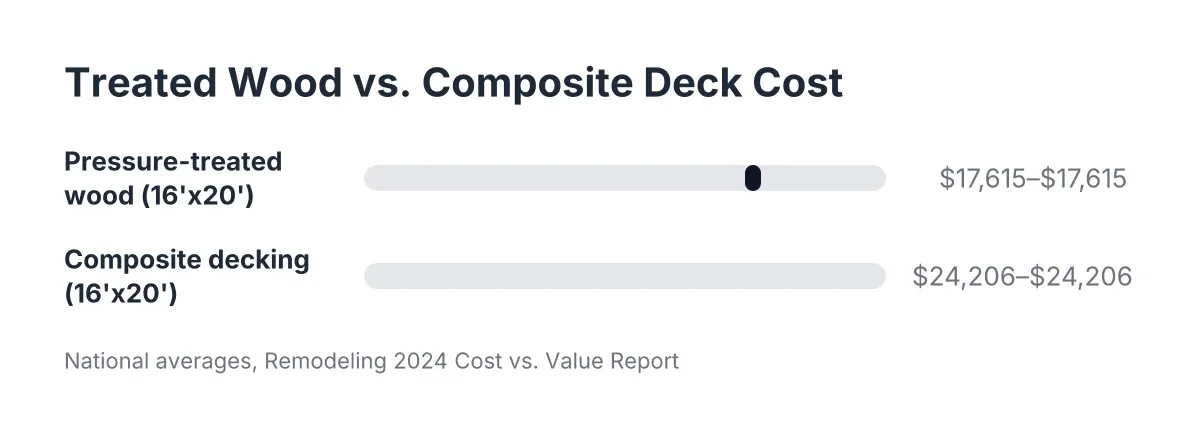
Treated wood decking costs the least up front, and the gap is not small. According to the Remodeling 2024 Cost vs. Value Report, a 16'x20' pressure-treated wood deck averaged $17,615 nationally, while the same deck in composite ran $24,206. That same report put wood at an 83% return on investment at resale versus 68% for composite.
However, upfront price is only half the math. Treated wood needs staining and sealing every couple of years, and boards that cup, split, or rot get replaced along the way. Composite decking costs more on day one and then mostly asks to be rinsed off. For a long-time homeowner planning to stay put for 15 or 20 years, the maintenance savings close much of the gap. For a Cincinnati landlord pricing a deck on a rental in Price Hill or Norwood, the lower cost of treated wood per unit often wins, especially across several properties.
2. Know what Trex decking material actually is before you compare lines
Trex decking material is a wood-plastic composite: recycled plastic film and reclaimed wood fiber pressed into boards with a protective cap on the outside. That cap is what resists fading, staining, and moisture. Unlike treated wood, it never needs stain or sealer, and it will not splinter underfoot, which matters if grandkids run across it barefoot every July.
Trex sells several product tiers, and the differences are mostly in the cap quality, color depth, and warranty length. The entry-level boards cost less per square foot but show a more uniform, less wood-like grain. Higher tiers add richer streaking and better scratch resistance. When you compare quotes from trex deck contractors, confirm which tier each quote includes. Two bids that both say "Trex" can be hundreds of dollars apart for a legitimate reason, or for no reason at all.
3. Trex vs. TimberTech comes down to cap style and color, not quality
TimberTech is the other major composite brand Cincinnati deck builders install, and at comparable tiers the two perform at the same level. TimberTech offers both wood-composite boards and a fully capped polymer line that contains no wood fiber at all, which handles standing moisture even better. That polymer option is worth a look for a pool deck or a low, shaded deck that stays damp.
In practice, most homeowners pick between the two brands based on color and grain. Order sample boards of both, set them on your existing deck, and look at them in morning and evening light. A board that looks gray-brown on a showroom wall can read pink on a west-facing deck in Anderson Township. A good deck contractor will bring samples to the estimate; if yours does not, ask.
4. Match the material to Ohio freeze-thaw reality, not a national chart
Greater Cincinnati decks live through repeated freeze-thaw cycles every winter, and that punishes wood harder than composite. Water soaks into treated lumber, freezes, expands, and over the years opens checks and splits that trap more water. Composite boards shrug most of that off, though they do expand and contract with temperature, so proper gapping during installation matters.
The structure matters more than the surface here. Whatever decking you choose, footings need to reach below the local frost line; according to Decks.com, structural deck footings must be dug below frost depth rather than relying on general above-grade rules. In Hamilton County that means deep footings, and it is one of the first things a permit inspector checks. A rebuilt deck on shallow footings will heave no matter how premium the boards are.
5. Remember the frame is treated wood either way
Here is something the brand marketing skips: almost every Trex or TimberTech deck in Cincinnati sits on a pressure-treated wood frame. The composite you walk on is only as good as the joists and beams under it. That is exactly why resurfacing an old deck with composite only makes sense when the framing passes inspection; putting 25-year boards on 20-year-old questionable joists is money wasted.
Detailing on the frame separates a careful builder from a fast one. According to TimberTech, applying waterproofing tape over the tops of pressure-treated joists adds moisture protection even though the lumber already resists rot. In addition, fasteners and hangers touching treated lumber should be hot-dip galvanized or stainless steel, since the copper-based treatment chemicals corrode standard hardware, according to the American Galvanizers Association. Ask any deck builder you interview whether joist tape and coated hardware are in the bid. The answer tells you a lot.
6. Budget for the details that change the price of Trex decking material
The cost of Trex decking material per square foot is only the starting number. Finishing choices move the total, and they move it whether you choose Trex, TimberTech, or wood. Before you compare quotes or plug numbers into a trex decking calculator online, make sure every bid spells out the same scope:
- Picture-frame borders. A border board around the deck edge, with the blocking underneath to support it, is the detail that makes a composite deck look finished rather than standard. It adds labor, and it is worth clarifying in the bid.
- Fascia treatment. A single fascia board, a double-step, or a two-tiered wrap each carries a different cost. Exposed pressure-treated framing on the outside of a finished deck reads as an incomplete job.
- Hidden fasteners and plugs. Most composite systems use hidden clips in the board grooves. According to Trex, matching plugs cover screw heads on border boards where fasteners must be driven from the top, so no screws show anywhere.
- Railing. Composite or aluminum deck railing can cost as much per linear foot as the decking itself. A quote that is vague on railing is a quote that will grow.
- Board layout. Designing the deck around standard board lengths cuts scrap. A 12'6" deck wastes material that a 12' deck does not.
Online trex decking material calculators and estimators give you a materials-only ballpark. They do not include framing repairs, demolition, permits, labor, or any of the details above, so treat them as a floor, never a final number.
7. Think about who maintains the deck for the next 20 years
For an owner-occupied home, composite usually earns its premium. Suppose a homeowner in Delhi Township tears off a failing 20-year-old wood deck and rebuilds the same footprint in mid-tier Trex. In that scenario the upfront bill runs several thousand dollars higher than treated wood, but the staining ladder goes in the garage for good, and the surface still looks presentable when the house sells a decade later. According to the National Association of Realtors, 81% of homeowners say they enjoy their homes more after adding a deck, and not spending Memorial Day weekend sealing boards is part of that.
For rental property, the math flips. A landlord with four units needs safe, code-compliant, inspection-ready decks and porches, not premium color blends. Treated wood with corrosion-rated hardware, solid railings, and frost-depth footings delivers that at the lowest cost per property, and a deck contractor who handles several of your units can keep the scope consistent across all of them. Composite only starts to pencil out on rentals where repeated maintenance calls are the bigger expense.
One trade-off to accept either way: composite scratches more visibly than wood, and a deep gouge cannot be sanded out the way a wood board can. Heavy planters and dragged furniture leave marks on any capped board.
8. Buy the installation, not just the boards
Searching for where to buy trex decking cheap leads to box stores and online sellers, and yes, you can find trex decking material at Home Depot and similar retailers. The boards themselves are the same product. What differs is everything around them: contractor pricing on full-deck packages, access to the complete color range rather than two stocked options, and an installer whose work is covered if a board fails or a fastener backs out.
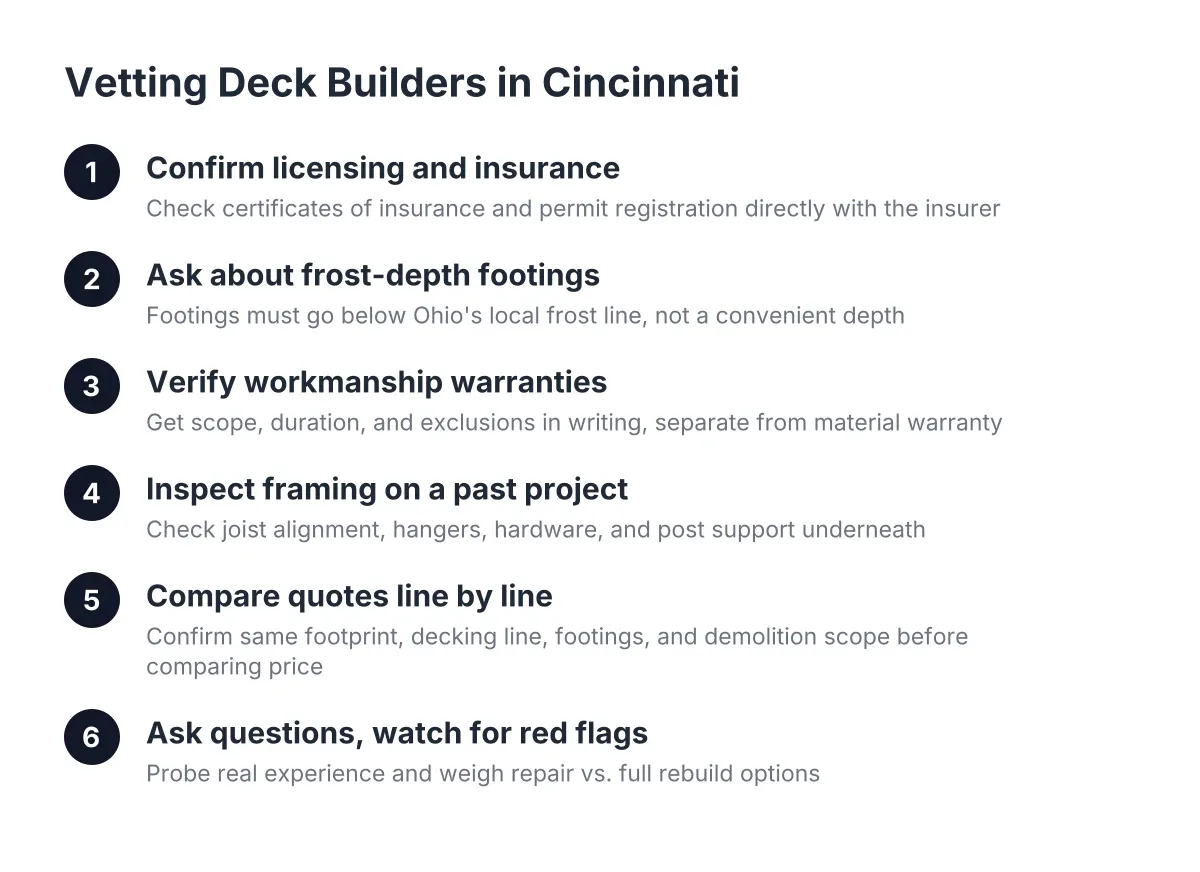
Therefore, when you are hiring a deck builder, judge the labor and the structure, not the brand on the box. Ask to see a current project, and look underneath it. Straight, level joists, proper hangers, adequate footings, and posts supporting the beams tell you more about a builder than any brochure. Composite brands also tie their longest warranties to proper installation, so a bargain board installed wrong can cost you the coverage you paid extra for.
The short version for your decision
If you are choosing between these three materials for a Cincinnati deck in 2026, the decision tree is straightforward:
- Staying in the house long term and tired of maintenance: mid-tier Trex or TimberTech composite, on a sound or new treated frame with taped joists.
- Rental property or tight budget: treated wood decking with hot-dip galvanized hardware and frost-depth footings; spend the savings on a solid railing.
- Pool deck or chronically damp site: look hard at fully capped polymer boards, which handle constant moisture best.
- Selling within a few years: wood recoups more at resale; the Remodeling 2024 Cost vs. Value Report put wood at 83% ROI versus 68% for composite.
Whichever way you lean, get the framing assessed before you commit to a surface. An honest deck contractor will tell you when resurfacing works and when the structure needs to come down, and will explain why in terms you can verify from the ground looking up. That conversation, more than the brand of board, is what keeps you from overpaying or rebuilding twice.
If you need deck building and installation, Cincinnati Deck Pros can help.
Prefer to talk it through? Call (513) 613-3364 — a quick call is usually the fastest way to get a straight answer for your situation.