Deck Permit and Inspection Costs in Cincinnati: HOA, Setback, and Frost-Depth Rules
If you are tearing out a failing deck and rebuilding, the permit paperwork feels like one more headache on top of soft boards and a loose railing. This FAQ walks through deck permit cost issues in Cincinnati and greater Hamilton County, plus the local rules that catch homeowners off guard: HOA approvals, setback lines, and Ohio frost-depth footing requirements. Understanding the deck permit cost in Cincinnati helps you sanity-check any quote instead of guessing at what a contractor rolled into the number.
Do I need a permit to rebuild my deck in Cincinnati?
Yes, rebuilding a deck in Cincinnati almost always requires a building permit, even when you are replacing a deck in the same footprint. A full teardown and rebuild counts as new construction in the eyes of the city and Hamilton County, so plans, fees, and inspections all apply. Simple board swaps are often a different story.
In general, replacing a few decayed boards or resurfacing the walking surface without touching the frame may not trigger a permit. However, once you replace structural framing, footings, or the ledger connection to the house, you are in permit territory. If an inspector flagged your deck during a home sale, assume the fix will need a permit; that paper trail actually helps you at closing.
Rules vary by jurisdiction. Cincinnati proper, suburbs like Blue Ash or Anderson Township, and the unincorporated parts of Hamilton County each run their own permit desk, so confirm with the office that covers your address before any demolition starts.
What does deck permit cost involve in Cincinnati?
Deck permit and inspection costs cover the plan review, the permit itself, and the site visits an inspector makes during construction. You are paying the jurisdiction to verify that the footings, framing, ledger attachment, and railing meet the residential code, not just to stamp a form. For a typical residential deck, these fees are a small slice of the total project.
Most Cincinnati-area jurisdictions base the fee on project valuation or square footage. As a rough illustrative estimate, permit fees for a standard backyard deck often land in the low hundreds of dollars, while the deck itself runs into five figures. That ratio matters: skipping the permit to save a few hundred dollars puts a five-figure investment at risk during a future home sale.
The inspection piece is where the value sits. According to the International Association of Certified Home Inspectors, as many as 60 percent of the roughly 45 million decks in America have safety issues, and about 90 percent of deck collapses trace back to ledger board connection failures. The ledger inspection is the cheapest insurance you will ever buy.
Which inspections happen during a deck build?
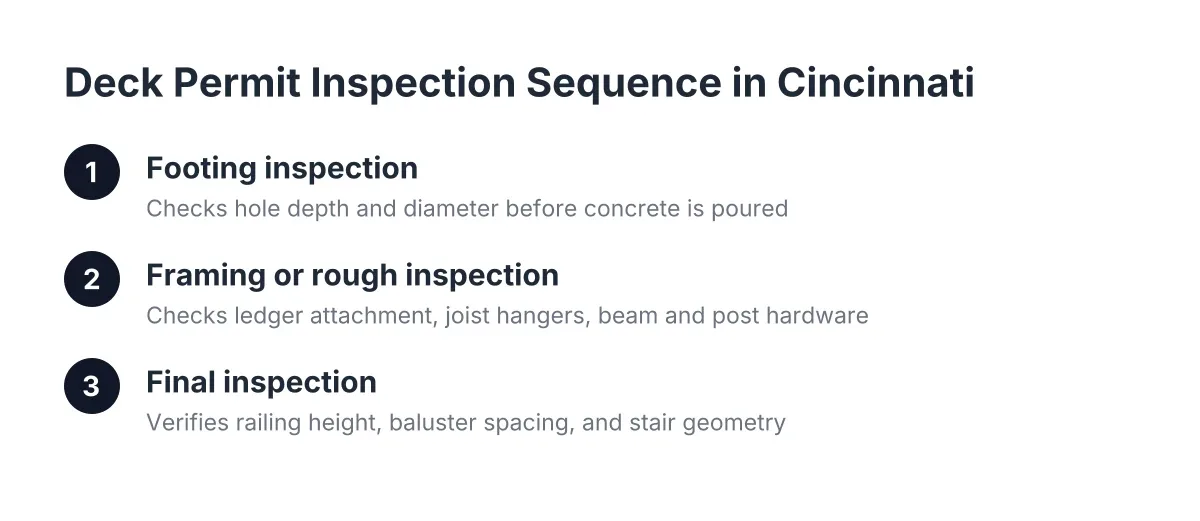
A permitted deck build in greater Cincinnati typically involves two to three inspections: a footing inspection, sometimes a framing inspection, and a final inspection. Each one checks the work at a stage where problems are still easy to fix. Your deck contractor schedules these, but you should know when they happen.
Here is the usual sequence:
- Footing inspection. After holes are dug and before any concrete is poured, the inspector confirms the holes match the depth and diameter on the approved plans. Pouring early means digging it all back out.
- Framing or rough inspection. Some jurisdictions check the ledger attachment, joist hangers, beam connections, and post hardware before decking goes down.
- Final inspection. The inspector verifies railing height, baluster spacing, stair geometry, and the finished structure before signing off.
Therefore, build a few open days into your schedule. Inspections depend on the inspector's calendar, and a rainy Ohio week can push things back. A deck builder who works in Hamilton County regularly knows the rhythm and plans around it.
How do Ohio frost-depth rules affect deck permit cost in Cincinnati?
Ohio frost-depth rules require deck footings to extend below the local frost line, which in the Cincinnati area means digging well past the shallow depth a DIY guide might suggest. According to Decks.com, when a post is part of a structural build like a deck footing, the hole must go below the frost line rather than following general above-grade rules.
Why it matters here: southwest Ohio winters cycle through repeated freeze and thaw. Shallow footings heave as the ground freezes and settles as it thaws, which is exactly how a 15-year-old deck ends up with a wavy frame and a railing you no longer trust. Deeper footings mean more digging, more concrete, and more labor, and that shows up in your quote.
Footing size matters as much as depth. Footings must be sized to carry the deck's load, and on larger or multi-level deck designs that sizing sometimes calls for a structural engineer's calculations, which adds a line item. A quote that seems high on the foundation work may simply be a quote that takes Ohio frost seriously.
Do HOA approvals and setback rules add cost?
HOA approvals and setback rules rarely add large direct fees, but they can add time and reshape the design, which affects the budget. Many Cincinnati-area subdivisions require an architectural review before you build, and your property's setback lines limit how close the deck can sit to the lot line.
For example, suppose a homeowner in a West Chester subdivision plans a 16-by-20 deck replacement with an expanded footprint. The HOA review takes three weeks and requires a composite decking color from an approved palette, and the side setback forces the stairs to turn. None of that is a disaster, but in that scenario the design round-trip adds weeks and a modest redesign cost before the permit application even goes in.
First, pull your plat map and HOA covenants before you finalize a design. Second, give your deck builder copies up front. Catching a setback conflict on paper costs nothing; catching it after the footing holes are dug costs real money.
How do permit fees fit into total deck building costs?
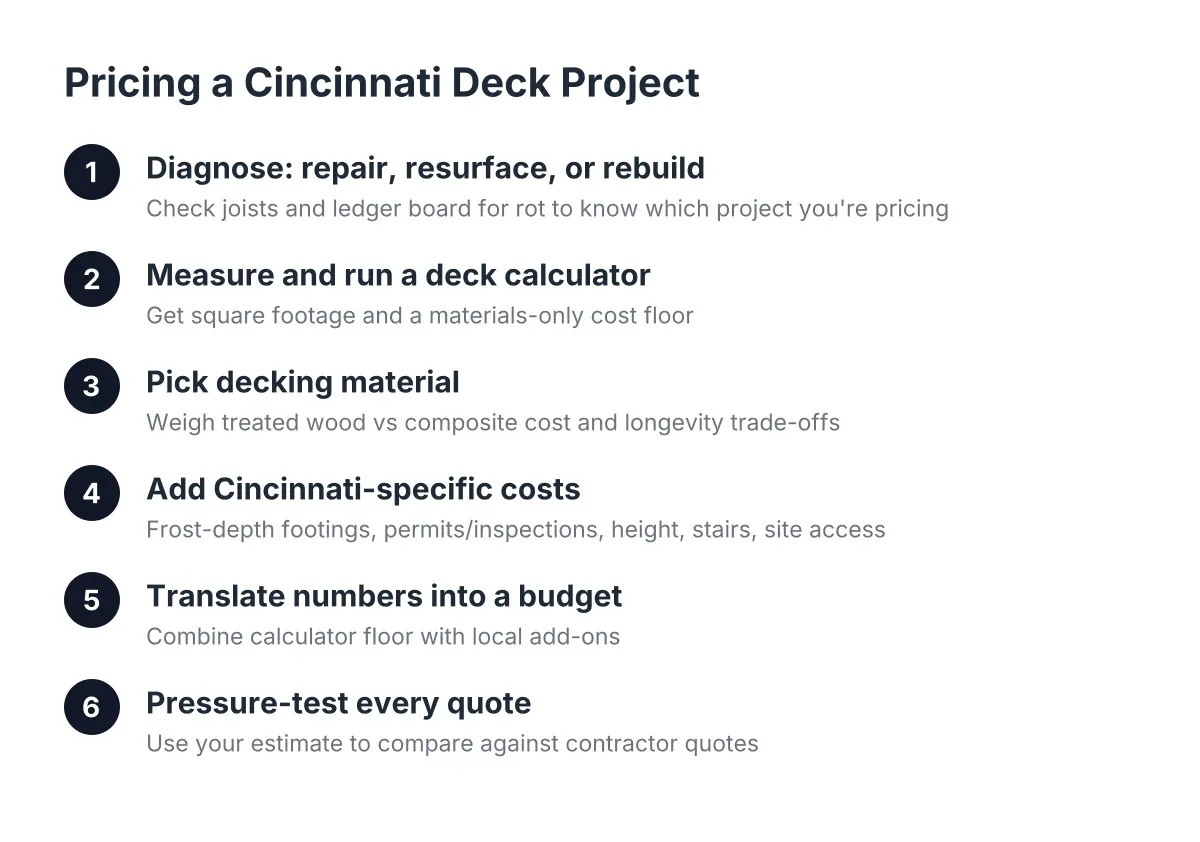
Permit and inspection fees are one of the smaller inputs to total deck building costs; size, material, and labor do the heavy lifting. Deck size is the single biggest cost driver, since more square footage means more lumber or composite deck boards and more labor hours. Material choice comes next.
For national context, the Remodeling 2024 Cost vs. Value Report found a 16-by-20 pressure-treated wood deck averages $17,615 with an 83 percent ROI, while the same deck in composite decking averages $24,206 with a 68 percent ROI. Those are national averages, not Cincinnati quotes, but they frame the budget conversation honestly: composite costs more up front and saves on staining and sealing over the years.
Height and finish details move the number too. A deck high off a sloped Cincinnati backyard needs ladders or scaffolding to build safely, which adds labor. Picture-frame borders, wider premium boards, and layered fascia all cost more than standard builds, so ask each deck contractor exactly what finishing style their quote includes.
Can I save on permits by handling them yourself or buying your own materials?
You can sometimes pull a homeowner permit yourself, but the savings are small and the responsibility shifts to you. The fee is the same either way; what you save is the contractor's time handling paperwork, and what you take on is scheduling inspections and answering for any plan corrections.
On materials, buying in bulk from a home improvement retailer can qualify you for volume discounts, according to The Home Depot, and that applies to treated lumber and composite deck boards alike. However, be careful with discount composite decking from unknown sources; established lines, including Trex composite deck boards and TimberTech products, carry warranties that off-brand surplus material may not. A low material bill that voids a warranty is not a saving.
One honest trade-off: if your old deck has soft framing or a questionable ledger, this is not the project to value-engineer. Have a qualified deck builder or structural engineer assess the frame before you decide between deck resurfacing and full deck demolition and replacement. The inspection process exists because deck failures hurt people, and in 2026 the Cincinnati-area permit desks enforce it for exactly that reason.
What should I ask a contractor about deck permit inspection costs?
Ask every deck contractor three direct questions: who pulls the permit, whether permit and inspection fees are included in the quote, and who meets the inspector on site. The answers tell you as much about the builder as the price does.
A builder who works greater Cincinnati regularly should name your jurisdiction's permit office without looking it up and should fold deck permit inspection costs into the written quote as a visible line, not a buried allowance. If a bidder suggests skipping the permit on a structural rebuild, that is your cue to keep shopping. An unpermitted deck can stall a home sale, complicate insurance claims, and leave you owning someone else's shortcut.
If you need deck building and installation, Cincinnati Deck Pros can help.
Prefer to talk it through? Call (513) 613-3364 — a quick call is usually the fastest way to get a straight answer for your situation.