Deck Railing Code Requirements in Cincinnati: What Ohio Homeowners Miss
Most articles about deck railings start with styles. Cable, composite, aluminum, wood balusters. That order is backwards. Before you pick a look, you need to understand the requirements for deck railing code in Cincinnati, because those rules decide whether your railing passes inspection, survives an Ohio winter, and holds when someone leans on it during a Fourth of July cookout. The style conversation is the fun part. The code conversation is the part that keeps people off the ground.
Here is the uncomfortable truth behind that. As many as 60 percent of the roughly 45 million deck structures in America have safety issues, according to the International Association of Certified Home Inspectors. Railings are one of the most common failure points, and they are the one part of a deck that people push against, sit on, and trust with their body weight every time they walk outside. This guide walks through what the code actually requires, why those numbers exist, and how to choose a railing system that meets them without giving up the look you want.
Why Deck Railings Fail More Often Than Decks
A deck rarely announces that it is unsafe. It looks fine right up until it is not. CPSC data show about 2,900 injuries associated with collapses and failures of porches, decks, and balconies over a recent four-year period, averaging about 725 injuries annually, according to the U.S. Consumer Product Safety Commission. Railings do not have to fail catastrophically to cause harm. A post that flexes two inches under load is already a problem.
The physics work against railings in a specific way. A guardrail post is a lever. When someone leans against the top rail, the force at the connection point at the bottom of the post multiplies. A 200-pound push at the top of a 36-inch post puts far more stress on the bolts and framing below than most homeowners assume. That is why the code cares less about how a railing looks and more about how it is anchored.
Cincinnati adds its own pressure. Ohio freeze-thaw cycles work moisture into every joint, gap, and bolt hole on an outdoor structure. Water gets into the connection between a wood post and the rim joist, freezes, expands, and slowly opens the joint. After ten or fifteen winters, a railing that was solid when built can wobble like a loose tooth. Carriage bolts corrode, wood fibers around them soften, and the connection that inspectors tested on day one no longer exists in any meaningful way.
For a homeowner planning a new deck and patio setup, this is the part worth internalizing early. The railing is not trim. It is a structural system, and the deck railing code requirements that govern it exist because the failure mode is a person falling.
What Deck Railing Code Requirements Say in Ohio
Ohio residential construction follows the Residential Code of Ohio, which is based on the International Residential Code (IRC). For decks in greater Cincinnati, the requirements that matter most break down into four categories: when a railing is required, how tall it must be, how the infill must be spaced, and how strong the whole assembly has to be.
When a Guardrail Is Required at All
Under the IRC framework Ohio uses, a guardrail is required on any deck surface more than 30 inches above the ground at any point within 36 inches of the deck edge. That last clause trips people up. If your yard slopes, the deck might sit 24 inches off the ground at the house and 40 inches at the far corner. The measurement is taken from the walking surface to grade, and sloped Cincinnati lots produce that situation constantly, especially in hillside neighborhoods.
However, "not required by code" does not mean "not a good idea." A 28-inch fall onto a paver patio can still break a wrist. Plenty of homeowners add a railing on low decks anyway, either for safety with kids and pets or simply to define the space visually.
Height, Spacing, and Opening Rules
The core dimensional requirements are consistent across Ohio and most of the country:
- Guardrail height: minimum 36 inches from the deck surface to the top of the rail for residential decks.
- Baluster spacing: openings in the railing infill cannot allow a 4-inch sphere to pass through. This is a child-safety rule; it is sized to keep a toddler's head and body from slipping through.
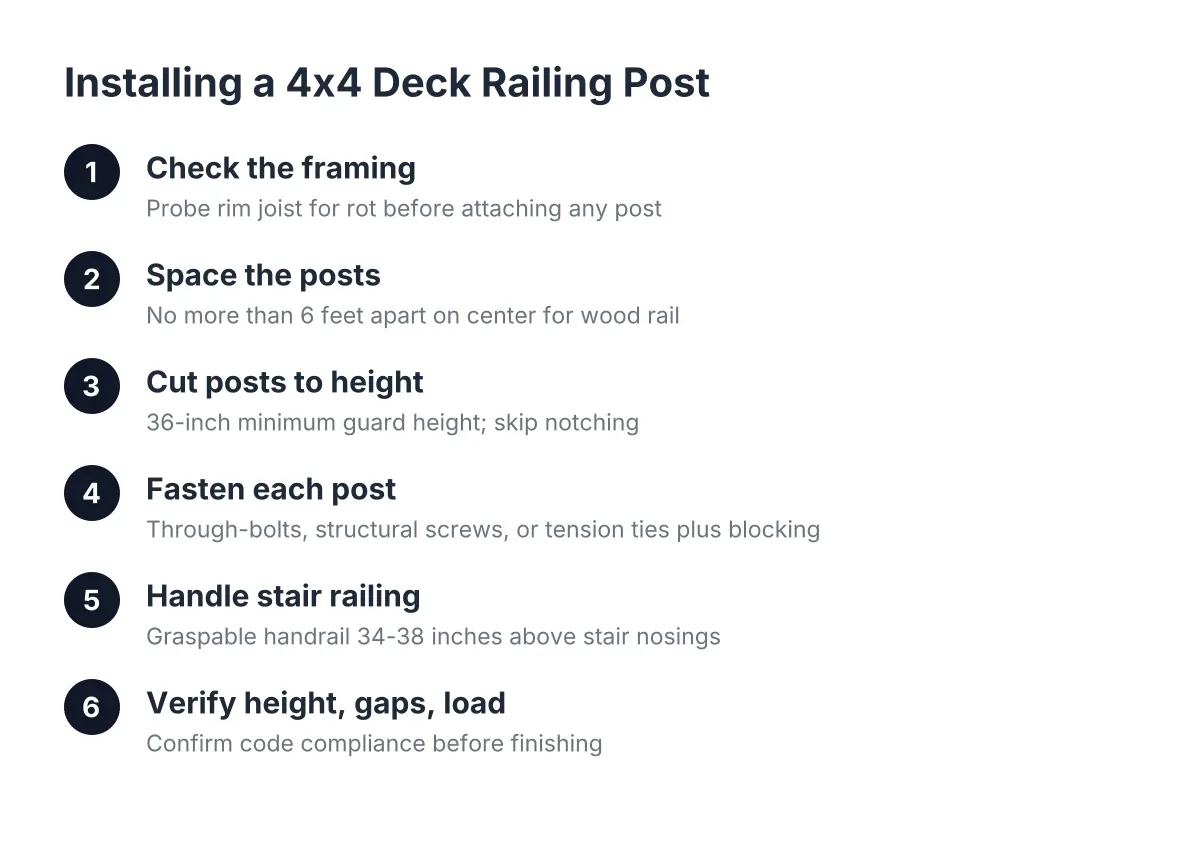
- Stair guardrails: minimum 34 inches measured vertically from the nosing of the stair treads.
- Stair triangle: the opening formed by the tread, riser, and bottom rail on stairs cannot pass a 6-inch sphere.
- Graspable handrail: stairs with four or more risers need a handrail between 34 and 38 inches high that a hand can actually wrap around, which a flat 2×6 top rail does not satisfy on its own.
Readers who search deck railing height requirements often stop at the 36-inch number and miss the stair rules. In practice, deck stairs code requirements are where inspections snag most often, because the handrail graspability rule and the 6-inch triangle rule are less widely known. Porch railing code requirements follow the same logic; a covered porch floor more than 30 inches above grade needs a compliant guardrail just like an open deck does.
The Strength Requirement Nobody Talks About
Height and spacing are easy to measure with a tape. The requirement most DIY railings fail is invisible: the guardrail assembly must resist a 200-pound concentrated load applied at any point along the top, in any direction. Infill must separately resist a 50-pound load over a one-square-foot area.
That 200-pound load is why post attachment is the whole game. A 4×4 post notched around the rim joist and held with two carriage bolts, the classic backyard method, often cannot meet that load without additional blocking and hardware. Modern practice uses through-bolts with tension hardware, solid blocking between joists behind each post, and connectors rated for the job. In addition, hardware in contact with pressure-treated lumber should carry a heavier zinc coating, such as Simpson's ZMAX line, because the copper-based preservative in treated wood corrodes standard connectors, according to Simpson Strong-Tie.
One more note for anyone comparing state rules online. You will find pages about deck railing code requirements in California, Florida, Pennsylvania, or New Jersey, and the numbers are similar because most states adopt the IRC. Ohio's version governs here, and the local building department applying it, whether that is the City of Cincinnati or Hamilton County Building Inspections for unincorporated areas, has the final word on interpretation.
Permits, Inspections, and Managing Deck Railing Code Compliance in Greater Cincinnati
New decks with railings need a permit in the City of Cincinnati and throughout Hamilton County, and the railing is part of what the inspector checks. If you live in one of the surrounding municipalities, Blue Ash, Anderson Township, West Chester, and so on, the permit path runs through that jurisdiction's building department, and details can vary. Some HOAs layer their own rules on top, usually about railing color and style rather than structure.
Replacing a railing on an existing deck sits in a gray zone that catches sellers off guard. Swapping deteriorated balusters like-for-like may not trigger a permit, but replacing the entire guardrail system, or changing posts and attachment points, generally does. When in doubt, a call to the local building department costs nothing and prevents a stop-work notice mid-project.
This matters double if you are preparing to sell. Home inspectors test railings by pushing on them, and a loose guardrail or non-compliant baluster spacing lands on the inspection report almost every time. The North American Deck & Railing Association estimates about 30 million decks in the United States are beyond their useful life and require repair or replacement, and aging railings are frequently the first symptom a buyer's inspector flags. For anyone selling a home in the Cincinnati area, understanding deck railing code standards helps prevent surprises on inspection day when the report flags "guardrail movement exceeds acceptable limits" and "baluster openings exceed 4 inches." In that scenario, the fix is usually targeted deck repair or railing replacement rather than a full rebuild, which fits a listing timeline far better than tearing the whole structure down.
Choosing a Railing System That Meets Code and Looks Right
Once the code requirements are clear, the style conversation gets easier, because you can filter deck railing ideas by whether they can actually be built to pass inspection in Ohio's climate. Here is how the main options compare.
Wood Railings
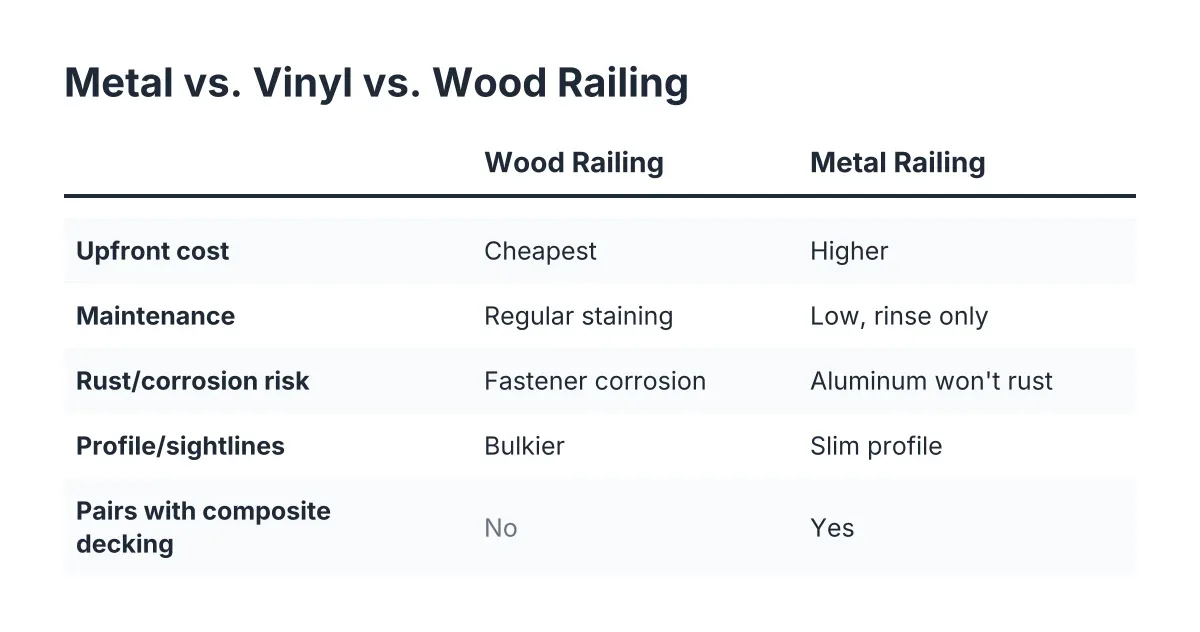
Treated wood is the budget option and the most flexible for custom shapes. Simple deck railing designs in wood, a 2×4 top and bottom rail with 2×2 balusters, remain the most common railing in greater Cincinnati for a reason. The trade-off is maintenance. Wood railings take more weathering abuse than deck boards because water sits on horizontal top rails, and they need staining and sealing on a regular cycle to avoid the checking and splitting that lead to loose balusters.
Composite and Aluminum Railings
Composite railing systems from manufacturers like Trex and TimberTech pair naturally with composite decking and shrug off freeze-thaw cycles that punish wood. Aluminum balusters or full aluminum systems are lighter, slimmer, and hold paint-grade finishes for decades. These systems ship as engineered kits with tested post mounts, which takes guesswork out of meeting the 200-pound load requirement. The market reflects the shift; Grand View Research valued the global composite railing and decking market at 4.7 billion dollars in 2025 with projected growth to 12.6 billion by 2033.
Cable Railing
Cable railing for decks earns its popularity honestly. Horizontal stainless cables all but disappear visually, which matters if your deck overlooks a wooded lot or a view you paid for. Two cautions apply. Cables must be tensioned correctly so the 4-inch sphere rule holds even when the cables deflect under pressure, and posts carry higher loads than baluster systems, so the framing behind them has to be built for it. Some inspectors also scrutinize horizontal infill more closely because it is climbable, a consideration worth raising with your building department before you order materials.
Glass and Mixed Systems
Tempered glass panels give the cleanest sightline of all and block wind, which extends the season on an exposed deck. They cost more and demand cleaning, but for a screened-in porch adjacent to an open deck, mixing glass or cable on the view side with composite elsewhere keeps the budget in check.
Installation Details That Decide Whether a Railing Lasts
Style is what you see. Installation is what you feel every time you grab the rail. The details below separate a railing that passes inspection in year one and stays solid in year fifteen from one that wobbles by year five.
First, post attachment. Knowing how to install deck railing posts correctly means blocking, through-bolts, and rated tension hardware, not just lag screws into the rim. Every post needs solid blocking behind it so the load transfers into the deck frame rather than levering against a single board. On new builds, planning post locations before the decking goes down makes this far easier, which is one reason railing decisions belong in the design phase, not the final week.
Next, water management. Post bases and connection points collect water. Flashing tape at these joints, the same waterproofing tape professional builders apply over pressure-treated joist tops as an extra moisture measure, according to TimberTech, slows the rot that loosens railings from the inside out. Fasteners must be rated for exterior decking use; deck screws and hot-dipped galvanized or stainless hardware, never generic screws that corrode in a season.
Then, the retrofit problem. Replacing a railing on an older deck often reveals why pros charge for demolition. Corroded carriage bolts embed themselves in partially rotted posts and refuse to back out, so posts frequently have to be cut away and the bolts worked loose slowly. If the rim joist behind the old posts has softened, it needs replacement before any new railing goes on, because no hardware can anchor into punky wood. This is the point where deck railing installation stops being a weekend project and becomes structural work, and where a deck contractor's assessment saves money by catching frame problems before you bolt new railing to a failing edge.
Finally, know when the railing is the symptom and not the disease. If posts move because the rim joist is rotted, or the deck itself flexes, the honest answer may be deck resurfacing or a rebuild rather than new railing on old bones. A loose deck railing fix that ignores the frame underneath is a cosmetic patch on a structural problem.
A Practical Path Forward for Cincinnati Homeowners
Pull all of this together and the sequence looks like this:
- Measure your deck height above grade. Over 30 inches anywhere within 36 inches of the edge means a code-compliant guardrail is required.
- Test what you have. Push hard on each post and section of rail. Movement of more than an inch, visible rot at post bases, or baluster gaps wider than 4 inches all mean the railing needs attention.
- Check the stairs separately. Confirm a graspable handrail exists on stairs with four or more risers and that guard height and opening rules are met on the stair run.
- Decide repair versus replace. Sound frame with tired railing favors replacement of the railing alone. Soft rim joists or moving posts point toward deck repair or rebuilding first.
- Confirm the permit path. Call your building department, whether City of Cincinnati, Hamilton County, or your municipality, before starting structural railing work.
- Choose materials for Ohio weather. Composite, aluminum, and properly maintained treated wood all work here; pick based on maintenance tolerance and the look you want, then verify the system meets the load requirements.
One honest caveat: this article summarizes the general IRC-based framework Ohio uses as of 2026, but codes get amended and local officials interpret edge cases differently. For anything structural, a raised deck, a cable system, a railing on a screened-in porch addition, have a licensed deck builder or your local building department confirm the specifics for your address before you build.
The larger point stands regardless of material or style. Deck railing code requirements are not bureaucratic friction; they are the documented lessons of thousands of falls. Get the code layer right first, and every railing style you are considering, from simple wood balusters to cable and glass, becomes a safe option instead of a gamble. That is the order of operations that produces an outdoor space you can hand a drink to a guest on without a second thought, and one that sails through a buyer's inspection if you ever sell.
If you need deck building and installation, Cincinnati Deck Pros can help.
Prefer to talk it through? Call (513) 613-3364 — a quick call is usually the fastest way to get a straight answer for your situation.