Do Trex Decking Colors Fade? What Ohio Sun and Weather Really Do to Composite
If you have already decided on composite decking and now you are staring at sample boards, the question underneath everything is simple: do Trex decking colors fade? The short answer is yes, a little, early, and then they hold. The longer answer depends on which line you buy, which color you pick, and how your deck sits relative to the Ohio sun. As a Cincinnati deck builder that installs both Trex and TimberTech, we do not have a dog in the brand fight. What we do have is a practical view of how these boards look after a few Cincinnati summers, and that is what this guide covers.
This matters more here than people expect. Greater Cincinnati decks take full-sun July afternoons, freeze-thaw winters, maple and oak leaf litter, and long stretches of humidity. Each of those affects how a composite color reads over time. Pick well and your deck looks close to day one for decades. Pick poorly and you will notice the drift every time you walk outside.
Why Trex Decking Colors Fade at All
Trex decking colors fade because ultraviolet light breaks down pigments in any material left outdoors, composite included. Modern capped composite handles this far better than wood or early-generation boards, but no manufacturer sells a color that is frozen in time. Expect a subtle shift in the first few months, then long-term stability.
Here is what is actually happening. A modern Trex or TimberTech board is a wood-plastic core wrapped in a polymer cap. That cap carries the color and the UV inhibitors. In the first weeks of sun exposure, surface-level tannins and manufacturing residues weather out, and the color settles. Builders sometimes call this the break-in period. After that, the cap does its job, and the color change per year becomes hard to see with the naked eye.
The horror stories you find online, gray streaky boards, blotchy fading after five years, almost always trace back to one of two things. Either the deck used first-generation uncapped composite from fifteen or twenty years ago, or the boards were a budget uncapped product sold as "composite" without the protective shell. Uncapped composite weathers like wood because the exposed wood fibers are sitting right at the surface. If you are rebuilding a deck that was built in the early 2000s with original composite, that is likely what you have, and no modern capped board from either brand will behave the way your old deck did.
One more thing worth knowing before you judge any sample: a board's color reads differently in evening shade than it does in noon sun. Never evaluate fading, or a color choice, from a photo taken in one lighting condition. Take sample boards outside and look at them in morning light, midday sun, and dusk before you commit.
How Trex and TimberTech Each Fight Fade
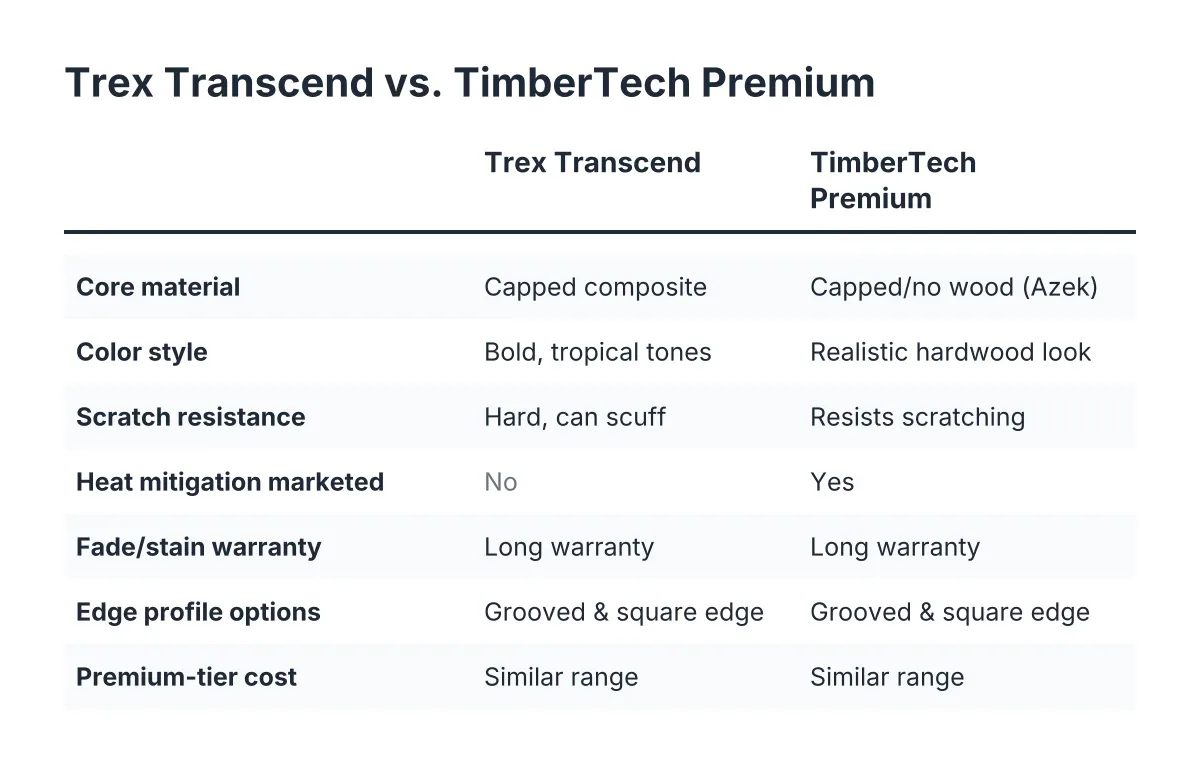
Both brands cap their mainstream boards, and both back color performance with written fade-and-stain warranties on their better lines. The differences are in cap construction and color technique, not in whether one fades and the other does not.
Trex caps three sides of the board on most lines, leaving the bottom uncapped. Its upper lines use multi-tonal streaking that mimics grain variation, which has a practical side effect: subtle color shift is harder to notice in a varied board than in a flat, uniform one. Trex publishes fade and stain coverage on its capped lines, with the longest coverage on the top-tier boards.
TimberTech takes a different route on its premium products. Its top-end boards are capped on all four sides, which matters less for fading, since the bottom of a board never sees sun, and more for moisture resistance at cut ends and in damp conditions. TimberTech's premium lines also use complex color blending with reverse-side alternate colors on some boards, and its fade-and-stain warranties on upper lines are among the longest in the category.
For a homeowner comparing trex vs timbertech on fade resistance alone, the honest builder's answer is that the top lines of both brands perform within shouting distance of each other in a Cincinnati yard. The gap that actually matters is between tiers, not brands. An entry-level capped board from either company will show more color drift over ten years than a premium board from either company. If your deck faces south with no tree cover, spend up a tier before you spend time agonizing over brand.
Which Composite Colors Hold Up Best in Ohio Sun
Darker, richer colors show fade sooner than mid-tone and lighter colors, on any brand. That is physics, not marketing. A deep espresso brown has more pigment to lose, and the human eye catches a shift from dark to slightly-less-dark faster than a shift between two light grays.
For greater Cincinnati specifically, here is how we think about color selection against our climate:
- Full-sun, south- or west-facing decks: Favor mid-tone browns, grays, and weathered-wood blends. These hide both UV drift and pollen or dust between cleanings. Dark boards here also get hot underfoot in July, which matters on a pool deck where kids run barefoot.
- Shaded, tree-covered decks: You can go darker with less risk. The trade-off is that shade plus Ohio humidity grows mildew film faster, so plan on hosing the deck down a few times a season. Lighter colors show that film sooner; darker colors hide it.
- Decks visible from a light-colored house: Mid-tone and streaked boards disguise the small amount of early weathering better than flat, uniform dark colors do.
- Rental properties: Variegated mid-tones are the forgiving choice. They hide scuffs, grill drips, and tenant wear, and they will not telegraph a decade of sun exposure the way a saturated dark board can.
Both brands publish wide color palettes, and both update them regularly, so verify current availability before you fall in love with a 2026 catalog photo. Also order physical samples rather than trusting a screen. Monitor color accuracy is bad enough indoors; it is useless for predicting how a board looks on your actual deck.
A Realistic Cincinnati Scenario
Suppose a homeowner in Anderson Township is replacing a 20-year-old wood deck that faces due west with no shade after 1 p.m. They love a dark walnut-tone board in the showroom. In that scenario, we would walk them through the trade-off plainly: the dark board will look stunning for the first few seasons, it will run hotter in summer, and in year eight the color drift will be more visible than it would be on a mid-tone streaked board from the same line. Some homeowners take the dark board anyway because they prioritize the look today. That is a fine choice, as long as it is an informed one. The job of a deck contractor is to lay out that trade-off, not to make the decision for you.
Can You Change the Color of Trex Decking Later?
You cannot reliably stain or paint capped Trex decking to a new color, and both manufacturers advise against it. The polymer cap that protects the board from fading also rejects stain penetration, so coatings sit on the surface and peel. If you dislike a color after installation, your realistic options are living with it or replacing boards.
This is the single biggest difference between composite and the treated wood deck you may be replacing. Wood lets you restain every few years; composite locks in your choice for the life of the deck. It also removes the maintenance chore, which cuts both ways. Conventional deck stains on full-sun decks tend to fail within a few seasons no matter what the can promises, so many homeowners rebuilding an old wood deck are happy to give up the restaining option entirely.
Because the color decision is permanent, slow down at this step. Get samples of your top two or three colors, set them on the old deck or in the yard for a week, and look at them wet, dry, and at different times of day before composite decking installation begins.
Keeping Composite Color Looking New Longer
Fade from UV is mostly baked into the board you buy, but the other things that make a deck look faded, surface grime, mildew film, pollen haze, and tannin stains from leaf litter, are entirely in your control. A deck that looks washed out after five Cincinnati autumns is often just dirty, not degraded.
Here is the maintenance rhythm that keeps a capped composite deck looking close to new:
- Blow or sweep off debris regularly, especially in fall. Wet oak and maple leaves left sitting over winter leave tannin shadows on any surface.
- Wash the deck twice a year with soapy water and a soft brush, then rinse. Spring and fall works for most greater Cincinnati decks.
- Rinse pollen film in late spring. The yellow-green haze reads as fading in photos but hoses right off.
- Clean grill and food spills promptly. Capped boards resist staining, but oil left baking in August sun for weeks tests any warranty's fine print.
- Keep planters and rugs breathable. Trapped moisture under solid mats creates uneven weathering patterns, light rings where the sun never hit.
Skip pressure washing at close range and skip any product promising to "restore" composite color with a coating. On a capped board, those coatings fail the same way stain fails on sun-baked wood.
Installation Choices That Affect How Fading Shows
How the deck is built changes how color change reads over time, which is something single-brand dealer pages rarely mention. A few decisions during composite decking installation make early weathering less visible and the deck age more evenly.
First, board sourcing matters. Deck boards 16 ft and longer should come from the same production run where possible. Boards from different runs can start with slight color variation that becomes more visible as the deck weathers. A careful deck builder checks lot numbers and mixes boards across the deck surface rather than installing one bundle at a time in blocks.
Next, fastener choice affects the long look. Hidden fasteners keep the walking surface clean, and where screws must drive from the top, such as on picture-frame border boards, color-matched plug systems make the fastener visually disappear, a detail Trex itself documents for its systems. Exposed mismatched screw heads become more obvious as the board around them shifts tone.
Orientation and framing matter too. A board's streaking pattern runs directionally, so flipping or reversing boards inconsistently creates a checkerboard effect that weathering exaggerates. Underneath, moisture protection keeps the structure from aging faster than the surface; applying waterproofing tape over the tops of pressure-treated joists is an extra moisture measure professional deck builders use, a practice TimberTech describes, even though treated lumber resists rot on its own. Fascia boards covering the rim joists protect the framing from weather and keep the finished edges looking as sharp as the deck surface.
Finally, if your project mixes materials, say a composite deck and patio combination, or composite decking over a treated wood frame, confirm the structural hardware is rated for treated lumber. Fasteners in pressure-treated framing should be hot-dip galvanized or stainless steel to resist corrosion from the copper-based treatment chemicals, according to the American Galvanizers Association. Faded boards are cosmetic; corroded hangers are not.
What This Means If You Are Rebuilding an Old Deck
If you are replacing a 15-to-20-year-old deck, the fade question connects directly to the repair-or-rebuild decision. An old uncapped composite or worn wood surface on sound framing may only need deck resurfacing: new capped composite boards and deck railing on the existing structure. If the joists and posts are soft or the frame was built to older standards, deck demolition and replacement is the safer call. An honest deck contractor should show you the specific framing problems, not just hand you a number.
For landlords with rental properties around Cincinnati, the color-stability question is a business question. A capped composite porch or deck at a rental means no restaining between tenants, no fade complaints driving cosmetic callbacks, and a surface that handles turnover wear. The upfront cost runs higher than treated wood decking; the 2024 Cost vs. Value Report from Remodeling Magazine put a new 16'x20' pressure-treated wood deck at an 83% ROI versus 68% for the same deck in composite. Resale ROI favors wood, but for a hold-long rental, the maintenance math often favors composite on high-visibility units and treated wood on the rest. There is no single right answer across a portfolio, and a deck builder who works on multiple properties can help you sort which units justify which material.
One honest limitation: no article can tell you how a specific color will look on your specific lot. Sun angle, tree cover, house color, and even the lighting at different times of day all change how a board reads. Get physical samples, and if your deck involves structural questions, soft framing, loose railing, or an inspector's flag during a sale, have a professional look before you order a single board.
The Bottom Line on Composite Color and Ohio Weather
Do Trex decking colors fade? Slightly, early, and then they stabilize, and the same is true of TimberTech. The capped boards both brands sell in 2026 are a different product from the gray, streaked composite decks of twenty years ago. In greater Cincinnati, your results depend less on the logo on the box and more on three choices: buying a capped board in a tier that matches your sun exposure, picking a color with your actual yard light in mind, and having the deck installed with consistent lots, hidden fasteners, and protected framing.
Get those three right, and the deck you build this year will still look like the deck you chose, long after you have forgotten what the sample board cost you in deliberation.
If you need deck building and installation, Cincinnati Deck Pros can help.
Prefer to talk it through? Call (513) 613-3364 — a quick call is usually the fastest way to get a straight answer for your situation.