TimberTech Composite Decking Brand Guide: Product Lines for Cincinnati Decks
If you are comparing composite decking brands before you request quotes, you will run into the TimberTech composite decking brand almost immediately, usually alongside Trex. Most of what you will find online comes from dealers who sell one brand or the other. This guide is different. As a Cincinnati deck builder that installs both TimberTech and Trex, we have no reason to steer you either way. Below are eight things worth knowing about TimberTech before you sign anything, from its product tiers to how it holds up through an Ohio freeze-thaw winter. This article walks through the TimberTech product tiers guide to help you understand which line fits your project.
One note before the list. If you want the head-to-head matchup, we cover trex vs timbertech cost and durability in separate articles. This piece focuses on TimberTech itself, so you can walk into a quote conversation knowing exactly what the salesperson means when they say "Azek" or "capped polymer."
TimberTech Product Tiers Guide: What the Composite Decking Brand Actually Covers
TimberTech is not one product; it is a family of decking lines that range from entry-level composite to premium PVC. The brand covers two distinct material categories: capped composite boards with a wood-fiber core, and capped polymer (PVC) boards with no wood content at all. That split matters more than most homeowners realize.
Capped composite behaves like what most people picture when they hear composite decking: a dense core of wood fibers and plastic, wrapped in a protective shell. Capped polymer skips the wood entirely, which makes it lighter, more stain-resistant, and better around water. It also costs more. When a Cincinnati deck contractor quotes you "TimberTech," your first question should be which line, because the price and performance gap between the bottom and top of the catalog is wide.
Understanding TimberTech Product Tiers and Guide to Material Levels
TimberTech organizes its decking into tiers, and the tier you choose drives most of your material cost. In simple terms, the lineup runs from a budget-friendly capped composite at the entry level, through a mid-range composite with richer color blending, up to the premium all-PVC boards at the top. The TimberTech product tiers guide shown below breaks down each level.
Here is how to think about the tiers when you are comparing quotes:
- Entry-level capped composite: Solid colors, simpler grain patterns, capped on three sides. A practical pick for a straightforward backyard deck where budget leads the decision.
- Mid-tier capped composite: More realistic wood-look streaking, better fade and stain warranties, capped on all four sides in most profiles. This is the tier most greater Cincinnati homeowners land on.
- Premium capped polymer (PVC): No wood fibers, the best moisture resistance in the catalog, and the most convincing wood grain. The usual choice for pool decks, hot tub surrounds, and shaded yards where boards stay damp.
If a quote just says "TimberTech decking" without naming the line, ask for the specific product. Two quotes can differ by thousands of dollars simply because one builder priced the entry tier and the other priced PVC.
3. How TimberTech Decking Colors Compare to Trex
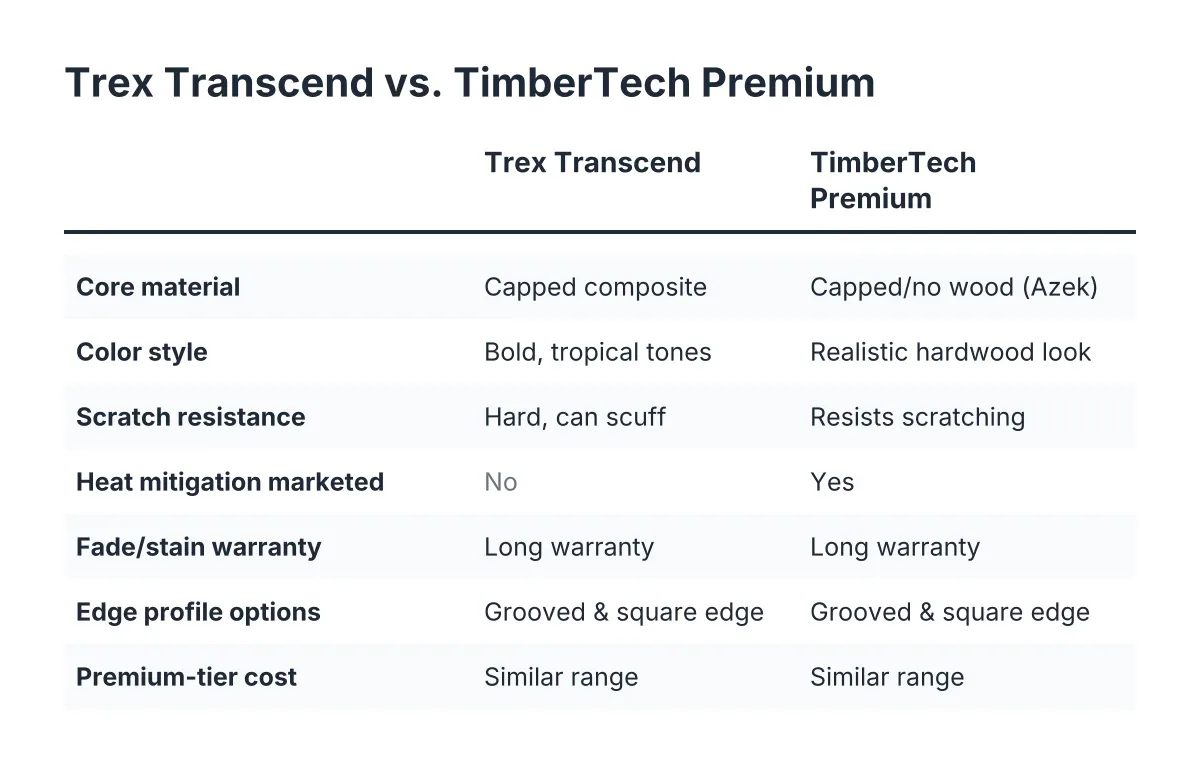
TimberTech decking colors run from light coastal grays to deep walnut browns, with the premium lines offering multi-tonal streaking that reads as real hardwood from a few feet away. Trex decking colors cover similar ground, so neither brand wins on palette size alone. The real difference shows up in how the color is made.
TimberTech's upper lines use complex blending and embossed grain patterns that vary board to board, which hides repetition on a large deck surface. Trex Transcend decking, the comparable premium line on the other side, takes a similar approach with its own tropical-inspired tones. In practice, the right move is to get physical samples of both and look at them in your own backyard light, not under showroom bulbs. A gray that looks soft online can read blue against red Cincinnati brick.
4. Why the Capped Polymer Lines Matter in Ohio Weather
Cincinnati decks live a hard life: humid summers, wet falls, and freeze-thaw cycles that push moisture into any material that will accept it. Wood-fiber composite cores absorb small amounts of moisture at cut ends and scratches. Capped polymer boards do not, because there is no wood in them to swell.
For most open, sunny decks in Hamilton County, a quality capped composite from either brand performs fine for decades. However, if your project involves a pool deck, a low deck close to grade, or a shaded north-facing yard that stays damp into June, the all-PVC TimberTech lines earn their premium. This is one of the few spots where the TimberTech composite decking brand has a structural argument, not just a style one, since its PVC offering is a core part of the catalog rather than a side product.
5. What TimberTech Costs Relative to the Alternatives
Composite decking costs more upfront than treated wood decking, and TimberTech follows that pattern, with its tiers roughly tracking Trex's tiers at each level. As an illustrative estimate, expect the premium PVC lines to run meaningfully higher per square foot than the entry composite, sometimes close to double on materials alone.
The national data backs up the composite-versus-wood tradeoff. According to the Remodeling Magazine 2024 Cost vs. Value Report, a 16-by-20 pressure-treated wood deck averages $17,615 nationally with an 83% return at resale, while the same deck in composite runs $24,206 with a 68% return. Composite costs more and recoups a smaller share, but it buys you decades without staining and sealing. For an established homeowner planning to stay in the house, that maintenance math often outweighs the resale gap. The National Association of Realtors also reports that 81% of homeowners say they enjoy their homes more after adding a deck, which is the number that matters if you are building space you plan to live in.
6. Hidden Fasteners, Edge Profiles, and the Details That Change Your Quote
TimberTech boards come in two edge profiles, and the one your builder specifies affects both the look and the labor. Grooved-edge boards accept hidden fastener clips between planks, which gives a clean surface with no visible screw heads. Square-edge boards get used for picture-frame borders and stair treads, where fasteners must drive from the top.
On those border boards, color-matched plug systems cover the screw heads so the fastener visually disappears, a detail Trex documents for its own systems as well. These plug systems work across major composite brands, so your deck contractor is not locked into one manufacturer's fasteners. Why does this matter for your quote? Finishing details like fascia treatment, picture framing, and hidden fasteners add cost independent of which brand you pick. Two TimberTech quotes for the same square footage can differ because one includes a double-step fascia and a picture-framed border and the other does not. Always ask what finishing style the number includes.
7. TimberTech Availability and Support for Cincinnati Projects
TimberTech products stock well in the greater Cincinnati market through lumberyards and big-box retailers, so lead times for common colors are rarely the bottleneck on a build. Specialty colors in the premium PVC lines can take longer, which matters if you are trying to finish a screened-in porch or deck and patio combo before fall.
Suppose a homeowner in Anderson Township wants a multi-level deck stepping down to a paver patio, with the upper level in a premium TimberTech PVC color. In that scenario, a typical crew would confirm material availability before pulling the Hamilton County permit, because a six-week wait on boards can push footing work into frost season. Ohio frost-depth footings do not care about your material choice, but your schedule does. This is also where a local deck builder earns their fee: sequencing permits, footing inspections, and material deliveries so the project does not stall mid-build.
8. When TimberTech Is the Right Pick, and When It Is Not
Choose TimberTech when moisture is your biggest enemy, when you want the widest range of PVC options, or when a specific TimberTech color simply wins the sample test in your yard. Its premium lines are a strong fit for pool decks, low-to-grade builds, and shaded Cincinnati lots.
That said, the honest answer is that both leading brands build excellent boards, and at comparable tiers the performance gap is small. If your heart is set on a specific Trex Transcend decking color, or your deck material Trex pricing comes in lower through your builder's supplier, that is a fine outcome too. Composite deck material from either catalog will outlast treated wood on maintenance. The brand decision is real, but it is smaller than the decisions about tier, fastening details, and who installs it.
One limitation worth naming: no article can account for your specific yard. Slope, drainage, sun exposure, and HOA setback rules all shift the right answer, so have a deck contractor walk the site before you lock in a brand or a line.
Questions to Ask Before You Accept a TimberTech Quote
Before you compare numbers, make sure every quote answers the same questions:
- Which specific TimberTech line and color is priced, and is it capped composite or PVC?
- Are the boards grooved-edge with hidden fasteners, square-edge, or a mix?
- What fascia and border treatment is included?
- Who pulls the Hamilton County or city permit, and are frost-depth footings specified?
- What does the comparable Trex tier cost through the same builder?
A builder who installs both brands can answer all five without flinching. That is the position you want to buy from: not a dealer defending one catalog, but a Cincinnati deck builder who has put both products on local homes and can tell you which one fits yours.
If you need deck building and installation, Cincinnati Deck Pros can help.
Prefer to talk it through? Call (513) 613-3364 — a quick call is usually the fastest way to get a straight answer for your situation.