Pergola vs. Patio Cover: Which Shade Structure Handles Cincinnati Weather Best?
If you are weighing a pergola, patio cover, and shade options for your Cincinnati backyard, you are asking the right question at the right time. When comparing pergola vs patio cover options, both structures put shade over your outdoor space, but they handle Ohio sun, rain, and freeze-thaw winters in different ways. One is open and airy. The other is a solid roof. Which one makes sense depends on how you use the space, what your house can support, and how much maintenance you want to sign up for.
This matters even more if you are rebuilding an aging deck or patio at the same time. Adding a shade structure during a rebuild is far cheaper and cleaner than bolting one on later, because footings, framing, and attachment points all get planned together. Here are eight points to work through before you commit to one or the other.
1. Know What Each Structure Actually Does
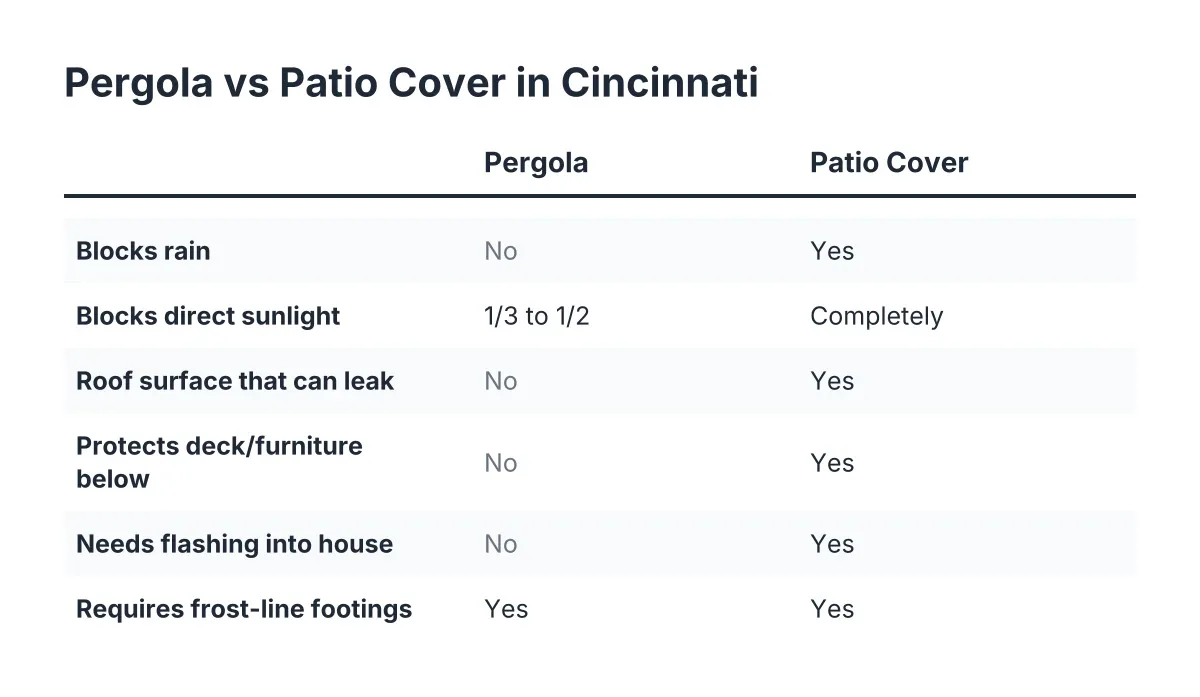
A pergola is an open-roof structure, usually four posts with beams and rafters spaced on top. It filters sunlight and defines the space, but it does not block rain. A patio cover attached to the house is a solid roof, framed and shingled or paneled, that keeps the space dry in any weather.
That single difference drives almost every other decision. If your goal is dappled shade on a summer afternoon, a pergola does the job with less structure and less cost. If your goal is sitting outside during a June thunderstorm or keeping furniture dry year round, you need a solid cover.
Many greater Cincinnati homeowners land somewhere in between: a pergola with a canopy or polycarbonate panels on top, which gets you partial rain protection without a full roof build.
2. How Much Shade Does a Pergola Really Provide?
An open pergola with standard rafter spacing blocks roughly a third to half of direct sunlight, depending on rafter depth, spacing, and the sun's angle. That is comfortable in morning and evening but thin at midday in July. A solid patio cover blocks sunlight completely underneath it.
Rafter orientation matters more than most people expect. Rafters running east to west cast wider shade during the high midday sun. Deeper rafters set on edge throw longer shadows than flat ones.
Therefore, if your deck faces west and bakes from 2 p.m. until sunset, an open pergola alone may disappoint you. Plan for a canopy, slats, or lattice from the start rather than retrofitting after your first hot summer under it.
3. Choosing the Right Pergola vs Patio Cover Shade Option
The best pergola top for shade depends on whether you also want rain protection. A fabric canopy or retractable shade cover gives you adjustable sun control and comes down for winter. Fixed lattice or closely spaced slats add permanent shade. Polycarbonate panels block rain while letting light through.
Here are the common pergola patio cover shade options, roughly from lightest to most robust:
- Retractable fabric canopy: adjustable shade, removable before winter, the fabric wears and needs replacement every several years
- Shade sail or grommet canopy: inexpensive and quick, but must be tensioned correctly or Ohio wind will shred it
- Fixed lattice or added slats: permanent, low maintenance, no rain protection
- Climbing plants on wire or lattice: dense summer shade, bare in winter, adds moisture against the wood
- Clear or tinted polycarbonate panels: rain protection plus light, must be pitched so water and snow shed properly
- Louvered aluminum roof systems: open and close on demand, the most capable option and the most expensive
One caution from the trade: a pergola with canopy fabric left up through a Cincinnati winter collects snow load it was never framed for. Take removable covers down by late fall.
4. Durability in Ohio Freeze-Thaw: Where Each Structure Wins
Cincinnati's freeze-thaw cycles punish both structures at the same point, the footings. Any post supporting a pergola or patio cover needs a concrete footing dug below the local frost line; in Hamilton County that means getting well below grade, not resting posts on a patio slab and hoping. According to Decks.com, structural posts must be set below the frost line rather than relying on general above-grade depth rules.
Above the footings, the comparison shifts. A pergola has no roof surface to leak, no shingles to replace, and no flashing to fail, so there is simply less to go wrong. A patio cover attached to the house must be flashed into your siding or roofline correctly; a bad flashing job sends water into your wall framing, and you may not see the damage for years.
However, a solid cover protects everything under it, including the deck boards, railing, and furniture below. Decks under a roof weather far more slowly than decks in open sun and rain.
5. Match the Material to the Structure and the Climate
For pergola wood in Ohio's humid climate, pressure-treated pine is the budget workhorse, and cedar costs more but resists decay naturally and looks better unstained. Larger treated posts, such as 6x6s, are often treated to a higher preservative retention level for better ground-contact durability, according to Journal of Light Construction (JLC). Aluminum and fiberglass pergola kits skip rot entirely and hold paint-grade finishes longer.
For patio covers, the framing is usually treated lumber with a roof that matches your house shingles, or an aluminum pan roof system on a simpler build. Use heavier zinc-coated hangers and connectors with treated lumber; standard hardware corrodes against the copper-based preservative chemicals, a point Simpson Strong-Tie makes about its ZMAX line.
One material note that catches homeowners off guard: wood stains and finishes on structures in direct all-day sun tend to fail early no matter what the label promises. A pergola in full sun needs refinishing more often than one that gets afternoon relief. Meanwhile, wood in heavy shade dries slowly after rain and carries higher rot risk, so it needs more diligent sealing, not less.
6. Do You Need a Permit to Build a Pergola in Ohio?
In most Ohio jurisdictions, including Hamilton County and the city of Cincinnati, a pergola or patio cover above a modest size requires a building permit, and anything attached to the house almost always does. Rules vary by municipality; Blue Ash, Loveland, Fairfield, and the Northern Kentucky cities each run their own permit desks with different thresholds.
Setbacks matter as much as the permit itself. Suppose a homeowner in Anderson Township wants a 14×16 patio cover off the back of the house; the structure has to respect rear and side setback lines, and an HOA may add height or material rules on top of that. Checking before footings go in costs nothing. Moving a built structure costs a lot.
A local deck contractor who pulls permits regularly in your municipality knows these thresholds cold, which is one of the quieter advantages of hiring locally rather than ordering a kit.
7. Plan the Shade Structure Around Your Deck Rebuild, Not After It
If your deck is 15 to 20 years old with soft boards and a loose railing, you are likely facing deck resurfacing or a full deck demolition and replacement anyway. That is the moment to decide on shade, because the footings and framing for a pergola or patio cover should be engineered into the rebuild.
For example, say your existing deck framing is sound but the boards are shot. A deck builder can resurface with composite decking and set new frost-depth footings for pergola posts at the same time, while the deck surface is open. Retrofitting those footings two years later means cutting into a finished deck.
There is a safety angle too. The U.S. Consumer Product Safety Commission reports about 2,900 injuries from collapses and failures of porches, decks, and balconies over a recent four-year period, averaging about 725 injuries a year. An aging deck frame was never designed to carry a roof load. Never mount a patio cover, and ideally not even a pergola, on framing that has not been evaluated first. This is one place where a professional assessment is worth the visit; a builder can tell you whether your posts, beams, and footings can take the added load or whether the shade structure needs its own foundation.
8. Decide With a Simple Side-by-Side: Pergola vs Patio Cover Comparison
When Cincinnati homeowners compare a pergola against a patio cover for shade, durability, and weather performance, the choice usually comes down to a handful of trade-offs:
- Shade: Patio cover wins outright; pergola wins if you want adjustable or partial light.
- Rain protection: Patio cover, no contest, unless you add solid panels to the pergola.
- Upfront cost: Pergola is typically the lower-cost build since there is no roofing, flashing, or gutter work.
- Maintenance: Open pergolas in wood need periodic staining and sealing; a well-built patio cover roof needs little until the shingles age out.
- Winter performance: A patio cover sheds snow like your house roof; a pergola carries almost no snow load as long as removable covers come down.
- Light into the house: A pergola keeps interior rooms bright; a solid cover attached over rear windows darkens them noticeably year round.
- Resale appeal: Both read as finished outdoor living space. The National Association of Realtors' 2023 Remodeling Impact Report found outdoor projects score high on homeowner satisfaction, with a new wood deck earning a Joy Score of 9.6 out of 11 project types rated.
Neither option is wrong. A west-facing patio that bakes all afternoon and hosts dinners in the rain argues for a solid cover. A deck that gets pleasant evening sun and mostly fair-weather use argues for an open pergola, maybe with a canopy for July and August.
Getting the Build Right in 2026
Whichever direction you choose, the construction fundamentals are the same in greater Cincinnati: footings below frost depth, corrosion-resistant hardware on treated lumber, correct flashing anywhere the structure meets the house, and a permit filed with your municipality before work starts. Those details decide whether your pergola patio cover shade project is still solid after its tenth Ohio winter or leaning after its third.
Quality pergola construction is less about the lumber you can see and more about the connections and concrete you cannot. If you are already planning a deck repair or full rebuild this year, fold the shade decision into that project. You will get better engineering, one mobilization instead of two, and a backyard that finally works in July heat and April rain alike.
If you need deck building and installation, Cincinnati Deck Pros can help.
Prefer to talk it through? Call (513) 613-3364 — a quick call is usually the fastest way to get a straight answer for your situation.