A Pergola vs. An Arbor: Which Is Right for You?
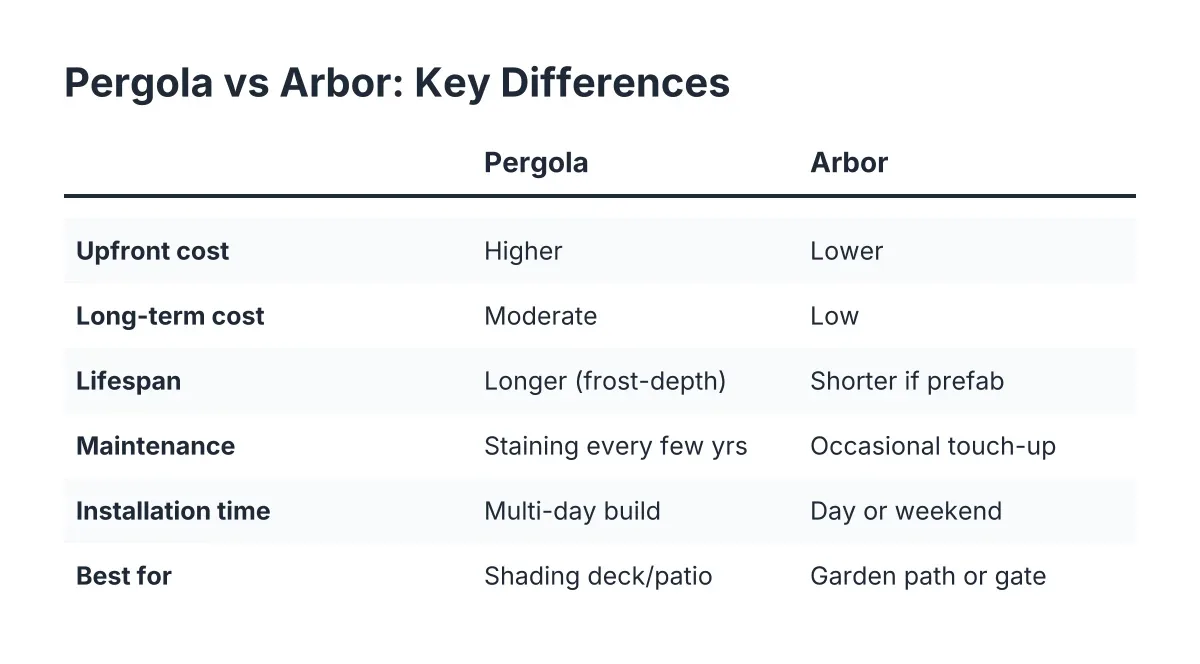
What is the difference between a pergola and an arbor? If you're deciding between the two for your Cincinnati backyard, the short answer comes down to size and purpose. The difference between a pergola and an arbor is this: a pergola is a large overhead structure that shades a whole seating or dining area, while an arbor is a small archway that frames a walkway, gate, or garden entry. A pergola wins when you want usable shaded living space, often built over a deck or patio. An arbor wins when you want a decorative accent for climbing plants at a fraction of the cost. Here's how the two compare on the points that matter before you spend money.
| Criteria | A Pergola | An Arbor |
|---|---|---|
| Upfront cost | Higher; a full structure with posts, beams, and footings | Lower; a small accent piece, often prefab |
| Long-term cost | Moderate; periodic staining or sealing on wood versions | Low; small surface area means quick, cheap upkeep |
| Lifespan | Longer when built on proper frost-depth footings | Shorter for lightweight prefab units; longer if custom-built and anchored |
| Maintenance | Seasonal cleaning plus staining or sealing every few years for wood | Occasional cleaning and touch-up; plant trimming if vines are grown on it |
| Best for | Shading a deck, patio, or outdoor dining area | Marking a garden path, gate, or entry with climbing plants |
A Pergola: Strengths and Trade-offs
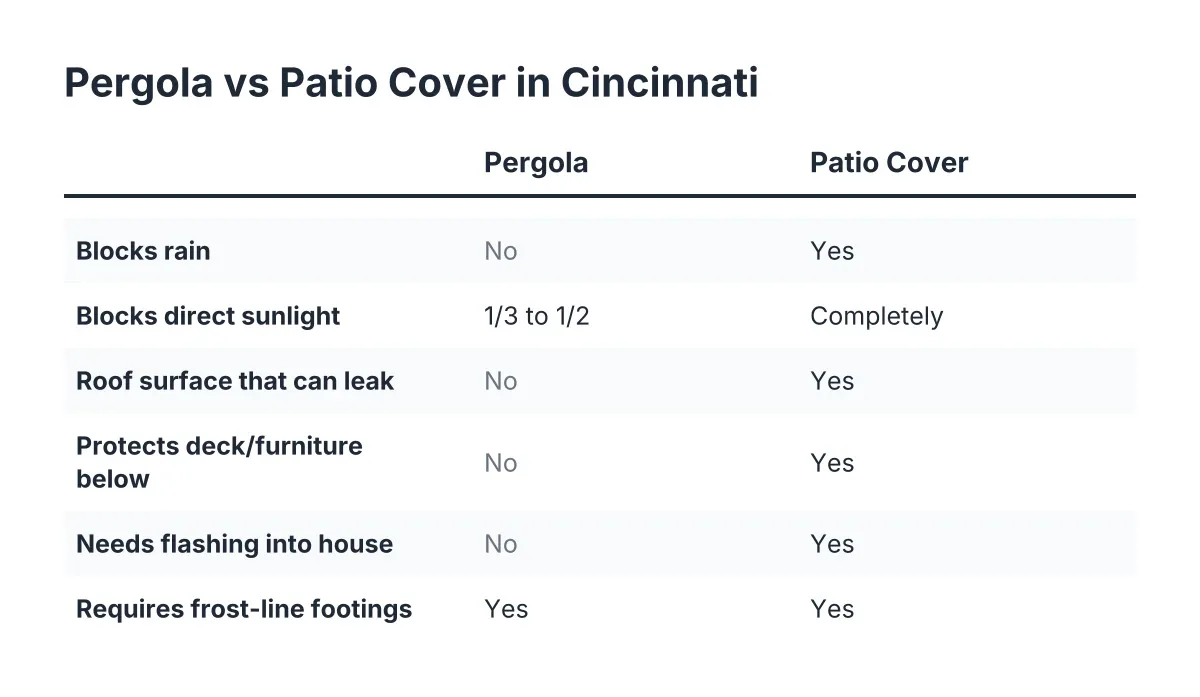
A pergola is an open overhead structure, usually four or more posts supporting cross beams and rafters. It doesn't have a solid roof, so it filters sunlight rather than blocking rain. Most homeowners in greater Cincinnati build one over a deck or patio to make the space comfortable in July and August, when full afternoon sun can make an uncovered deck unusable.
Where a pergola shines is scale. It defines an outdoor room. Add a ceiling fan, string lights, or a retractable canopy, and it becomes the anchor of your backyard. It also pairs naturally with other projects; we often design pergolas into deck and patio combination builds so the posts, footings, and framing work together from the start rather than getting bolted on later. That matters in Ohio, where freeze-thaw cycles push shallow footings out of the ground. A pergola attached to or standing beside a deck needs footings below frost depth, the same as the deck itself.
The trade-off is cost and commitment. Pergola construction is a real building project with permits to consider, concrete footings to pour, and structural lumber or composite materials to buy. If your goal is a simple garden accent, a pergola is more structure than you need. Our pergola cost guide walks through what drives the price if you're weighing the investment.
An Arbor: Strengths and Trade-offs
An arbor is a small freestanding archway, typically two or four posts with an arched or flat top, wide enough for a path or gate to pass under. It's a garden feature, not a shade structure. Climbing roses, clematis, and wisteria are the classic reasons people plant one at the entrance to a garden bed or along a fence line.
The strengths are obvious: low cost, small footprint, and fast installation. A prefab arbor can go in over a weekend, and even a custom-built one is a modest project compared to a pergola. If your yard needs a focal point or a graceful transition between spaces, an arbor delivers that without a permit conversation or heavy site work in most cases.
The trade-off is that an arbor does one job. It won't shade your dining table, it won't cover a grill station, and it adds little usable space. Lightweight prefab units also struggle in Ohio weather; thin lumber and shallow anchoring don't hold up well through freeze-thaw winters and spring storms. If you go the arbor route, anchor it properly and choose treated wood or a durable composite so it lasts more than a few seasons.
A Pergola vs An Arbor: The Deciding Factors
Cost drivers
A pergola costs meaningfully more than an arbor, and the gap comes from size, footings, and materials. A pergola needs multiple frost-depth footings, structural posts and beams, and enough lumber or composite to span a whole seating area. An arbor needs a fraction of the material and often no concrete at all. Material choice moves the number on both: treated wood decking lumber is the budget option, cedar costs more, and composite or aluminum sits at the top.
Lifespan
A well-built pergola typically outlasts an arbor because it's engineered like a small building. Proper footings below the Hamilton County frost line, structural connections, and quality materials mean a pergola can serve for decades with routine care. Arbors vary widely. A custom arbor in treated lumber, set and anchored correctly, holds up well. A big-box prefab unit often loosens, leans, or rots within a handful of Ohio winters.
Installation
An arbor installs in a day or a weekend; a pergola is a multi-day build with site work. Pergola installation involves layout, digging and pouring footings below frost depth, setting posts plumb, and framing beams and rafters overhead. In many Cincinnati-area jurisdictions it may also involve a permit, especially when attached to the house or built with a deck. An arbor usually skips all of that, which is part of its appeal.
Maintenance
Both need upkeep, but the pergola asks for more of your time simply because there's more of it. A wood pergola wants cleaning each spring and staining or sealing every few years, the same rhythm as deck staining and sealing, so many homeowners handle both at once. Composite and aluminum pergolas cut that work to occasional washing. An arbor takes minutes to clean, though if you grow vines on it, plan on seasonal trimming so the plants don't trap moisture against the wood.
Situational fit
Match the structure to the job: shade and living space point to a pergola, and a garden accent points to an arbor. If you're already planning a new deck or patio, that's the moment to fold in pergola construction, because sharing footings and framing during the original build costs less than retrofitting later. If your deck is fine and your garden just needs charm, an arbor gets you there without a construction project.
Which Should You Choose?
Choose A Pergola if:
- You want shade over a deck, patio, or outdoor dining area you actually sit in.
- You're planning a new deck or a deck and patio combination and can build both together.
- You want a structure engineered for Ohio freeze-thaw winters that lasts decades.
- You'd add features later, like a fan, lighting, or a canopy.
Choose An Arbor if:
- You want a decorative entry to a garden, path, or gate.
- You're growing climbing plants and need a frame for them.
- Your budget is modest and your timeline is short.
- You don't need shade or covered living space.
Most homeowners who call a deck builder are really asking about a pergola; they want the deck to be usable on hot afternoons. If that's you, the pergola is the right call. If your deck already works and the yard just needs a focal point, save your money and set an arbor.
Common Questions
Do you need a permit to build a pergola in Ohio?
Often, yes. Many Ohio jurisdictions, including cities and townships around Hamilton County, require a permit for a pergola once it passes a certain size or attaches to the house, while a small freestanding arbor usually doesn't trigger one. Rules vary by city and township, and some HOAs add their own approval step, so check with your local building department before you build. A local deck contractor who works these permit offices regularly can handle that legwork for you.
How much does it cost to build a pergola in the Cincinnati area?
It depends on size, materials, and whether it's freestanding or attached to your home or deck. Treated wood costs less upfront; composite and aluminum cost more but need less upkeep. Site conditions matter too, since every post needs a footing below frost depth. For a full breakdown of what drives the price, see our guide to how much pergola construction costs.
What is the difference between a pergola and an arbor?
The difference is scale and purpose. A pergola is a large open-roofed structure that shades a deck or patio; an arbor is a small archway that frames a path or gate, usually for climbing plants. The practical takeaway is that a pergola creates living space and an arbor creates a garden accent.
Can a pergola be added to an existing deck?
Usually, yes, but the deck has to be able to carry it. Pergola posts either need their own frost-depth footings beside the deck or the deck framing must be reinforced to take the load. If your deck is older or the framing is undersized, it may make sense to pair the pergola with deck resurfacing or a rebuild so the whole structure is sound. A deck contractor can assess the framing before you commit.
If you need deck building and installation, Cincinnati Deck Pros can help.
Prefer to talk it through? Call (513) 613-3364 — a quick call is usually the fastest way to get a straight answer for your situation.