Timbertech vs. Trex: Which Is Right for You?
If you're planning a composite deck in Cincinnati, the choice usually comes down to TimberTech vs Trex, and the timbertech vs trex question has a real answer: TimberTech tends to win when you want the most realistic wood look and a cooler surface underfoot, while Trex tends to win when you want a proven brand with wide availability and strong value at the entry level. Both are quality composite decking lines we install across greater Cincinnati. Both hold up well through Ohio freeze-thaw cycles far better than treated wood. The right pick depends on your budget, your design goals, and how the deck will be used, so here is the honest breakdown.
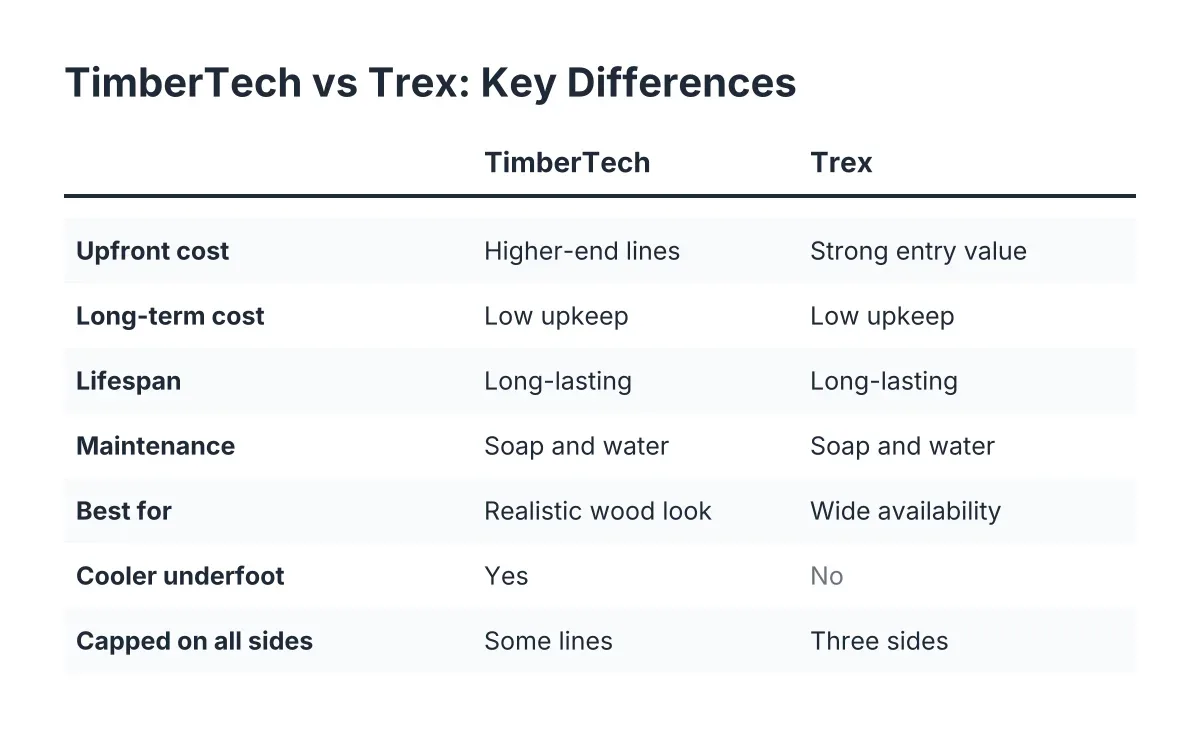
| Criteria | TimberTech | Trex |
|---|---|---|
| Upfront cost | Comparable to higher, depending on line | Comparable to lower, strong entry-level value |
| Long-term cost | Low; minimal upkeep beyond cleaning | Low; minimal upkeep beyond cleaning |
| Lifespan | Long-lasting; capped lines resist moisture well | Long-lasting; capped boards with a strong track record |
| Maintenance | Soap-and-water cleaning, no staining or sealing | Soap-and-water cleaning, no staining or sealing |
| Best for | Realistic wood grain, cooler surfaces, premium looks | Wide availability, dependable value, familiar brand |
TimberTech: Strengths and Trade-offs
TimberTech, owned by AZEK, is a composite and PVC decking brand that builds boards from wood fibers and plastics, or in its top lines, from polymer with no wood at all. In plain terms, that means boards that won't rot, splinter, or need staining the way treated wood does. Where TimberTech shines is appearance. Its higher-end lines carry varied grain patterns and multi-tone streaking that read as real hardwood from a few feet away, holding up to close inspection, not just curb-appeal distance. Homeowners who want the look of ipe, teak, or reclaimed barnwood without the upkeep usually end up holding a TimberTech sample when the decision gets made, and many homeowners we work with in Cincinnati pick TimberTech specifically because the boards don't look plasticky up close.
The polymer-based lines also tend to run cooler underfoot in direct sun, which matters on a south-facing deck or a pool deck in July. The fully synthetic PVC boards are lighter and resist moisture completely, and TimberTech offers capped boards on all four sides in some lines, which adds moisture protection, a real consideration with the wet springs and freeze-thaw winters we get in Hamilton County. The four-sided cap and the PVC option give TimberTech an edge in spots where water sits, like around a pool or at grade level.
The trade-off is cost and availability. TimberTech's premium lines sit at the higher end of composite pricing, and some colors or profiles take longer to source locally than the most common Trex options. If your budget is tight, TimberTech's entry lines close the gap, but at that tier the two brands perform much alike, so the brand name matters less than the installer — and the boards people fall in love with in the showroom are usually the pricier ones. You can read more about how we handle TimberTech decking installation in Cincinnati.
Trex: Strengths and Trade-offs
Trex is the most widely known composite decking brand, and that familiarity is earned. The company makes capped composite boards from recycled wood fibers and recycled plastic film, and its products have decades of real-world performance behind them. Trex organizes its boards into good, better, and best tiers, so you can match the product to your budget without switching brands. Where Trex shines is value and availability. Its entry-level line is one of the most affordable ways to get into composite decking, and its mid-range boards deliver a strong look for the money. Because Trex is stocked so widely and local suppliers around Cincinnati carry it consistently, lead times on common colors are short, and matching boards years later for a repair or an addition is easier.
Trex also holds its color well. The capped surface resists fading and staining, so the gray you pick in spring still looks like that gray after a few Cincinnati summers. The color range across the mid and upper tiers is broad, and the streaked, variegated boards in the premium lines look convincing from a normal viewing distance. For homeowners who want a low-maintenance deck without overthinking the material decision, Trex is a safe, proven answer.
The trade-offs show up in the details. Entry-level Trex boards have a more uniform, repetitive grain pattern than TimberTech's premium lines, and darker Trex colors can get hot in full sun — if your deck faces south with no shade, we'll talk color choice with you before you order samples. Trex boards are capped on three sides in most lines, leaving the bottom uncapped, which performs fine in practice but is a spec difference worth knowing. If you're leaning this direction, our page on Trex decking installation in Cincinnati covers what to expect.
Timbertech vs Trex: The Deciding Factors
Cost drivers
Trex usually wins on entry-level price, while the two brands overlap heavily in the mid-range. The biggest cost driver isn't the brand at all; it's which line within the brand you choose, plus deck size, height, railing, and framing. In Cincinnati, footings dug below frost depth, the Hamilton County permit process, and any demolition of an old deck also move the number — the brand decision shifts the material line, not the whole budget. Our composite decking cost guide walks through the factors that matter most, and our guide to deck building costs breaks down what actually moves the number for both brands equally.
Lifespan
Both brands last far longer than treated wood, and for most homes the lifespan difference won't decide the choice. Capped composite from either maker typically outlasts a stained wood deck by decades with basic care. TimberTech's fully capped and PVC lines have an edge in wet, shaded spots where moisture lingers, which is why we often steer pool deck projects that way, but both handle Ohio winters well when installed over a properly built frame.
Installation
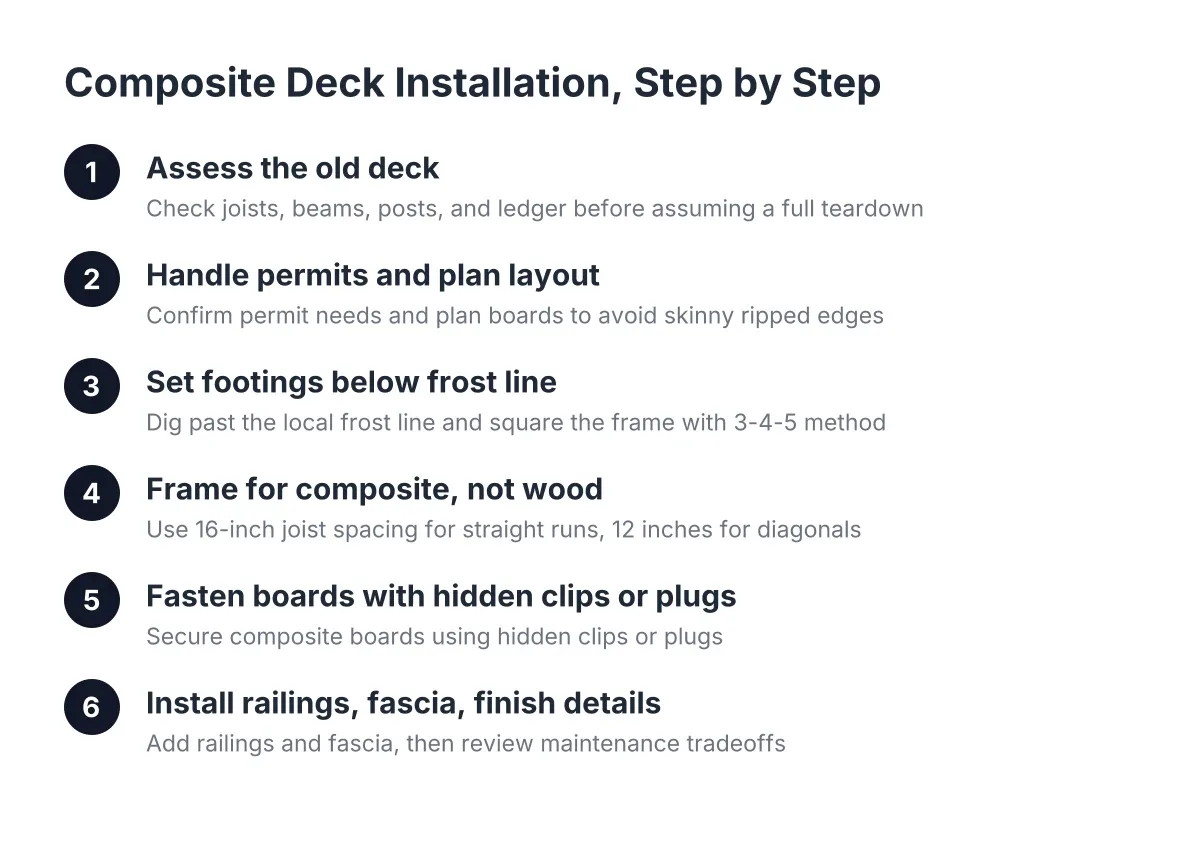
Installation quality matters more than the brand on the label. Both TimberTech and Trex use hidden fastener systems, both cut and handle much like wood, and both install over a conventional treated wood frame, so the skill is in the framing, the footings, and the board spacing, not the boards themselves. Composite boards flex more than wood between joists, so joist spacing and blocking have to be right. Composite also expands and contracts with temperature swings, and Cincinnati sees big swings, so gapping done right in January versus July is where an experienced deck builder earns their keep. A quality composite decking installation also means frost-depth footings and the correct joist spacing for the specific board line, since some lines allow different spans. A well-built frame under mid-tier boards beats premium boards over a sloppy frame every time.
Maintenance
This one is a tie: both brands need only occasional soap-and-water cleaning. Neither requires staining, sealing, or sanding, which is the main reason homeowners switch from treated wood in the first place. Sweep off leaves and debris, rinse a couple of times a year, and you're done. If low upkeep is your top priority, either brand delivers it.
Situational fit
TimberTech fits the homeowner chasing a premium, wood-realistic look, and Trex fits the homeowner who wants proven value. A pool deck or a south-facing deck with no shade points toward TimberTech's cooler-running lines, as does a low, grade-level deck where moisture never quits. A large multi-level deck where every square foot adds cost points toward Trex's value lines. Additionally, a screened-in porch, where the boards stay out of direct sun and rain, works well with either brand's mid-range options. Multi-level decks and deck and patio combination builds can even mix approaches, with premium boards on the main entertaining level and value boards on secondary areas.
Which Should You Choose?
Choose Timbertech if:
- You want the most realistic wood-grain appearance in a composite board
- Your deck gets full sun, or it's a pool deck where surface heat matters
- The deck sits in a damp, shaded, or grade-level spot where a four-sided cap or fully synthetic PVC board helps
- You're willing to spend more upfront for a premium look
Choose Trex if:
- You want strong value, especially at the entry and mid-range price points
- Fast availability and easy color matching down the road matter to you
- You're building a large deck and cost per square foot drives the decision
- You want the reassurance of the most widely used composite brand
If you're still torn, the practical tiebreaker is to see both boards in person. Hold samples side by side in the sun on your actual site, or order samples from both brands and set them outside for a week — rain, sun, and your own porch light will tell you more than any spec sheet. Most homeowners know their answer within a minute of comparing them, and we're happy to bring samples to a Cincinnati estimate visit. We install both, so our only stake is that the deck fits your home and your budget.
Common Questions
Is one brand better for Ohio winters?
Both handle freeze-thaw cycles well because capped composite doesn't absorb water the way wood does. The bigger winter factor is the structure under the boards: footings poured below frost depth, a properly flashed ledger, and joist spacing that meets the board manufacturer's specs. Get those right and either brand will come through Cincinnati winters without trouble.
Can I mix decking brands with any railing?
Yes, in most cases. Both TimberTech and Trex make their own railing systems, but you can also pair either brand's boards with aluminum, cable, or composite railing from another maker. We often mix a value decking line with a railing upgrade, or the reverse, to hit a budget without giving up the feature you care about most.
Which costs more, TimberTech or Trex?
It depends on the line, not the brand. Trex's entry line is typically the lower-cost way into composite, while at the premium tier TimberTech generally costs more per board — there you're paying for the more realistic grain and the four-sided cap. Either way, the boards are one line item; framing, railing, and stairs shape the total just as much. When homeowners ask us to settle the timbertech vs trex cost question, we price the same deck in two or three specific board lines so you're comparing real numbers, not brand reputations.
Can I resurface my existing deck with either brand?
Often, yes. If your existing frame is structurally sound, we can remove the old boards and railing and install TimberTech or Trex decking on top, which saves demolition and new footing work. If the frame has rot or the joist spacing is too wide for composite boards, a rebuild is the honest answer, and we'll tell you which situation you have before any work starts.
Do TimberTech and Trex offer warranties?
Both brands back their boards with manufacturer warranties covering defects and fade or stain performance, with terms that vary by product line. Read the specific warranty for the line you're considering, since coverage differs between entry and premium tiers. Your installer's workmanship matters separately; a warranty on the boards doesn't cover a frame built wrong.
Is composite worth it over treated wood?
For most Cincinnati homeowners planning to stay in their home, yes. Treated wood decking costs less upfront but needs staining and sealing every few years, and boards crack and splinter over time. Composite costs more on day one and then asks almost nothing of you afterward. If you're only staying a few years, treated wood can still make sense.
If you need deck building and installation, Cincinnati Deck Pros can help.
Prefer to talk it through? Call (513) 613-3364 — a quick call is usually the fastest way to get a straight answer for your situation.