Concrete Pool Deck vs. Composite Decking: 7 Durability Factors for Ohio
If you are weighing a concrete pool deck against composite decking in greater Cincinnati, the right answer depends less on brand marketing and more on how each material handles Ohio winters, wet feet, and years of traffic. Concrete pool decks are the default around most in-ground pools, and for good reason. Composite decking has a strong case too, especially for above ground pools and elevated surrounds. This list walks through seven durability factors that matter in our climate, so you can compare the two honestly before you talk to any contractor.
A quick frame before the list: a pool deck lives a harder life than a backyard deck. It stays wet for hours at a time, gets splashed with chlorinated or salt water, bakes in July sun, and then sits through 30 or more freeze-thaw cycles between November and March. Judge any material by that standard, not by how it looks in a showroom.
1. Freeze-Thaw Cycles Hit a Concrete Pool Deck Hardest
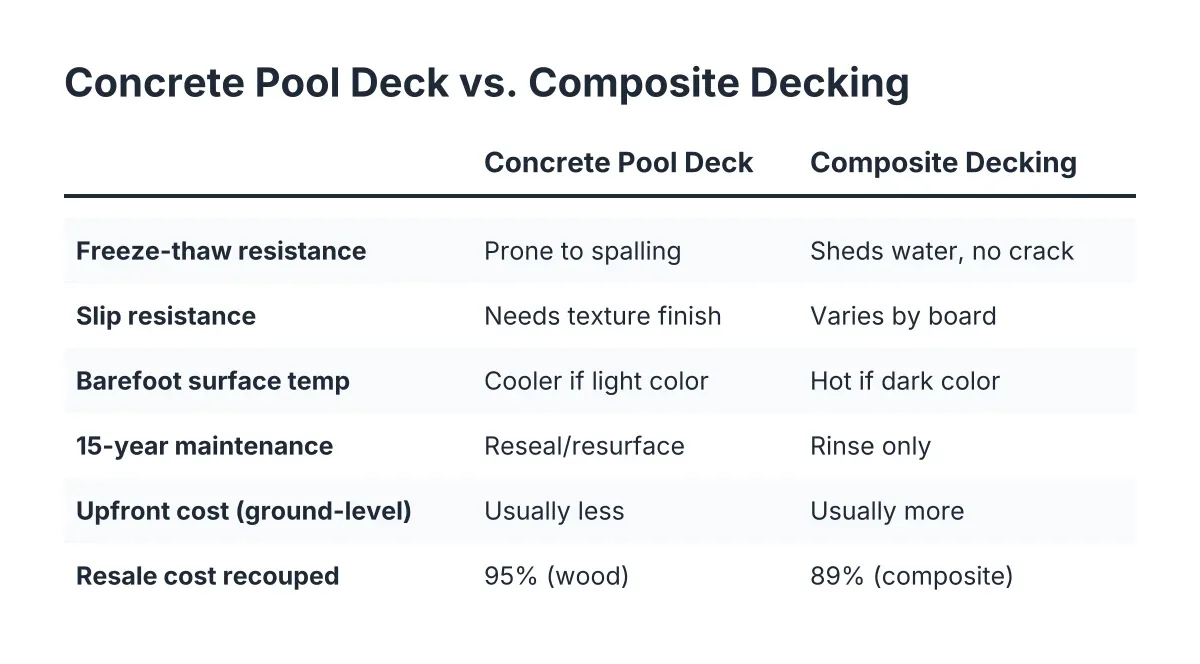
Ohio winters are the single biggest durability factor separating these two materials. Water works into tiny pores in a poured slab, freezes, expands, and over the years that pressure causes spalling, pitting, and hairline cracks. A well-poured slab with proper control joints, air-entrained concrete, and a quality sealer resists this for a long time; a cheap pour without those details often shows surface damage within a handful of winters.
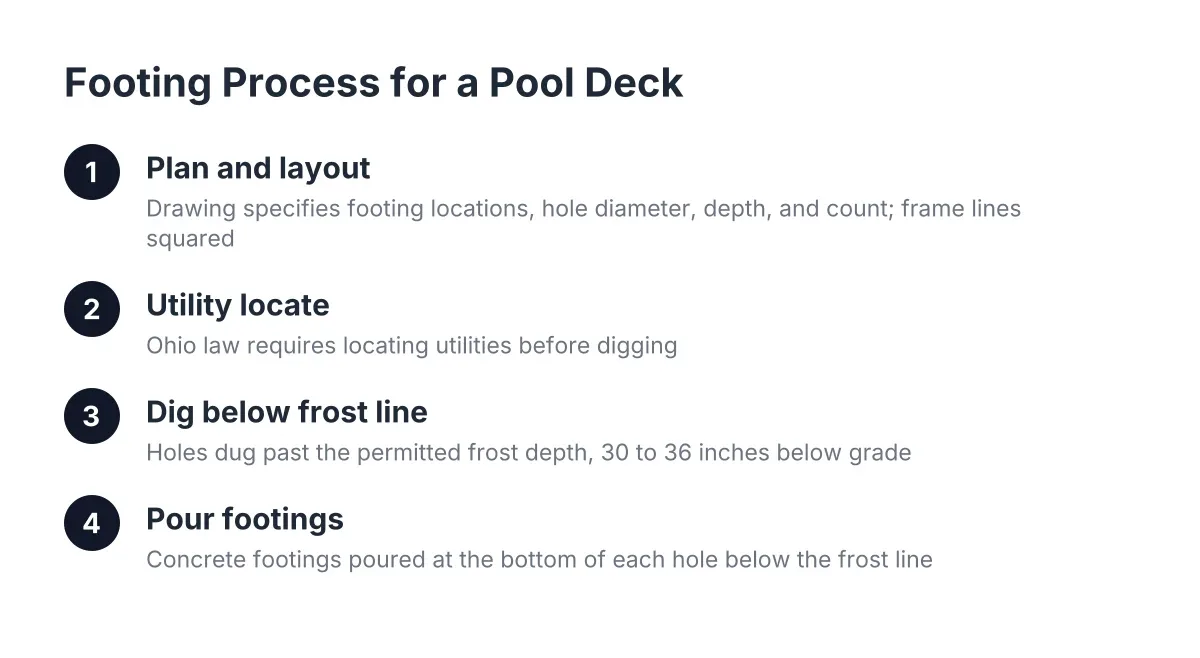
Composite decking handles freeze-thaw differently because it sheds water through gaps between boards instead of holding it on the surface. The boards themselves do not absorb much moisture, so there is nothing to crack. However, the framing underneath still matters. Footings for any elevated pool deck in Hamilton County must be dug below the local frost line, since a post set shallow will heave when the ground freezes, according to Decks.com.
2. Slip Resistance Is a Design Choice, Not a Material Guarantee
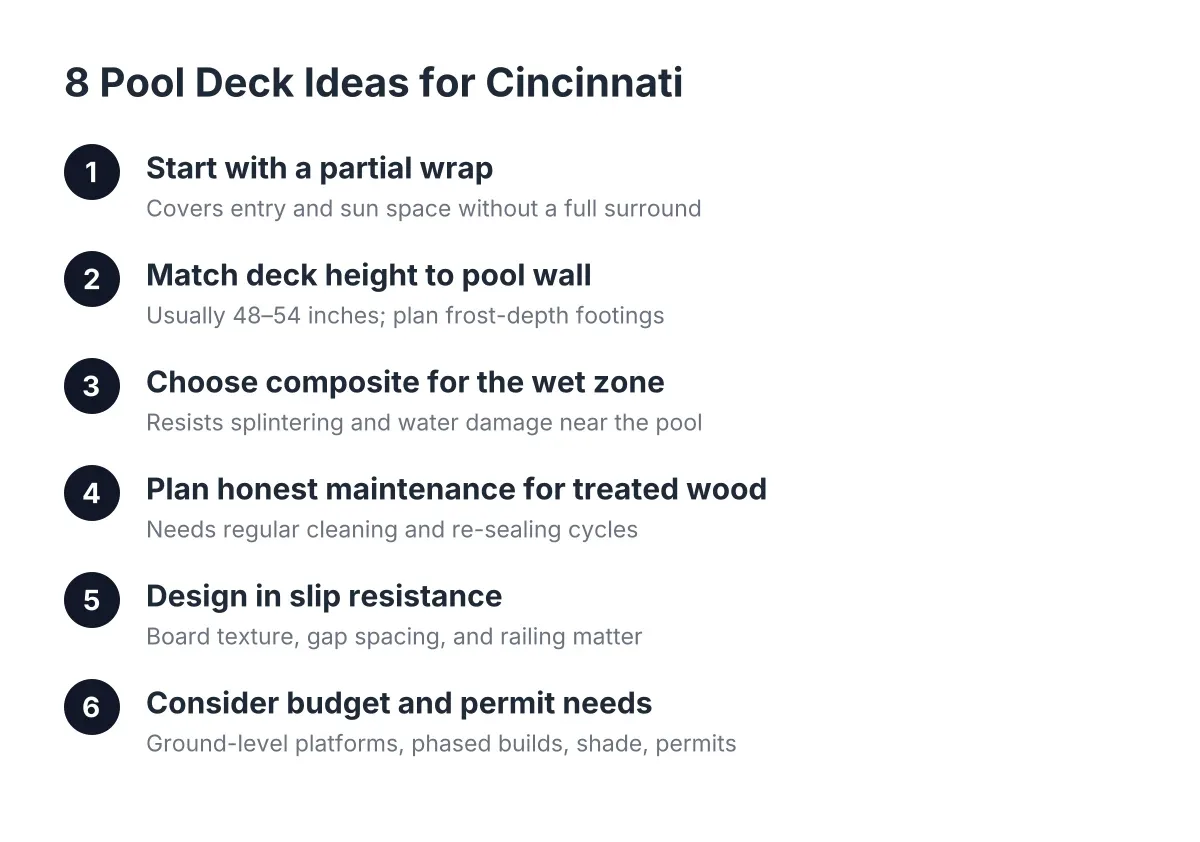
Neither material is automatically safe when wet. A smooth-troweled slab can be slick as ice with wet feet, which is why pool concrete is typically finished with a broom texture, exposed aggregate, or a textured coating. If you inherit a slick slab, a sealer with non-slip additive or a textured overlay can fix it without tearing anything out.
Composite boards vary by product line. Most current-generation capped composites carry embossed wood-grain texture that grips reasonably well when wet, but glossier budget boards can get slippery. When you compare quotes, ask the deck builder which specific board they price for pool use and whether it has a traction-oriented surface. That one question filters out contractors who have never built around a pool.
3. Surface Temperature on Bare Feet
Dark composite boards in direct sun get hot enough to make kids sprint across them in August. Lighter composite colors stay noticeably cooler, so if you want composite around a Cincinnati pool, choose a light gray or sand tone rather than a deep brown or charcoal. Board color is one of the few decisions here that is free at build time and expensive to regret later.
Concrete generally runs cooler than dark composite, and light broom-finished concrete is one of the more comfortable barefoot surfaces available. Stamped finishes in darker stains absorb more heat, so the same color logic applies. Cool-touch coatings exist specifically to knock surface temperatures down on existing slabs.
4. Maintenance Over 15 Years Looks Different for Each
Here is where the long-term math diverges. A concrete pool deck needs resealing every few years to keep water out of the surface, plus occasional crack repair. Skip the sealer and freeze-thaw damage accelerates, which is why resurfacing is a common project on 15-year-old slabs around here. Resurfacing with an overlay or coating costs far less than demolition and a new pour, and it resets the look of the whole pool area.
Composite decking asks less of you. Periodic rinsing and blowing off debris is the routine; there is no staining, sealing, or painting cycle. The honest trade-offs: composite scratches more visibly than concrete scuffs, and the framing under it is still wood that benefits from good detailing. For example, professional deck builders often apply waterproofing tape over the tops of pressure-treated joists as an extra moisture measure, according to TimberTech, which matters more than usual in the splash zone around a pool.
5. Upfront Cost and What It Buys You
For a ground-level surround on an in-ground pool, a basic broom-finished slab usually costs less per square foot than a framed composite deck, because the composite price includes an entire substructure. Cost per square foot climbs when you add stamping, staining, or decorative borders, and a high-end stamped option can land in the same range as mid-tier composite. Treat any cost estimator online as a rough starting point; site access, grading, and demolition of old concrete swing the number more than the finish does.
For above ground pools, the comparison flips. You cannot pour a slab at swim height, so a framed deck in treated wood or composite is the practical path, and treated wood decking is the budget option among above ground pool deck ideas on a budget. One useful note for ground-level composite platforms: adjustable deck pedestal systems can eliminate the need to pour concrete footers for a ground-level deck, according to Bison Innovative Products, which simplifies some pool-adjacent platform projects.
6. Resale Value if You Are Listing Soon
If a realtor or inspector flagged your pool area before listing, durability and cost recovery both matter. The 2025 Cost vs. Value Report shows a wood deck recoups about 95% of its cost at resale nationally and a composite deck about 89%, according to Remodeling Magazine / Zonda. A cracked, flaking slab or a gray, splintering wood surround reads as deferred maintenance to buyers, so a seller often gets more from a targeted fix than a premium rebuild.
For a pre-listing budget, the cost-effective moves are usually:
- Repair for cracks and settled sections, then a fresh sealer coat
- Resurfacing or a textured coating over a sound but ugly slab
- Deck resurfacing on a wood pool surround, replacing boards and railing while keeping solid framing
- Pressure washing and restaining a structurally sound treated wood deck
Suppose a homeowner in Anderson Township is listing in May and the inspector flagged a spalled slab plus a wobbly wood stair to the pool. In that scenario, resurfacing the slab and rebuilding the stair might run in the low thousands, while full demolition and a new composite surround could be a five-figure project that blows the timeline. The cheaper path is often the smarter one when there is a firm listing date.
7. Repair and End-of-Life Realities
Every surface fails eventually; what matters is how it fails. Concrete fails in place: cracks, settling, and surface wear that you can patch, grind, or overlay for decades before replacement makes sense. Concrete pool deck paint and coatings offer another reset, though coatings in Ohio sun and winter need reapplication on a cycle, and any film-forming finish exposed to all-day sun tends to fail sooner than its label suggests.
Composite fails board by board, which is an advantage. A cracked or badly scratched board swaps out in minutes if you kept spares from the original order. The substructure is the real end-of-life clock; treated framing that stays wet in shade rots faster than framing that dries quickly, so pool decks tucked behind privacy fencing or under tree cover deserve extra attention. Corrosion-resistant hardware matters too, since hangers and connectors used with pressure-treated wood should carry a heavier zinc coating to resist the copper-based preservative chemicals, according to Simpson Strong-Tie.
How to Decide for Your Pool Deck
Match the material to the pool type and your timeline. Here is the short version:
- In-ground pool, ground-level surround, budget-conscious: broom-finished or lightly stamped concrete, sealed on schedule.
- In-ground pool, low-maintenance priority: light-colored capped composite on a well-detailed frame, or a quality textured coating over existing concrete.
- Above ground pool: framed deck in treated wood for lowest upfront cost, composite if you want to skip the staining cycle.
- Selling within a year: repair and resurface what you have rather than rebuilding, unless the structure is unsafe.
Whichever direction you lean, the foundation phase decides the outcome. Footings below frost depth, correct drainage slope away from the pool, and proper joints or framing details matter more than the brand name on the surface. Mistakes at that stage get harder to correct with every step that follows, which is one reason pool deck installation is worth pricing with a contractor who builds around pools regularly rather than a general handyman.
One honest caveat: drainage, soil conditions, and pool coping details vary enough from yard to yard that no article can replace an on-site look. If your slab is heaving, your framing is soft, or your pool equipment complicates the layout, have a local deck contractor or concrete professional evaluate it before you commit to a material.
The good news for a comparison researcher: there is no wrong answer here, only a wrong match. Concrete wins on upfront cost and barefoot comfort at ground level. Composite wins on maintenance and flexibility at height. Walk into your quote conversations knowing which trade-offs you accept, and you will not get steered into an upgrade you never needed.
If you need deck building and installation, Cincinnati Deck Pros can help.
Prefer to talk it through? Call (513) 613-3364 — a quick call is usually the fastest way to get a straight answer for your situation.