Deck Repair Near Me in Cincinnati: Signs to Fix It Now vs. Wait
If you have been searching for deck repair near me, chances are something on your deck already caught your attention. Maybe a board feels spongy underfoot, the railing wobbles when you lean on it, or your real estate agent walked the backyard and frowned. The hard part is not finding someone to fix a deck. The hard part is knowing what is actually wrong, whether it can wait until spring, and whether the fix is a few boards or a bigger conversation. This guide walks through how a Cincinnati deck builder diagnoses those problems, which ones are urgent, and how to avoid paying for repairs you do not need.
Why Deck Problems in Cincinnati Are a Now-or-Later Question
Every deck problem sits on a spectrum. On one end are cosmetic issues: faded stain, a cracked board, a popped nail. On the other end are structural failures: a rotted ledger board, a heaved footing, or a beam that has lost its post support. The first group can wait. The second group cannot, and the danger is that both can look similar from the surface.
The scale of the problem nationally is worth knowing. The North American Deck & Railing Association estimates about 30 million decks in the United States are beyond their useful life and need repair or replacement. According to the International Association of Certified Home Inspectors, as many as 60 percent of the roughly 45 million deck structures in America have safety issues, and about 90 percent of deck collapses trace back to ledger board connection failures. That last number matters, because the ledger is the one part of a deck most homeowners never look at.
Cincinnati adds its own pressure. Ohio winters put decks through repeated freeze-thaw cycles. Water gets into cracks in wood, into gaps around fasteners, and into the soil around footings. Then it freezes, expands, and pries everything apart a little more each year. A deck that made it through ten Ohio winters has been tested in ways a deck in a milder climate has not. That is why the fix-now-or-wait question deserves a real diagnostic answer, not a sales pitch.
The Fix-It-Now List: Problems That Should Not Wait
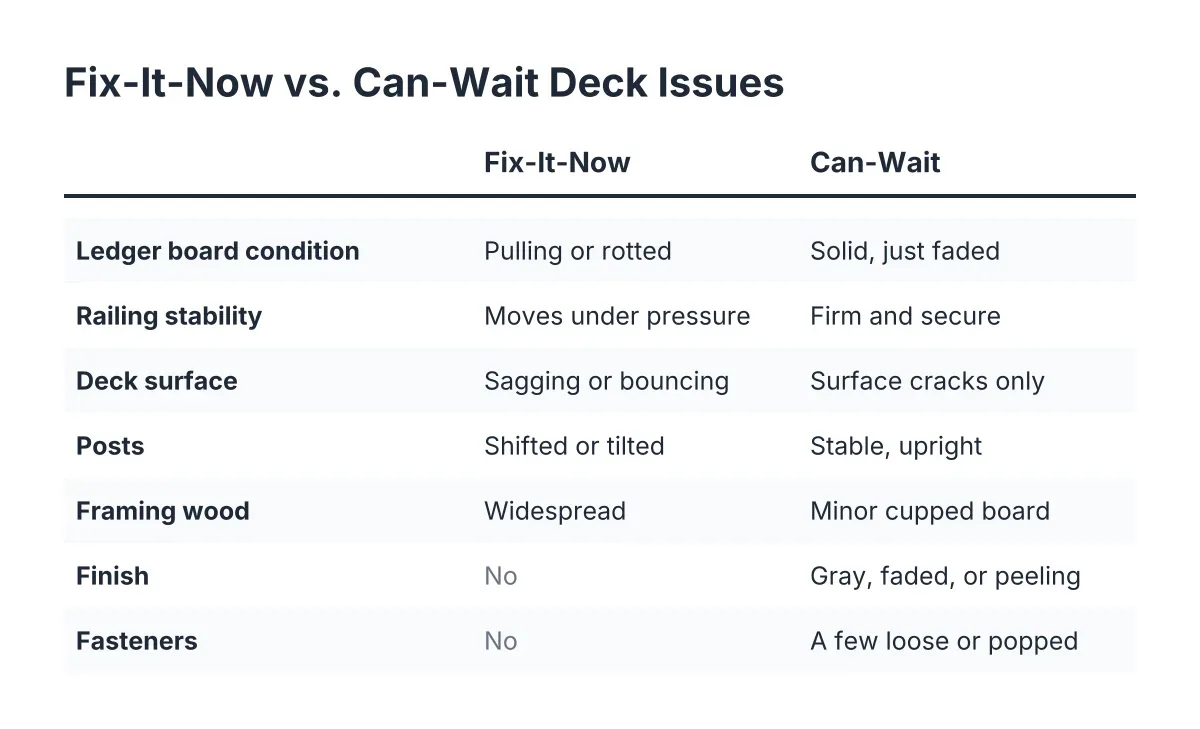
Some deck problems are safety issues, full stop. If you spot any of these, keep people off the deck until someone qualified has looked at it. A deck in visibly poor condition should come out of service before a repair plan exists, not after someone gets hurt.
- A pulling or rotted ledger board. The ledger is the board that attaches your deck to the house. If you see it separating from the siding, see rust streaks from the fasteners, or find soft wood where it meets the house, treat it as urgent. Ledger failures are the most common cause of deck collapse.
- A railing that moves under hand pressure. A loose deck railing is not a squeaky-hinge annoyance. Railings exist to stop a fall, and a post that rocks at the base has usually rotted where it connects to the framing, which you cannot see from above.
- Sagging or bouncing across the whole deck. A sagging deck usually means a beam, joist, or post has failed or a footing has sunk. Bounce that has gotten worse over a season means the structure is losing capacity.
- Posts that have shifted or tilted. In greater Cincinnati, footings poured too shallow sit above the frost line. Freeze-thaw cycles heave them, and the posts they support move with them. A tilted post is a footing problem wearing a disguise.
- Widespread soft or crumbling wood in the framing. One soft deck board is a board problem. Soft joists underneath are a structure problem.
If your situation matches this list, the honest advice is simple: stop hosting on the deck and get a professional evaluation. This is one place where a homeowner should not diagnose alone, because the difference between a repairable frame and an unsafe one often comes down to probing lumber you cannot reach without getting under the deck.
The Can-Wait List: Annoyances That Are Not Emergencies
Plenty of deck problems look ugly and feel alarming but do not threaten anyone. These can go on the spring project list without guilt.
Gray, faded, or peeling finish falls in this category. Weathered stain is a maintenance issue, not a structural one, and deck staining and sealing on a sound frame is one of the most cost-effective things a Pre-listing seller can do. Surface cracks and checking in individual boards are also normal wood behavior, as long as the board is still solid when you press a screwdriver into it.
A few loose or popped fasteners, a single cupped board, or mildew stains in shaded corners all belong here too. One caution on shade: decks under heavy tree cover in Cincinnati neighborhoods stay wet longer after rain and dry slowly, which speeds up rot. A shaded deck deserves inspection more often than a sunny one, even when it looks fine.
The trap to avoid is assuming that because the symptom is minor, the cause is minor. A cupped board near the house might just be a cupped board, or it might be the first visible sign of water pooling against the ledger. When a can-wait symptom sits next to the house connection or a post base, bump it up the list.
How to Inspect Your Own Deck Before You Call Anyone
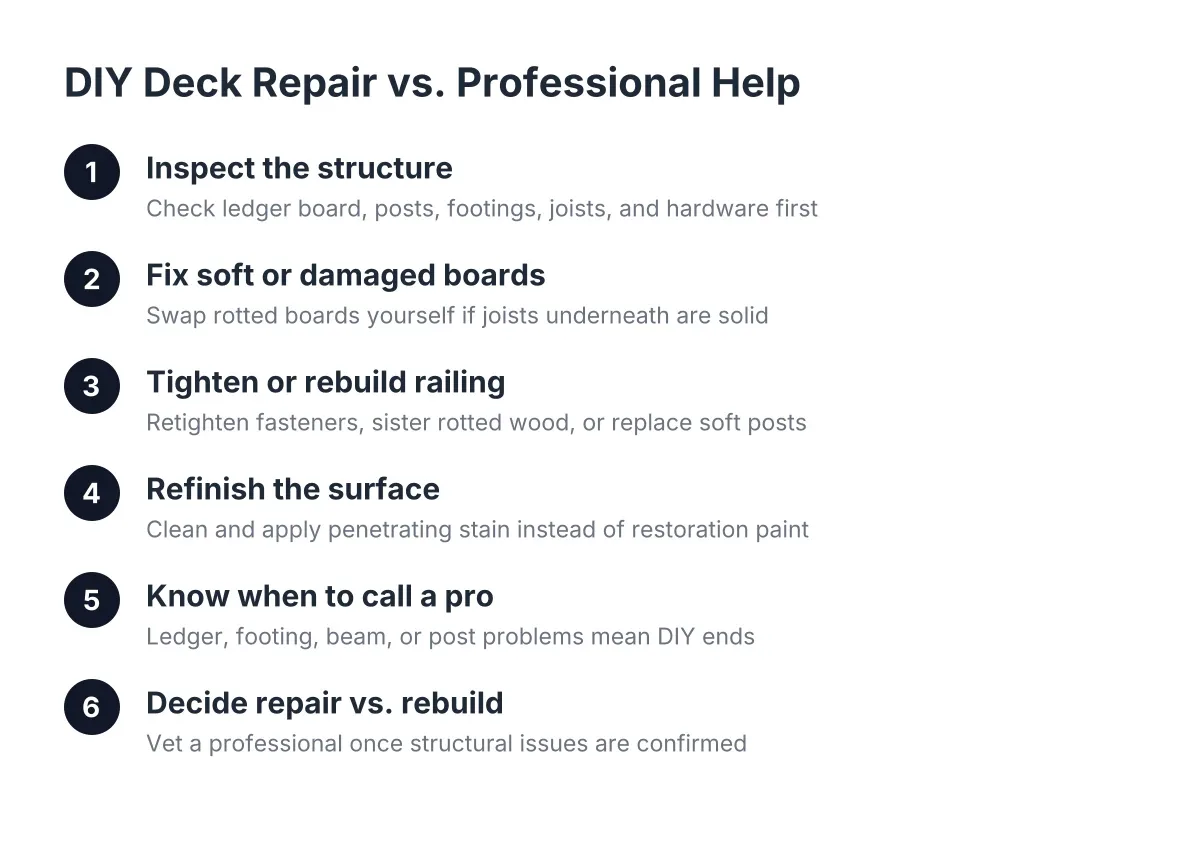
You can do a useful first-pass inspection in twenty minutes with a screwdriver and a flashlight. The goal is not to replace a professional evaluation. It is to walk into that phone call knowing what you are dealing with, so nobody can steer you toward a rebuild you do not need or a patch job that will not hold.
- Probe the boards, one by one. Press a screwdriver into deck boards, especially in high-traffic zones near the stairs and the door. Traffic areas rot first and lose fasteners first. Solid wood resists; rotted wood gives way with light pressure. Individual boards can fail while the rest of the deck stays sound, so check board by board rather than judging the whole surface at once.
- Check the ledger connection. Look where the deck meets the house. You want to see solid attachment, flashing that directs water away, and no gap, rust streaks, or soft wood.
- Shake every railing section. Grab each post and push. Any movement at the base means the connection needs attention.
- Get underneath if you can. Look at the framing for alignment, level beams, proper metal hardware at the joists, and posts that land squarely on footings. Craftsmanship shows underneath a deck more than on top of it. Sagging between supports or joists spanning long distances without help are red flags.
- Look at the footings and grade. Concrete that has cracked, tilted, or heaved above the soil line points to frost movement. In Ohio, structural footings must sit below the local frost line, according to Decks.com, which is why shallow footings from an old DIY build tend to walk uphill a little each winter.
Write down what you find. A homeowner who can say "two soft boards near the stairs, one loose railing post, ledger looks solid" gets a more focused visit and a more honest quote than one who says "the deck seems old."
What a Deck Repair Visit Near You Should Actually Include
A legitimate deck repair evaluation starts with the structure, not the surface. Expect the contractor to check the ledger and flashing, probe the framing, examine post bases and footings, test railings, and only then talk about the deck boards you can see. If someone quotes a repair price without looking underneath, that quote is a guess.
The scope of targeted deck repair usually covers deck board replacement, railing repair or replacement, sistering or replacing damaged joists, re-securing or re-flashing the ledger, and repairing or replacing individual footings and posts. Staining and sealing, and a wood deck sealant on fresh lumber, often ride along with the repair since the new boards need protection anyway. What usually costs extra: full resurfacing, structural rework beyond a few members, stairs rebuilt from scratch, and any change to the deck's footprint, which can trigger the Hamilton County or city permit process.
Deck restoration and deck resurfacing sit between repair and rebuild. If the frame underneath is sound but the surface is tired, a crew can strip the old boards and railing and install new decking on the existing structure. That is often the sweet spot for a seller with a listing date, because it delivers the visual reset of a new deck without new footings or a full permit-and-build cycle. One practical note from the trade: replace any damaged boards before deep cleaning a deck for refinishing, since repairs are easier before the cleaning process. And do not let anyone reuse your old boards on a resurfacing job; years of weathering and cracking make old lumber structurally weaker than new stock.
Costs vary too much by scope to quote here honestly. As a rough illustrative frame, replacing a handful of boards and tightening a railing sits at the low end of repair budgets, while footing work and ledger rework climb quickly because they involve excavation and structural labor. If you have priced new construction, you know the labor cost to build a deck per square foot runs well beyond material costs; repair pricing follows the same logic, where access and structural complexity drive the bill more than lumber does. Get the scope in writing, itemized by problem, so you can compare quotes on the same terms.
Repair, Resurface, or Replace: The Decision That Saves You Money
The frame decides. If the joists, beams, posts, and ledger are sound, almost any surface problem is repairable, and resurfacing can make a fifteen-year-old deck present like new. If the frame has widespread rot or the footings have failed, money spent on new boards is money spent decorating a structure that still needs to come out.
Here is a hypothetical that a lot of Cincinnati sellers will recognize. Say a homeowner in Anderson Township is listing in ten weeks, and the inspector flagged "deck shows deterioration." A board-by-board check finds four soft deck boards, one wobbly railing section, and a gray finish, but the framing underneath is dry and tight. In that scenario, targeted board replacement, a railing fix, and staining and sealing solve the flag for a fraction of a rebuild, and the timeline fits the listing date. Now suppose the same walk-under reveals a ledger pulling from the house and two heaved footings. That deck should come out of service, and the conversation shifts to deck demolition and replacement, because no amount of surface work makes it safe.
Resale math supports staying proportional. According to the Remodeling 2024 Cost vs. Value Report, a new pressure-treated wood deck recoups about 83 percent of its cost at resale, while composite recoups about 68 percent. For a pre-listing seller, that means a full premium rebuild rarely pays for itself in the sale price; a sound, clean, safe deck usually does. Save the composite decking upgrade conversation, whether Trex, TimberTech, or another brand, for a house you plan to stay in, where the lower maintenance pays you back in weekends rather than resale dollars.
There is a limit to what any article can diagnose. If your deck is more than about fifteen years old, was built without permits, or shows any of the fix-it-now signs above, have a professional evaluate it before you spend on cosmetics.
Finding Trustworthy Deck Repair Near Me: Questions That Filter Fast
Finding good deck repair near me in Cincinnati comes down to asking three questions before anyone quotes a number. The answers separate a deck contractor who diagnoses from one who sells, and they take five minutes on the phone.
First, ask "Will you inspect the framing and ledger before quoting?" The only right answer is yes. Second, ask "When would you recommend repair versus resurfacing versus replacement, and what would push my deck from one to the next?" A specialist can answer in plain terms because they do all three; a generalist tends to steer toward whatever they prefer to sell. Third, ask "How do you handle footings and frost depth here?" Anyone building or repairing structure in greater Cincinnati should talk comfortably about frost-depth footings and when a repair triggers a permit.
A fair quote itemizes the work: which boards, which posts, what happens at the ledger, and what the surface treatment includes. Be cautious of two extremes. A quote that only mentions surface work on a deck with structural symptoms is a patch that will resurface as a problem, possibly during your buyer's inspection. A quote that jumps straight to full replacement without documenting frame failure deserves a second opinion. Note that many searches for deck repair near me surface national directories and handyman franchises; those can work for a board swap, but structural diagnosis, porch repair, and footing work belong with a deck-and-patio specialist who builds these structures from the ground up.
The Bottom Line for Cincinnati Homeowners
Deck problems sort cleanly once you know where to look. Ledger, railings, posts, and footings decide whether you have an emergency. Boards, fasteners, and finish decide whether you have a weekend of maintenance or a resurfacing project. Do the twenty-minute inspection, write down what you find, and match the fix to the actual problem rather than to the loudest quote.
Decks are worth keeping right. According to the National Association of Realtors, 81 percent of homeowners say they enjoy their homes more after adding a deck, and a safe, clean deck shows well to buyers too. If your inspection turned up soft boards, a loose railing, or anything at the ledger or footings, get a local evaluation before the next season of freeze-thaw does more work on it. A Cincinnati deck builder who repairs, resurfaces, and rebuilds can look at the structure, tell you honestly which category your deck falls into, and give you an estimate scoped to what it actually needs.
If you need deck building and installation, Cincinnati Deck Pros can help.
Prefer to talk it through? Call (513) 613-3364 — a quick call is usually the fastest way to get a straight answer for your situation.