DIY Deck Repair vs. Professional Help: When to Call a Cincinnati Builder
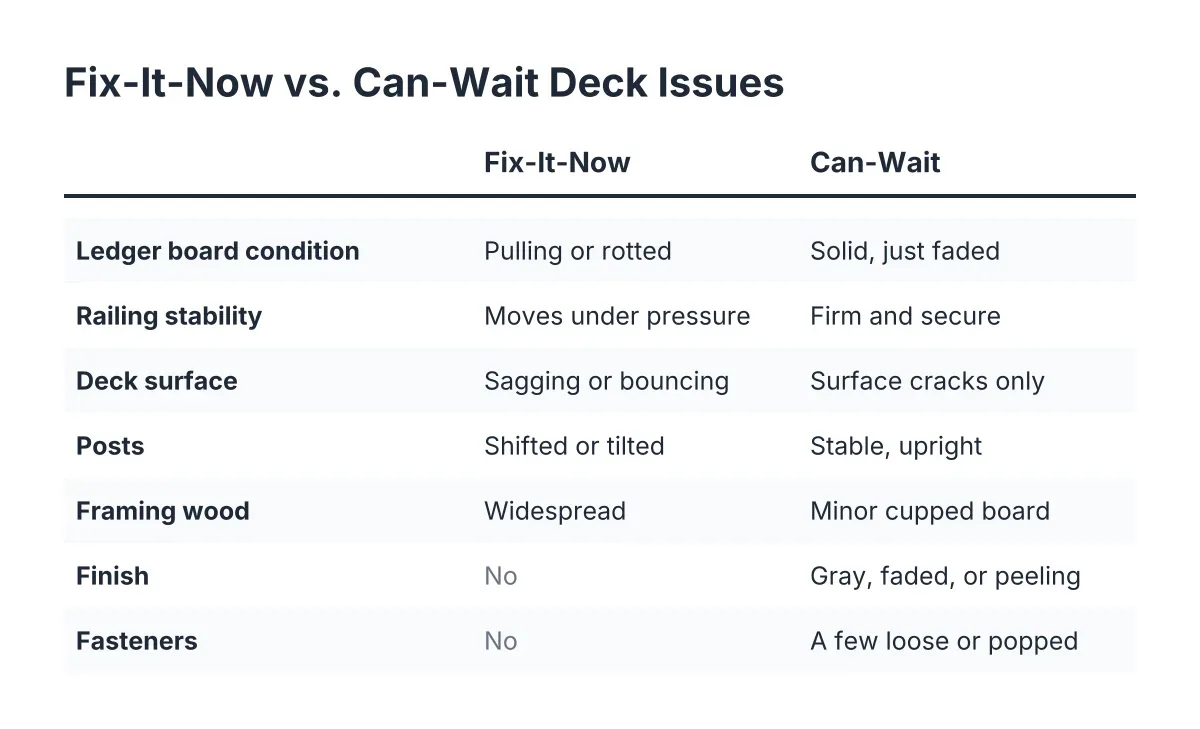
Before you buy a single board, you need to know what is actually wrong with your deck. The DIY deck repair vs. professional question comes down to one thing: is the problem cosmetic, or is it structural? Cosmetic problems, like a few soft deck boards or a faded finish, are fair game for a weekend project. Structural problems, like a wobbly ledger connection or a sinking footing, are not. This guide walks you through diagnosing your deck step by step, so you can fix what you can safely fix and know exactly when to bring in a Cincinnati deck contractor.
That order matters. The North American Deck & Railing Association estimates about 30 million decks in the United States are past their useful life and need repair or replacement. Most owners find out the hard way, after a railing gives or a board breaks. A one-hour inspection tells you which category yours falls in.
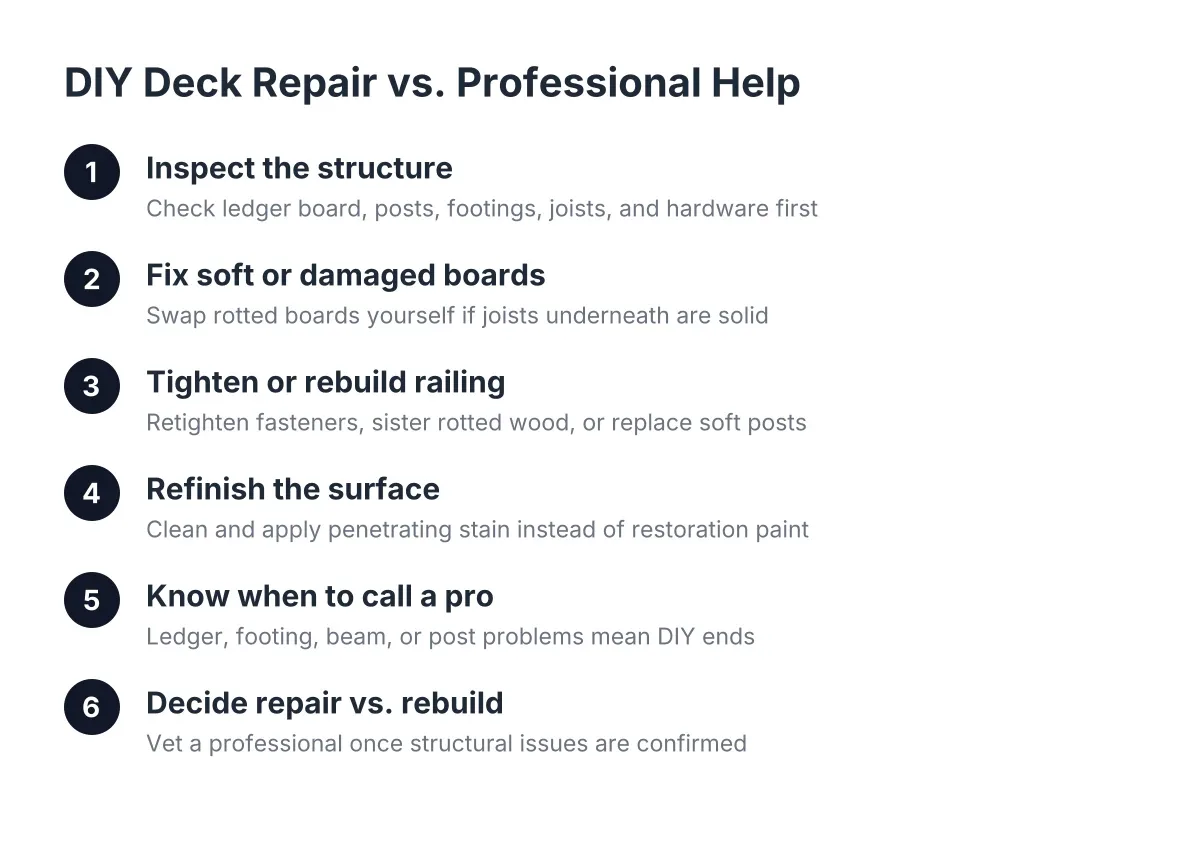
Step 1: Inspect the Structure Before You Touch a Single Board
Start underneath, not on top. The framing under a deck tells you more about its condition than the deck boards ever will. Bring a flashlight, a screwdriver, and a notepad, and check these items in order:
- Ledger board. This is the board bolted to your house. Look for rust-stained bolts, gaps between the ledger and the siding, or missing flashing. According to the International Association of Certified Home Inspectors, as many as 60 percent of the roughly 45 million decks in America have safety issues, and about 90 percent of deck collapses trace back to ledger connection failures.
- Posts and footings. Look for posts that lean, sit directly on soil, or rest on concrete that has heaved or cracked.
- Joists and beams. Press the screwdriver tip into the wood near joist ends and anywhere water pools. If it sinks in easily, the wood is rotting from the inside.
- Hardware. Check joist hangers and post bases for rust, missing nails, or hangers that have pulled away.
If everything under the deck checks out, your problem is likely surface-level and DIY-friendly. If you find soft framing, a suspect ledger, or shifting footings, stop here and read Step 5.
Step 2: Fix Soft or Damaged Deck Boards Yourself
Replacing individual deck boards is the classic DIY win. If the joists underneath are solid, a homeowner with a drill and a circular saw can swap boards in an afternoon. Pull the damaged board, cut a matching length of treated wood decking, and fasten it with exterior-grade screws into the existing joists.
Two details separate a repair that lasts from one you redo in three years. First, check the top of the joist where the old board rotted; water often gets trapped there and starts rot in the framing. Professional deck builders often add waterproofing tape over the tops of pressure-treated joists as an extra moisture barrier, a practice noted by TimberTech, even though treated lumber resists rot on its own. Second, expect the new board to look lighter than its weathered neighbors. It will blend after a season, or after your next staining.
For landlords, this is the repair worth learning. Say you own a two-family in Norwood and the back deck has three spongy boards flagged at tenant turnover. In that scenario, a few treated boards and an hour per board keeps the unit rentable without a contractor visit. Multiply that across several properties and the skill pays for itself.
Step 3: Tighten or Rebuild a Loose Deck Railing
A loose deck railing is the most common liability issue on rental decks, and the fix depends on why it is loose. Work through it in this order:
- Tighten the existing fasteners. If the railing post bolts through the rim joist, snug the bolts. Loose is normal after Ohio's freeze-thaw swings; wood shrinks and expands every winter.
- If the fasteners spin without gripping, the wood around them has rotted or split. Move the connection to solid wood, or sister a new block behind the rim joist and bolt through both.
- If the post itself is soft at the base, replace the post. Do not shim or glue a rotted post; it will fail again, and railings only matter at the moment someone falls against them.
A wobbly railing you can retighten is DIY. A railing loose because the rim joist behind it is rotting is a framing problem, and that pushes you toward a professional deck repair or partial rebuild.
Step 4: Refinish the Surface, and Skip the Deck Restoration Paint
Once boards and railings are sound, refinishing protects everything you just fixed. Replace any damaged boards before you deep clean; repairs are easier on a dry, dirty deck than a freshly washed one. Then clean, let the wood dry, and apply a penetrating stain. Many Cincinnati homeowners searching for deck staining near me end up comparing penetrating oil stains, such as TWP deck stain and similar products, against thick deck restoration paint coatings.
Here is the honest trade-off. Thick restoration coatings promise to resurface worn boards, but they tend to peel on decks that see freeze-thaw cycles and trapped moisture, and once they peel, removal is miserable. A penetrating stain wears gradually and recoats easily. For a rental you want to touch every three years instead of every year, penetrating stain is the lower-maintenance call. If the boards are too far gone for stain to save, that is a deck resurfacing conversation, not a coating decision.
Step 5: Know When DIY Deck Repair Ends and Professional Work Begins
DIY deck repair ends where the structure begins. Surface boards, railing tightening, cleaning, and staining are homeowner work. Ledger connections, footings, beams, and posts carry the load of everyone standing on the deck, and mistakes there do not announce themselves until the deck fails. These signs mean call a pro now:
- The deck pulls away from the house, or you can see a gap at the ledger.
- Footings have heaved, cracked, or sunk, leaving posts out of plumb.
- The deck sags, bounces, or visibly slopes.
- Multiple joists are soft, not just one board.
- The framing was built without joist hangers or proper post bases.
Footings deserve special mention in greater Cincinnati. Structural deck footings must extend below the local frost line, according to Decks.com, and Ohio's freeze-thaw cycles will heave anything shallower. A footing poured too shallow twenty years ago is a common root cause behind a sagging deck fix, and correcting it means excavation and new concrete, not a weekend patch. Structural work here also typically runs through the Hamilton County or city permit process, which a local deck builder handles as part of the job.
One more decision rule: if the deck is in visibly poor condition overall, stop using it before it is repaired or replaced. A deteriorated deck full of people at a summer cookout is exactly how collapses happen.
Step 6: Decide Between Targeted Repair and Resurfacing or Rebuild
Sometimes the honest answer is that repair money is better spent on replacement. Use the framing as your guide. If the joists, beams, posts, and footings are sound, deck resurfacing keeps the structure and replaces the walking surface and railing, often for well under the cost of a full rebuild. If the framing itself is failing, replacement is the safer investment.
This is also where a repair project can become an upgrade. Suppose a homeowner in Anderson Township calls about deck repair for a bouncy 1990s deck and learns the framing is solid. Resurfacing with composite decking, adding new deck railing, or extending into a deck and patio combo can all build on that existing structure. A rebuild, by contrast, opens the door to a multi-level deck or a screened-in porch if bugs are what drive you inside every July evening.
There is a resale angle too. According to the Remodeling 2024 Cost vs. Value Report, a new pressure-treated wood deck recoups about 83 percent of its cost, while composite recoups about 68 percent. For a rental, treated wood usually wins on cost per unit; for the home you entertain in, composite's low upkeep may matter more than resale math.
Step 7: Vet the Professional Before You Hire for Deck Repair
When the diagnosis points past DIY, deck repair vs. professional judgment shifts to choosing the right professional. A good repair quote covers scope, not just price. Ask these three questions:
- Will you inspect the framing and footings, or just fix what I pointed at? A contractor who quotes a railing fix without looking underneath is treating symptoms.
- Does this work need a permit, and who pulls it? Structural repairs in Hamilton County and surrounding cities often do, and the builder should handle it.
- Is repair actually worth it here, or am I better off resurfacing or rebuilding? You want a builder willing to talk you out of a repair that will not hold.
A fair quote itemizes what is included, what is extra (haul-away, staining, railing replacement), and what the builder found during inspection. Vague one-line quotes are how owners get oversold on rebuilds they did not need, or undersold on repairs that ignore the real problem.
If you have worked through these steps and found structural issues, or you would rather have an experienced set of eyes confirm your diagnosis, reach out to a Cincinnati deck builder for an inspection and estimate. Knowing exactly what is wrong before anyone quotes a fix is the whole point, whether you swing the hammer yourself or hire it out.
If you need deck building and installation, Cincinnati Deck Pros can help.
Prefer to talk it through? Call (513) 613-3364 — a quick call is usually the fastest way to get a straight answer for your situation.