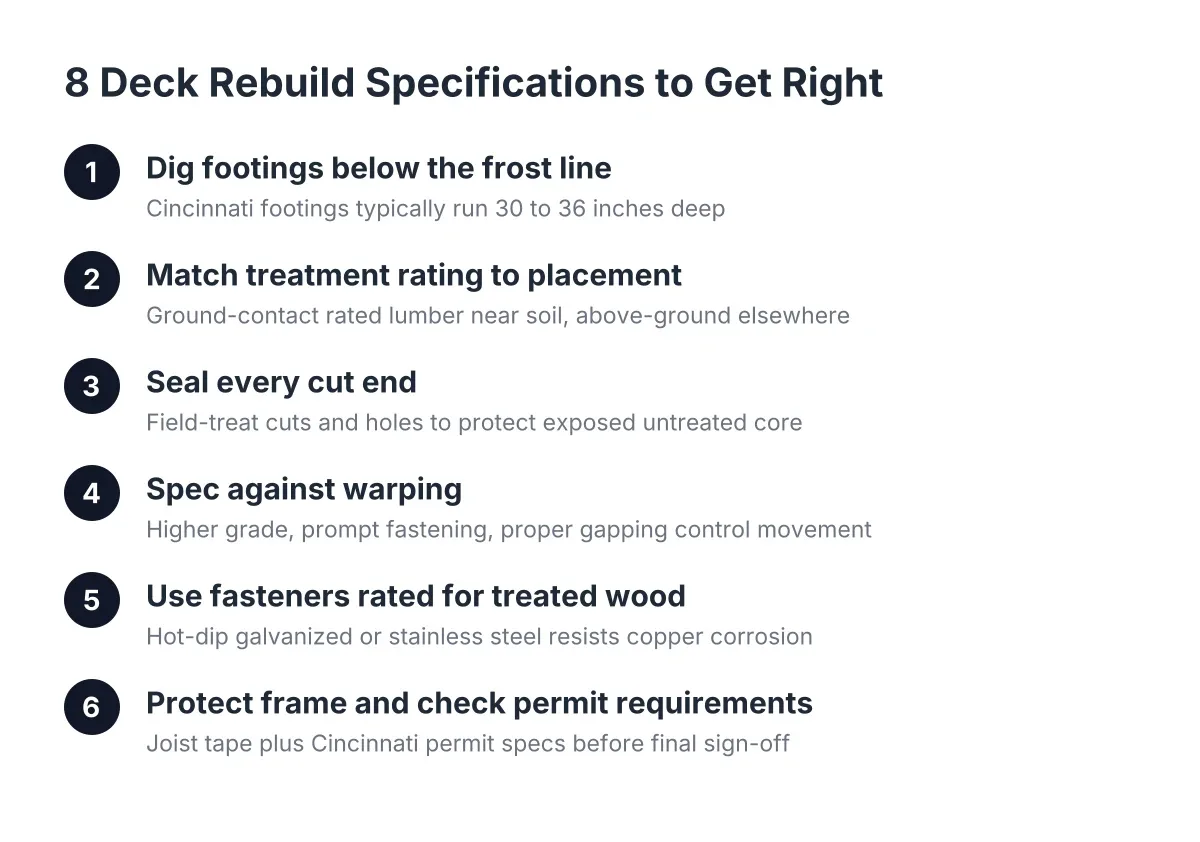
Pressure-Treated Wood Specifications for Cincinnati Decks: 8 Things to Get Right
If your deck is 15 or 20 years old and the boards feel soft underfoot, the material behind your rebuild matters as much as the crew doing the work. Getting the pressure-treated wood deck rebuild specifications Cincinnati decks actually need is what separates a deck that lasts through decades of Ohio winters from one that heaves, warps, and rots in half that time. Showroom brochures will tell you treated lumber "resists rot." That's true, but it skips everything that matters here: frost-depth footings, freeze-thaw movement, ground-contact ratings, and the fasteners that keep it all connected.
This list covers the eight specifications and decisions that matter most when you rebuild with treated wood in greater Cincinnati, whether you're planning to stay in the house or getting it ready to list.
1. Dig Footings Below the Frost Line, Not Just "Deep Enough"
Cincinnati winters push frost well into the ground, and any footing that stops above that depth can move when the soil freezes and thaws. According to Decks.com, when a post is part of a structural build like a deck footing, the hole must go below the local frost line rather than relying on general above-grade rules of thumb. In our region, that typically means footings in the range of 30 to 36 inches deep, though your local building department sets the exact number.
Why does this matter to someone rebuilding an old deck? Frost heave is often the hidden reason an aging deck feels wobbly or out of level. If your current deck sits on shallow footings or concrete blocks resting on grade, a rebuild is your chance to fix the foundation, not just the boards. On permitted projects in Hamilton County, an inspector checks the holes after digging and before concrete goes in, which protects you from a shortcut you'd never see once the deck is finished.
2. Match the Treatment Rating to Where the Wood Sits
Not all pressure treated wood is the same product. Boards are treated to different preservative retention levels depending on their intended use: above ground, ground contact, or in-ground structural. Posts and any framing within a few inches of soil need ground-contact rated lumber; deck boards six feet in the air do not.
In addition, larger dimension lumber often carries more protection. According to the Journal of Light Construction, bigger treated members such as 6×6 posts are often treated to a higher preservative retention level for greater ground-contact durability. A careful deck contractor specifies the rating for each part of the structure rather than buying one stack of lumber for everything. When you review a quote, ask which rating goes where. A builder who can answer that in plain terms is showing you their work.
3. Seal Every Cut End, Because Treatment Is Only Skin Deep
Standard dimensional treated lumber has preservative penetrating the outer shell of the board, not the core. Cut a joist to length and you expose untreated wood at the fresh end. According to the American Wood Protection Association, any cut or drilled hole made in pressure-treated lumber should be field-treated with an end-cut preservative sealer to prevent rot and insect entry at the exposed core.
This is one of the quiet differences between a deck that lasts and one that rots from the inside. Cincinnati's freeze-thaw cycles drive moisture into every exposed end grain, and untreated cores soak it up. If your old deck failed at the joist ends or around post notches, skipped end sealing is a likely culprit. It costs little and takes minutes per cut; it just requires a crew that bothers. Proper deck rebuild specifications demand that every cut surface receives this protection without exception.
4. Expect Some Movement, and Spec Against Warping
Does treated wood warp? Yes, it can, and Cincinnati summers are part of the reason. Treated boards arrive from the yard carrying moisture from the treatment process. When a wet board dries fast in July heat, it can cup, twist, or bow, especially in lower grades and certain species. That movement is the most common complaint homeowners have about treated wood decking in its first two years.
However, you can manage it with specification rather than luck:
- Choose the highest grade the budget allows; fewer knots means straighter drying
- Fasten boards promptly and correctly so they dry in place under restraint
- Allow proper gapping so boards can expand and contract with the seasons
- Consider engineered treated framing for beams where twist would cause structural problems, since engineered members resist warping far better than dimensional lumber
Worth knowing: the higher-grade industrial treatments with deeper penetration are generally not stocked at retail box stores and require specialty suppliers, according to Preserved Wood, the wood preservation industry trade organization. Most residential decks don't need them, but it explains why not all "treated wood" performs the same.
5. Use Fasteners and Hangers Rated for Treated Lumber
Modern pressure-treated wood uses copper-based preservatives, and copper corrodes ordinary steel. According to the American Galvanizers Association, fasteners driven into pressure-treated lumber should be hot-dip galvanized or stainless steel to resist corrosion from the treatment chemicals. The same logic applies to hardware; according to Simpson Strong-Tie, hangers and connectors used with treated wood need a heavier zinc coating, such as their ZMAX line.
For an aging deck, this one hits home. A loose, wiggling railing or a joist pulling away from the ledger is often a fastener failure, not a wood failure. Cheap screws corroded inside good lumber. When you get a rebuild quote, the hardware line item is worth asking about, because it's an easy place for a low bid to cut corners you won't notice until year eight.
6. Protect the Frame With Joist Tape, Even Though the Wood Resists Rot
Treated lumber resists rot on its own, but the tops of joists take the worst abuse. Water sits in the gap under every deck board, and every fastener hole gives it a path inside. According to TimberTech, applying waterproofing tape over the tops of pressure-treated joists is an additional moisture-mitigation step professional deck builders use, even on treatment-protected framing.
For Cincinnati's climate, where water freezes and expands in those fastener holes dozens of times each winter, joist tape is cheap insurance on a structure you want to last 20 years. It also matters if you plan to resurface later: a sound treated frame with taped joists can carry a new deck surface, wood or composite decking, without a full teardown.
7. Know How Treated Wood Specifications Play Into a Cincinnati Permit
Pressure-treated wood specifications for a Cincinnati deck are not just builder preferences; they show up on your permit drawings. Footing depth and diameter, post size, beam spans, joist spacing, and ledger attachment all get reviewed, and the footing inspection happens before concrete is poured. Footings must also be sized for the load they carry, which sometimes requires a structural engineer's input on larger or multi-level deck designs.
This is good news for the homeowner who has been burned before. If a past contractor handed you a number with no explanation, the permit process forces the explanation onto paper. It also matters for the pre-listing seller: a permitted rebuild with documented specifications is a clean story for a buyer's inspector, while an unpermitted deck can stall a sale at the worst possible moment.
8. Weigh Treated Wood Against Composite Before You Commit
Treated wood is the budget-friendly path, and it holds resale value well. According to the Remodeling 2024 Cost vs. Value Report, a new 16'x20' pressure-treated wood deck averages $17,615 nationally with an 83% return at resale, while the same deck in composite decking averages $24,206 with a 68% return. For a seller with a listing date, wood often wins on both cost and payback. It's also a project people love; the National Association of Realtors gave a new wood deck a Joy Score of 9.6 in its 2023 Remodeling Impact Report.
The trade-off is maintenance. Treated wood needs staining and sealing every few years to look its best through Ohio winters, while Trex decking, TimberTech, and other composite boards skip that cycle in exchange for a higher upfront cost. Neither answer is wrong; it depends on how long you'll own the deck and how much upkeep you'll accept.
What Deck Rebuild Specifications Should Be in Your Quote
Suppose a homeowner in Anderson Township has a 20-year-old deck with spongy boards and a railing that shifts when leaned on. In that scenario, a fair 2026 quote should read like a specification, not just a price. Look for these items in writing:
- Footing depth below frost line, with the permit and inspection included in scope
- Treatment rating for each component: ground-contact posts, framing, and deck boards
- Hardware spec: hot-dip galvanized or stainless fasteners, corrosion-rated hangers
- End-cut sealing and joist tape, listed as included rather than assumed
- Railing attachment detail, since loose railings are the most common safety failure
A quote that names these details tells you the builder understands the pressure-treated wood specifications Cincinnati's freeze-thaw climate demands. A quote that just says "build 16×20 treated deck" tells you to keep asking questions. And be honest about the repair-versus-rebuild question: if the frame is sound and only the surface has failed, deck resurfacing may cost far less than demolition and replacement, while rotted posts or heaved footings usually mean the structure has to go. When soft framing, shifting footings, or a failing ledger are in the picture, bring in a professional assessment before anyone commits to a plan; structural calls are not a DIY judgment.
Get a Straight Answer on Your Deck
If your deck has you nervous about summer cookouts, or an agent flagged it before listing, the right first step is an honest assessment, not a sales pitch. A local deck builder who works to Cincinnati's frost-depth and treatment specifications can tell you whether repair, resurfacing, or full deck demolition and replacement makes sense for your situation. Reach out for an estimate, walk the deck together, and get the reasoning behind the number, not just the number itself.
If you need deck building and installation, Cincinnati Deck Pros can help.
Prefer to talk it through? Call (513) 613-3364 — a quick call is usually the fastest way to get a straight answer for your situation.