Deck Removal Permits and Setback Rules in Cincinnati: A Step-by-Step Guide
If your old deck came through another Ohio freeze-thaw winter with soft spots, wobbly railings, or footings heaving out of the ground, you are probably weighing deck removal and a full rebuild. Before anyone swings a pry bar, though, there is paperwork. In Hamilton County and the City of Cincinnati, deck demolition and the new build that follows can trigger permit requirements, zoning setbacks, and inspections that catch homeowners off guard mid-project.
This guide walks through the process step by step: when demolition is genuinely necessary versus an upsell, which permits apply, how setbacks and HOA rules shape your new design, and what the teardown itself looks like. It is written for greater Cincinnati homeowners planning to replace an aging deck with something better, whether that is composite decking, a deck and patio combo, or a screened-in porch.
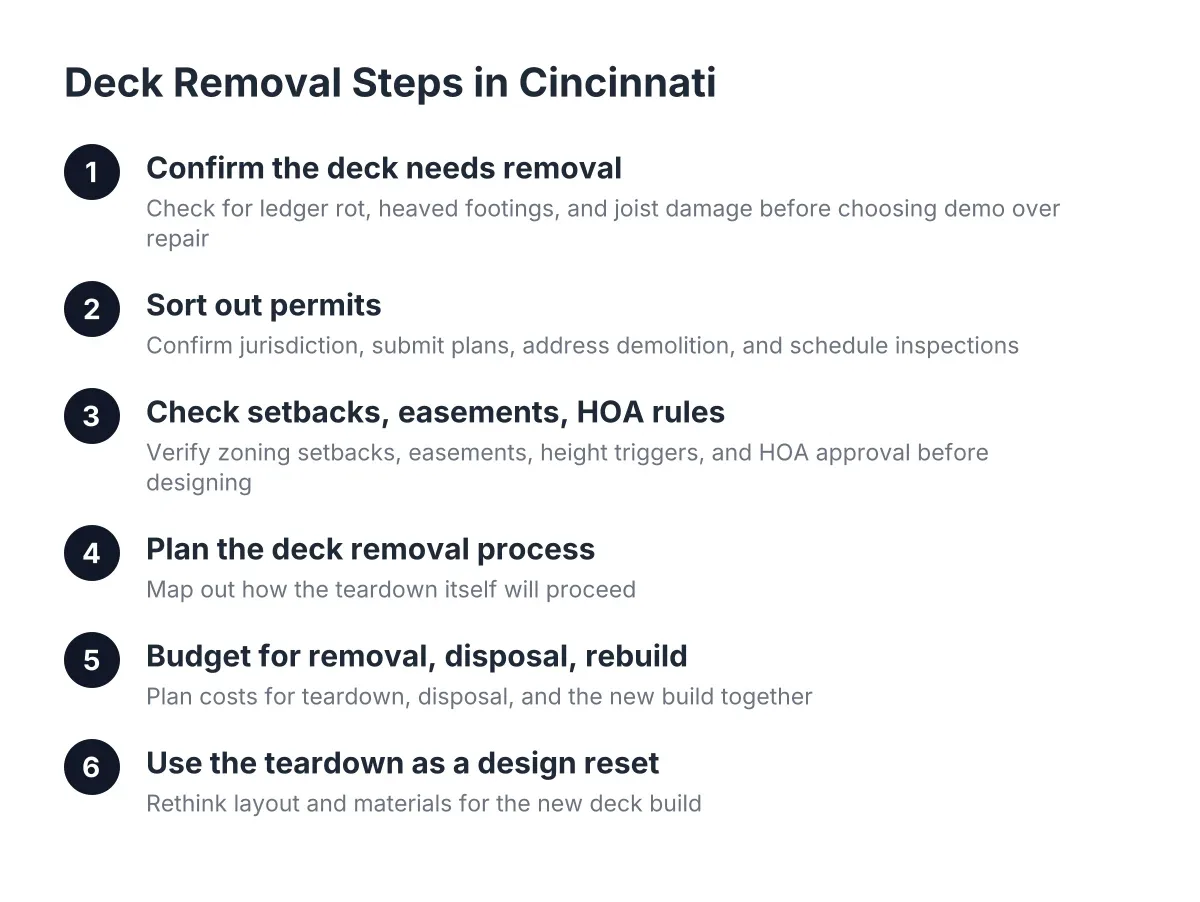
Step 1: Confirm the Deck Actually Needs to Come Down
Start with an honest assessment, because full demolition is not always the right call. If the framing underneath is sound and only the surface boards and deck railing are tired, deck resurfacing may get you a like-new deck at a lower cost. Replacement makes sense when the structure itself has failed.
Look for these signs that point to full removal rather than repair:
- Rot in the ledger board, posts, or beams, not just the deck boards
- Footings that have heaved or sunk after freeze-thaw cycles, a common issue in Cincinnati clay soil
- A ledger board attached with nails instead of lag bolts or structural screws
- Widespread joist rot or joists undersized for the span
- A deck built without permits that would not pass inspection today
The ledger connection deserves special attention. According to the International Association of Certified Home Inspectors, as many as 60 percent of the roughly 45 million decks in America have safety issues, and about 90 percent of deck collapses stem from ledger board connection failures. If your ledger is compromised, stop using the deck now. A deteriorated deck poses a real collapse risk, and it should come out of service well before demolition day, not the weekend after one more cookout.
However, be wary of a deck contractor who jumps straight to full teardown without crawling underneath first. If they never inspect the framing, footings, and ledger, they are quoting a replacement, not evaluating one. A good deck builder will tell you when repair or resurfacing is the smarter spend.
Step 2: Sort Out Permits Before Deck Removal Starts
In most of greater Cincinnati, tearing down an attached deck and building a new one requires a building permit, and the demolition itself may need to be covered under that permit or a separate one depending on your jurisdiction. The City of Cincinnati, Hamilton County, and the individual municipalities inside the county (think Norwood, Blue Ash, or Anderson Township) each run their own permit process, so your first call should be to the building department that covers your address.
Here is what the permit path generally involves for a deck replacement:
- Confirm jurisdiction. A Cincinnati address does not always mean city permitting; many neighborhoods with Cincinnati mailing addresses fall under Hamilton County or a separate municipality.
- Submit plans for the new deck. Expect to show framing details, footing depth and size, ledger attachment, railing height, and stair geometry.
- Address demolition. Some jurisdictions fold teardown into the building permit; others want it noted separately, especially if utilities like gas lines for a grill or electrical for lighting run to the old deck.
- Schedule inspections. Footing holes are typically inspected before concrete is poured, with framing and final inspections after.
Footing depth matters more here than in milder climates. Ohio frost pushes footings deep, and structural posts must bear below the local frost line rather than following any above-grade rule of thumb, a point Decks.com makes about deck footings generally. Footings that stop short of frost depth are exactly why so many older Cincinnati decks heave and rack, and why inspectors check the holes before concrete goes in.
Skipping permits to save time usually backfires. An unpermitted deck can stall a home sale, void insurance claims after a failure, and force you to tear out finished work for inspection. If you are replacing the deck partly to improve the house long term, the permit is part of the value.
Step 3: Check Setbacks, Easements, and HOA Rules Before You Design
Your new deck cannot automatically occupy the old deck's footprint. Zoning setbacks, which dictate how close a structure can sit to your property lines, apply to the replacement even if the original deck predates the current rules. This is where a lot of Cincinnati replacement projects change shape on paper before anything changes in the yard.
Work through this checklist during design:
- Rear and side setbacks. Each zoning district sets its own distances. A deck built to the lot line in 1995 may have been legal then, or simply never caught, but the replacement must meet today's rules or go through a variance process.
- Easements. Utility and drainage easements often run along rear lot lines. Footings generally cannot go in an easement, which can force a shallower deck or a shifted layout.
- Height and structure triggers. A low platform deck may face different requirements than an elevated multi-level deck or a roofed screened-in porch. Adding a roof usually moves the project into a more involved review.
- HOA approval. Many Hamilton County subdivisions require architectural review for material, color, and railing style. Get written approval before ordering composite decking, because HOAs can and do reject boards after they are on site.
For example, suppose a homeowner in Anderson Township wants to replace a 12-by-20 wood deck with a larger multi-level deck stepping down to a paver patio. If the expanded footprint crosses the rear setback, they have three options: shrink the design, apply for a variance, or shift square footage into the patio, since patios at grade are often treated differently than elevated structures. That third option is one reason deck and patio combination builds work well on tight Cincinnati lots.
Step 4: Plan the Deck Removal Process Itself
Once permits are in hand, the teardown follows a predictable sequence, and doing it in order keeps the job safe. Demolition runs roughly in reverse of construction: railings and stairs first, then deck boards, then the frame.
A typical crew works through it like this:
- Remove the deck railing, balusters, and stairs.
- Pull the deck boards. Composite decking installed with hidden fastener clips comes up faster than boards screwed down through the face; decades-old screwed or nailed wood boards are the slow, stubborn end of the spectrum.
- Strip hardware. Joist hangers, hurricane clips, and blocking come out before the joists and beams can be pulled.
- Remove joists, beams, and posts in sequence.
- Detach the ledger board and flash or repair the house wall behind it.
- Deal with the footings. Old concrete piers are either pulled or, if the new layout allows, abandoned below grade. New footings almost always go in fresh holes dug to frost depth.
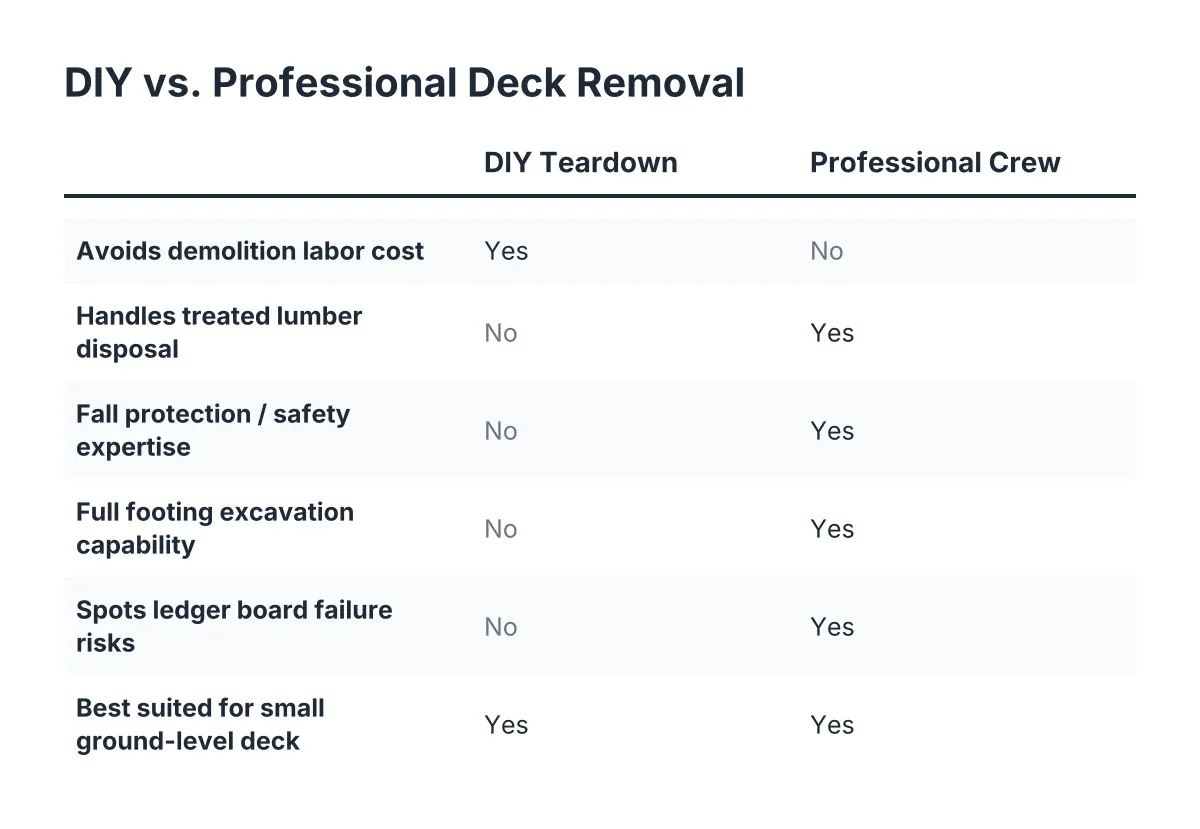
Some crews speed up board removal by cutting between joists with a circular saw. It is fast, but on an elevated deck it is also the riskiest method, since cut sections can give way underfoot. This is one honest argument for hiring a deck removal company rather than renting a dumpster and a demo bar for a DIY weekend: elevated teardown is a fall hazard, and a pro crew carries the insurance and the habits to manage it.
Resist the urge to reuse old deck boards in the new build. Years of weathering, cracking, and UV damage leave old lumber structurally weaker than it looks, and mixing it into new framing undermines the whole point of replacing the deck.
Step 5: Budget for Removal, Disposal, and the Rebuild Together
Deck removal cost depends mostly on size, height, attachment, and access. A small ground-level platform with a clear path to the driveway is a short job. A second-story deck with concrete footings to extract and a fenced backyard is not. Debris disposal is a real line item too; treated wood decking cannot be burned or casually dumped, and a full teardown fills a sizable dumpster.
As a rough illustrative range, standalone teardown on a typical Cincinnati deck might run several hundred to a few thousand dollars, while the full project lands wherever your new design does. Material choice drives most of that. Treated wood keeps upfront cost down; composite options like Trex or TimberTech cost more per square foot but skip the staining and sealing cycle that Ohio weather demands of wood. If you are comparing a deck wood composite decision, price the twenty-year picture, not just the install.
Two budgeting notes specific to replacement projects. First, most deck replacement contractors fold demolition into the overall quote, and bundling it is usually cheaper than hiring separate removal and build crews, since the same team handles disposal and site prep in one mobilization. Second, ask how the quote handles surprises behind the ledger. Hidden rot in the rim joist or siding is common on older Cincinnati homes, and it is better priced as a contingency up front than as a mid-project change order.
There is a payoff on the other side of the dumpster. According to the National Association of Realtors, 81 percent of homeowners say they enjoy their homes more after adding a deck, and decks earned a 9.8 out of 10 joy score in the NAR Remodeling Impact Report. A replacement done right, with legal setbacks, frost-depth footings, and a permit file in the drawer, is the version of the project you actually get to enjoy.
Step 6: Use the Teardown as Your Design Reset
Demolition clears more than lumber; it clears assumptions. With the old deck gone, you are free to fix everything that never worked, and this is the moment to decide before footings are poured.
Consider whether the replacement should be more than a like-for-like deck:
- A deck and patio combo that steps entertaining space down into the yard
- A screened-in porch section so bugs stop ending your evenings in July
- A multi-level deck design that handles a sloped Cincinnati lot instead of fighting it
- Framing sized now for a future hot tub or outdoor kitchen, which is far cheaper than retrofitting
One planning caveat: every yard is different, and slope, soil, easements, and drainage can rule out designs that look simple online. Have a local deck builder or structural engineer evaluate the site before you commit to a specific layout, especially for elevated multi-level decks or roofed porch additions.
Handled in the right order, permits, setbacks, teardown, then build, a deck replacement in greater Cincinnati is a predictable project rather than a gamble. The homeowners who get burned are the ones who demo first and ask the building department questions later. Do it in this sequence and the only surprise left is how much more you use the backyard.
If you need deck building and installation, Cincinnati Deck Pros can help.
Related guide: deck demolition and replacement — Complete Guide
Prefer to talk it through? Call (513) 613-3364 — a quick call is usually the fastest way to get a straight answer for your situation.