Deck Demolition vs. Repair in Cincinnati: When Replacement Is Actually Necessary
If a home inspector, real estate agent, or your own gut has flagged your old deck, the first question is usually the big one: does this deck need a full teardown, or can it be repaired? The answer changes your deck replacement cost by thousands of dollars, and it changes your timeline too. That matters whether you are planning to enjoy the space for the next fifteen years or trying to get a house listed by spring.
Here is the honest version most homeowners never hear. Some decks genuinely need to come down. Others get demolished because a contractor found it easier to quote a rebuild than to inspect the structure board by board. This guide walks through how to tell the difference on Cincinnati homes specifically, where Ohio freeze-thaw cycles, frost-depth footings, and decades of pressure-treated lumber all factor into the call.
Why "Tear It All Down" Is Sometimes an Upsell
A full demolition and rebuild is the simplest job for a deck contractor to price. There are no surprises hiding under the boards, no judgment calls about which joists stay, and no liability questions about old framing. So when a crew looks at a weathered deck for five minutes and says the whole thing has to go, that recommendation is sometimes about their convenience, not your deck.
That said, the opposite mistake is worse. The North American Deck & Railing Association estimates about 30 million decks in the United States are beyond their useful life and need repair or replacement. A deck that is structurally done should come out of service before anyone stands on it again, not after one more summer of cookouts.
The way through is a structural assessment that separates cosmetic problems from framing problems. Gray, cracked, splintery deck boards look terrible, but boards are the cheapest part of the structure to replace. Rotted posts, a failing ledger connection, or footings heaved by frost are a different category entirely. Learn which one you are looking at, and you can push back on an unnecessary teardown or accept a necessary one with confidence.
The Three-Layer Assessment: Surface, Frame, Foundation
Think of a deck as three layers, each with its own repair path and price tag. Problems at the top are cheap. Problems at the bottom are not.
Layer 1: Deck boards and railings
Surface problems include faded, cracked, or cupped deck boards, wobbly balusters, and splintering rail caps. These are the issues that make a deck look old in listing photos, and they are also the most fixable. Individual boards can rot while the rest of the deck stays sound, so the inspection should go board by board rather than condemning the whole surface.
If the framing underneath checks out, deck resurfacing solves this layer. The crew strips the old boards and railings, repairs the exposed joists where needed, and installs new decking on the existing frame. Many homeowners resurface with composite decking such as Trex or TimberTech so the new surface outlasts the wood it replaced. One caution: do not let anyone reuse the old boards flipped over. Years of weathering weaken lumber on both faces, and reinstalled boards compromise the safety of the finished deck.
Layer 2: Joists, beams, and the ledger
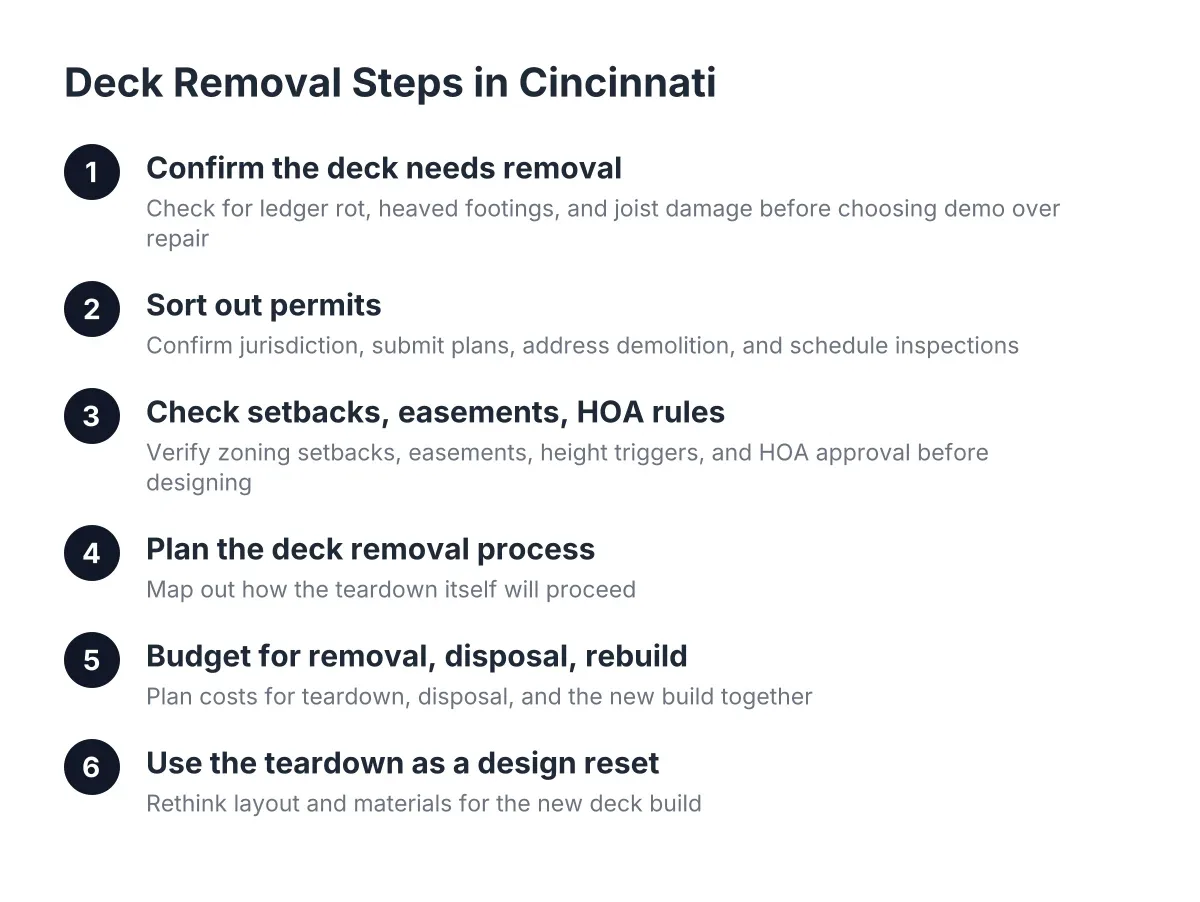
This is where the demolish-or-repair decision really gets made. Probe the joists with a screwdriver, especially at the ends and anywhere water pools. Soft, spongy wood that the tip sinks into means rot. A few bad joists can be sistered or replaced individually; widespread rot across the frame means resurfacing would be putting new boards on a failing skeleton.
Pay the most attention to the ledger board, where the deck attaches to the house. According to the International Association of Certified Home Inspectors, as many as 60 percent of the roughly 45 million decks in America have safety issues, and about 90 percent of deck collapses trace back to ledger connection failures. A ledger fastened with nails instead of lag bolts or structural screws, or one with no flashing and visible rot behind it, is the single strongest argument for major structural work.
Sagging matters too. If a beam dips between posts, the original builder may have exceeded safe spans, a common shortcut on older decks. Joist span charts govern what size lumber can cover a given distance, according to Decks.com, and a deck framed outside those limits cannot be fixed with new boards on top.
Layer 3: Posts and footings
Cincinnati sits in freeze-thaw country. Ohio winters push moisture in the soil through repeated freeze and thaw cycles, and footings poured too shallow get heaved out of position over the years. When a footing is part of a structural deck, the hole must extend below the local frost line rather than following the general above-grade ratio rules used for fence posts, according to Decks.com. Plenty of older decks in Hamilton County were built before anyone checked.
Look for posts that have shifted, footings that sit at an angle, concrete that has cracked and lifted, or posts set directly in soil with rot at the base. Failed footings are the clearest teardown trigger of the three layers. You cannot resurface your way around a foundation problem, and jacking a deck to repour footings often costs close to what demolition and replacement would.
When Full Deck Demolition and Replacement Is the Right Call
Full demolition earns its price when the damage lives in layers two and three. If the ledger connection is failing, if rot runs through most of the joists, if beams sag from overspanned framing, or if footings have heaved or sunk, repair stops being economical and starts being a patch on a structure that has reached the end of its life. In those cases, full demolition and replacement is the honest recommendation, not the upsell.
There are also non-structural reasons a teardown makes sense. Suppose you want to move from a basic 12×16 platform to a multi-level deck with a patio below, or add a screened-in porch where the old deck stands. Reworking old framing to carry a new design usually costs more in labor than starting clean, and new footings will be needed for the new loads anyway.
A full teardown is also the moment to fix code and layout problems that repairs cannot touch. Older Cincinnati decks often have railings below current height requirements, baluster spacing wide enough for a child to slip through, or stairs without graspable handrails. A rebuild resets all of that, which matters at inspection time whether the inspector works for the county or for your buyer.
One honest limitation: no article can substitute for hands and eyes on your actual structure. If your deck shows any ledger or footing symptoms described above, have a qualified deck builder or structural inspector evaluate it before anyone uses the deck again. Deteriorated decks are a collapse risk, and the safe move is taking a questionable deck out of service first and debating the fix second.
Factors That Drive Deck Replacement Costs
The expense of replacing a deck depends heavily on which layers need work, because each layer adds labor, materials, and disposal on top of the last. Resurfacing on a sound frame is the least expensive path. Full demolition and rebuild, with new footings dug below the Ohio frost line, sits at the top of the range. Everything else falls between.
Here is how the paths generally stack up, from least to most expensive:
- Targeted deck repair. Replacing a handful of rotted boards, tightening railings, and refastening loose connections. Deck board replacement costs stay low because the structure is untouched.
- Deck resurfacing. New boards and railings on the existing frame, with joist repairs and moisture protection added while the framing is exposed.
- Partial rebuild. New surface plus significant framing work, such as sistering joists, replacing a beam, or reflashing and refastening the ledger.
- Full deck demolition and replacement. Complete removal, disposal, new footings, new framing, and new decking, essentially the price of a brand-new deck plus deck removal costs on top.
Material choice moves the number as much as the structural path does. As a national reference point, the Remodeling 2024 Cost vs. Value Report puts a new 16×20 pressure-treated wood deck at an average of $17,615 with an 83 percent ROI, while the same deck in composite runs $24,206 with about a 68 percent ROI, according to Remodeling Magazine. Your project will differ; a smaller footprint, say the common question of how much a 14×20 deck costs, lands lower, while multi-level designs, premium railings, or a deck and patio combination push higher.
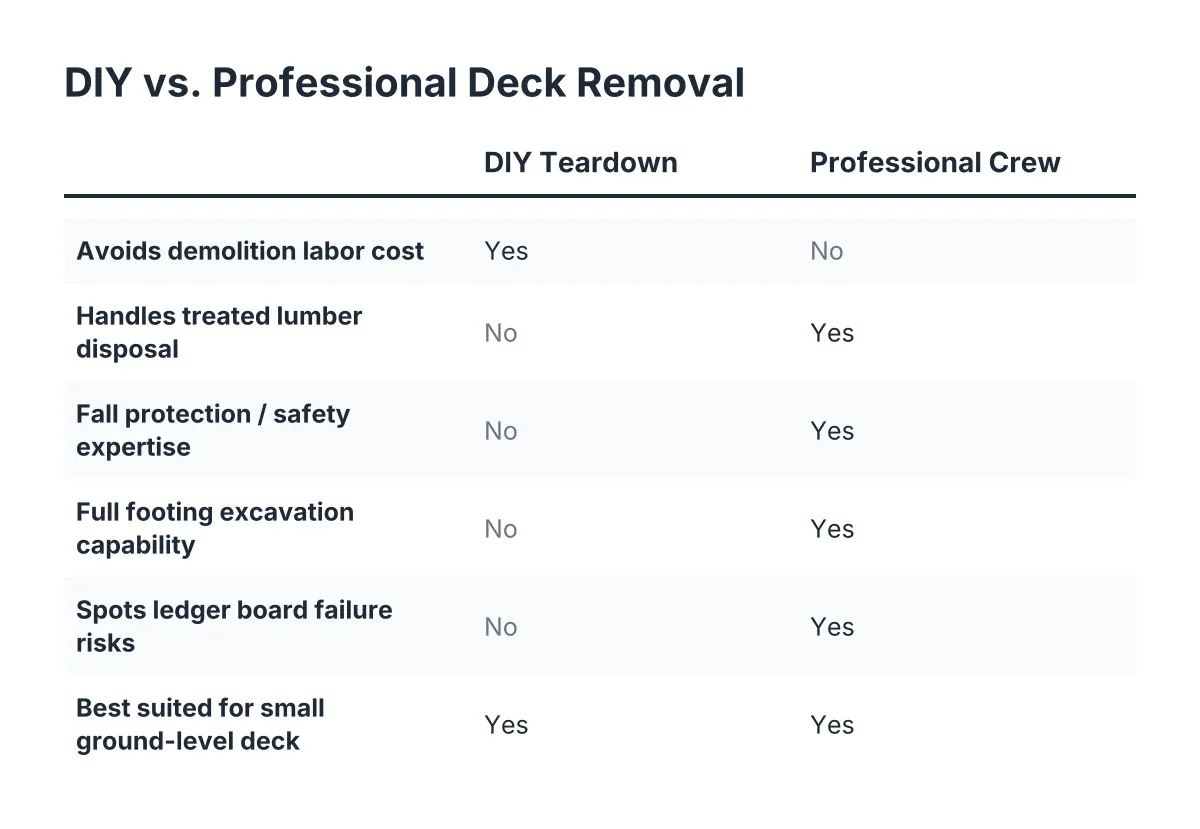
Demolition itself is a real line item, not a rounding error. Tearing out a deck means pulling boards, removing joist hangers and hardware, taking down joists, beams, and posts in sequence, breaking out or abandoning old footings, and hauling everything away. Older decks make it harder; decks fastened with Phillips-head screws often have dozens of stripped heads by removal day, which slows the crew down. Access matters too. A walkout deck on a flat Anderson Township yard demolishes faster than a second-story deck hanging over a steep Price Hill slope.
Permits, Frost Footings, and the Cincinnati-Specific Details
Deck replacement in greater Cincinnati almost always requires a building permit, and that is not a downside. In Hamilton County and within the City of Cincinnati, structural decks go through plan review and inspections that check footing depth, ledger attachment, and railing requirements. For a Pre-Listing Seller, a permitted rebuild produces paperwork a buyer's inspector can verify, which beats an unpermitted deck that raises questions during the sale.
Frost depth is the detail that separates a Cincinnati rebuild from a generic national cost guide. Footings here must reach below the frost line so the freeze-thaw cycle cannot heave them, and inspectors check the holes before concrete gets poured. This is often exactly where the old deck failed, so the rebuild fixes the root cause rather than repeating it.
In addition, a rebuild is the time to add moisture protection the original deck never had. Applying waterproofing tape over the tops of pressure-treated joists is a moisture-mitigation step professional deck builders use even though treated lumber already resists rot, according to TimberTech. It costs little during construction and extends the life of the frame under your new boards.
Two more local notes. First, if your neighborhood has an HOA, submit your plan before demolition day; some Cincinnati-area associations restrict decking colors, railing styles, or footprint changes. Second, setback rules can affect whether a replacement deck can grow larger than the original, so a bigger design may need zoning review even when a same-size rebuild would not.
A Tale of Two Decks: The Same Symptoms, Two Different Answers
To make this concrete, consider two hypothetical Cincinnati homeowners with 20-year-old wood decks that look equally rough from the yard.
Say the first is a seller in Montgomery whose agent flagged the deck before listing. The boards are gray and cracked, and two balusters are loose. But the screwdriver test finds solid joists, the ledger is bolted and flashed, and the posts sit plumb on stable footings. In that scenario, resurfacing with new treated wood decking or a mid-range composite fixes the listing photos and passes the buyer's inspection, at a fraction of full deck replacement costs. The frame had years left; only the surface was done.
Now suppose the second homeowner, in Delhi, wants to upgrade to a multi-level deck with a screened porch section for bug-free evenings. The inspection there finds a nailed-only ledger with rot behind it and one corner footing heaved two inches by frost. No amount of new decking fixes that. Full demolition and replacement is the right answer, and since the footprint is changing anyway, the teardown becomes the first step of the upgrade rather than a loss.
Same age, same weathered look, opposite answers. That is why the assessment has to come before the quote.
Questions to Ask Before You Sign a Teardown Quote
However a contractor arrives at their recommendation, you can test it. A deck builder who did a real structural assessment can answer these without hesitation:
- Which specific framing members are failing, and can you show me? Rot, sag, and heave are all visible or probeable.
- Is the ledger bolted and flashed, or nailed? This one connection drives most collapse risk and most legitimate teardown calls.
- Do the footings reach below frost depth, and have any moved? Ask how they checked.
- If the frame is sound, what would resurfacing cost instead? A pro should be willing to price both paths.
- Who pulls the permit? For a structural rebuild in Hamilton County or the City of Cincinnati, the answer should be the contractor, not you.
If the answers are vague, or the only option offered is full replacement with no walkthrough of the framing, get a second opinion before demolition day. If the answers are specific and the damage is in the frame or footings, a teardown is not an upsell; it is the fix.
The Bottom Line for Cincinnati Homeowners
The demolish-or-repair question comes down to which layer failed. Surface problems call for board replacement or resurfacing. Frame problems call for targeted structural repair or a partial rebuild. Ledger and footing failures call for full demolition and a new deck built to current code, with footings below the Ohio frost line so freeze-thaw cycles cannot repeat the damage.
Neither path is a bad outcome. National data suggests homeowners get lasting value either way; decks earned a joy score of 9.8 out of 10 in the NAR Remodeling Impact Report, according to the National Association of Realtors. Whether you are staging a home for sale or building the deck and patio setup you will use for the next decade, the goal is the same: spend money on the layer that actually failed, and nothing more.
If you need deck building and installation, Cincinnati Deck Pros can help.
Prefer to talk it through? Call (513) 613-3364 — a quick call is usually the fastest way to get a straight answer for your situation.