Deck Removal Services in Cincinnati: Proper Demolition, Disposal, and Compliance
If your old deck has reached the end of its life, the teardown matters as much as the rebuild. Good deck removal services in Cincinnati handle more than swinging a sledgehammer; they manage treated lumber disposal, protect your yard, pull the right permits, and leave a clean site ready for new footings. This guide compares your real options for getting an old deck down and hauled away, with a focus on doing it legally and responsibly in Hamilton County.
The stakes are higher than most homeowners assume. According to the North American Deck & Railing Association, about 30 million decks in the United States are beyond their useful life and need repair or replacement. If yours is one of them, here is how to compare the paths for taking it down the right way.
What Deck Removal Services Actually Include
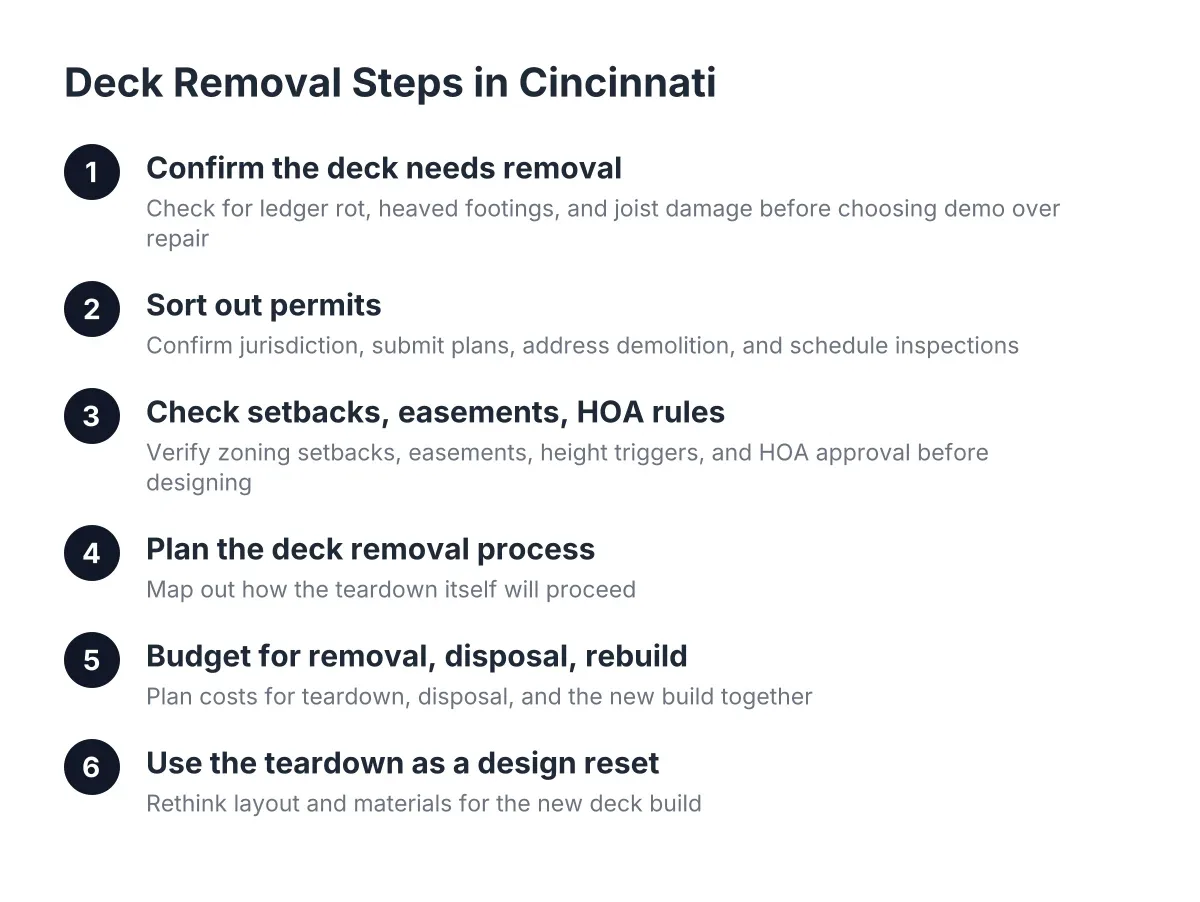
A complete deck removal covers five stages: disconnecting the structure from the house, removing decking and railings, taking down the frame, pulling or cutting footings, and hauling debris to the proper facility. Anything less than all five is a partial job, and the missing pieces usually surface later as a surprise cost.
A thorough crew works in sequence. Decking and deck railing come off first. Then joist hangers, hurricane clips, and blocking hardware get pulled before the joists and beams come down. Posts and footings come last. The order matters for safety, and it also determines whether any lumber survives in reusable condition.
Watch the footings line item closely. Some deck removal companies quote "removal to grade," meaning they cut posts flush and leave concrete footings buried in your yard. That is fine if the new deck lands on the same footprint, but it is a problem if your new design shifts even a few feet. In greater Cincinnati, new footings must reach below the local frost line; according to Decks.com, structural deck footings must be dug below frost depth rather than relying on general above-grade rules. Old buried concrete in the wrong spot can force redesigns or extra excavation.
What is usually extra, and worth confirming in writing:
- Full footing excavation and removal, not just cutting posts at grade
- Ledger board removal and patching the house siding or brick behind it
- Hauling and disposal fees, including any dump charges for treated lumber
- Regrading or filling holes where footings came out
- Permit fees if a permit applies to your demolition or the rebuild
Why Treated Lumber Disposal Is Not Just Junk Hauling
Most decks built in Cincinnati over the past few decades use pressure-treated wood decking, and treated lumber cannot be handled like ordinary yard waste. It should never be burned, whether in a fire pit, a burn pile, or a wood stove, because the preservative chemicals release into the smoke and ash. It also should not be chipped into mulch or left to rot in a corner of the property, especially at a rental where tenants and kids use the yard.
Responsible disposal means hauling treated lumber to a facility that accepts construction and demolition debris. This is where dedicated deck removal services differ from a general junk pickup. A deck contractor who demolishes decks regularly knows which loads go where, separates metal hardware and fasteners for recycling, and keeps concrete footings out of the landfill stream when a facility accepts clean concrete separately.
For landlords, the compliance angle is practical, not theoretical. Debris piled behind a rental unit invites code complaints, and improperly dumped construction waste traces back to the property owner. Paying for documented, proper disposal once beats dealing with a citation later.
There is also a salvage question. Old deck boards accumulate years of weathering, cracking, and hidden deterioration, so reusing them on a new deck is discouraged for safety reasons. However, sound framing hardware and some structural lumber can sometimes be stacked on pallets and reused for non-structural projects, which trims the disposal load. A crew that sorts as it demolishes gives you that option; a crew that smashes everything into a dumpster does not.
DIY Teardown vs. Hiring a Deck Removal Company
Here is the honest comparison, because plenty of Cincinnati homeowners and landlords consider doing the demolition themselves to save money on the rebuild.
The DIY route
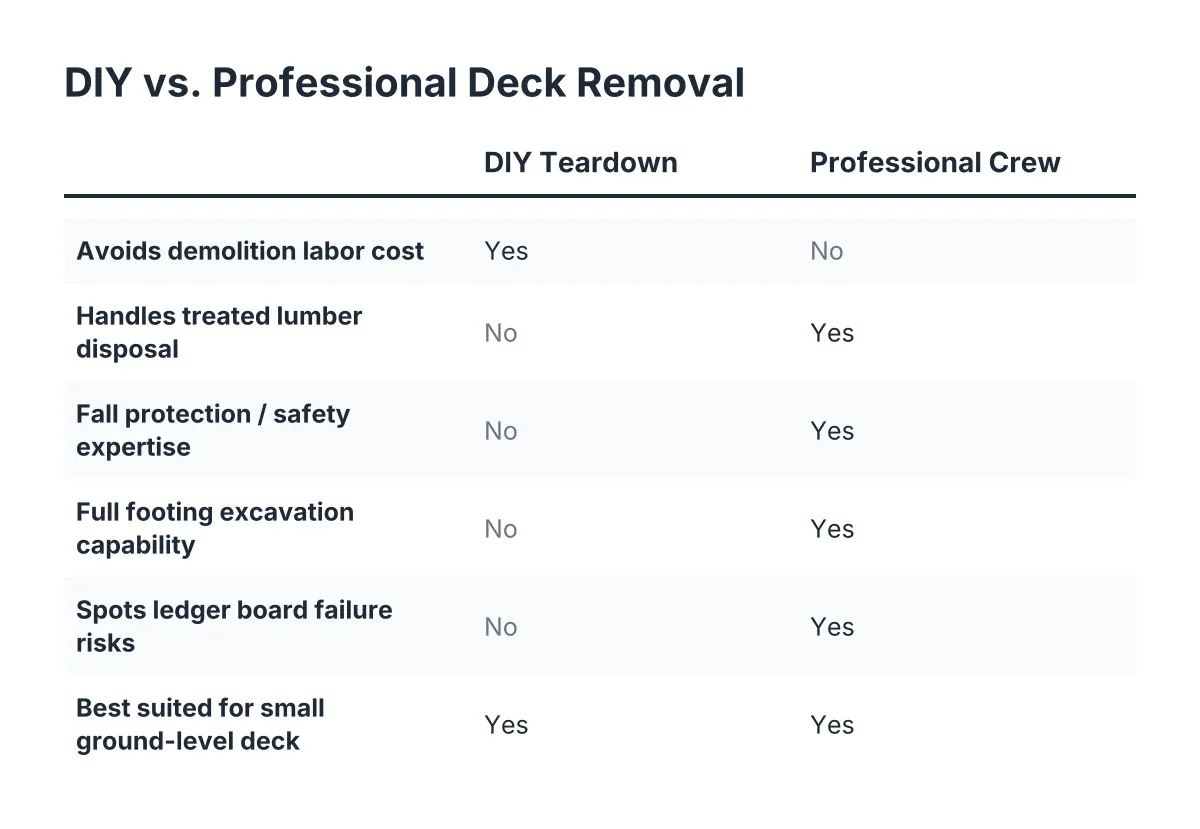
Tearing down a small, ground-level deck yourself is doable if you are comfortable with a pry bar, a reciprocating saw, and heavy lifting. You control the pace, and you avoid demolition labor costs. For a landlord with a handyman on call, a simple 10-by-10 platform deck at a rental might be a reasonable in-house job.
The risks scale fast with height and condition. The fastest removal method, cutting deck boards between joist cavities with a circular saw, is also the most dangerous, because a worker can step through a cut section on an elevated deck. A deck that is already failing, with soft boards and a loose railing, is the worst possible structure to stand on while swinging tools. If the deck scared you enough to replace it, it should scare you enough not to work on top of it casually.
DIY also leaves you holding the disposal problem. You will need a dumpster or multiple dump runs, a facility that takes treated lumber, and a plan for the concrete footings, which are the heaviest and most stubborn part of the job.
The professional route
A professional crew brings the right sequence, fall protection habits, and a disposal pipeline that already exists. They also see what you cannot. During teardown, the condition of the ledger board connection becomes visible, and that matters: according to the International Association of Certified Home Inspectors, about 90 percent of deck collapses stem from ledger board connection failures. A deck builder doing the demolition documents what they find at the ledger and uses it to build the new connection correctly.
The trade-off is cost and scheduling. You pay for labor, hauling, and disposal, and you work around the crew's calendar. For a single small teardown with no rebuild attached, a hauling-only service may be cheaper. For deck demolition and replacement as one project, bundling removal with the rebuild usually makes more sense, because the same contractor handles permits, footing layout, and site protection in one pass.
Junk Hauler vs. Deck Contractor: Which Removal Path Fits Your Project
Search for deck removal companies near me and you will find two different kinds of businesses: junk hauling outfits that list decks among mattresses and hot tubs, and deck contractors who demolish decks as the first step of building new ones. Both can get wood off your property. They are not interchangeable.
When a hauling service makes sense
If the deck is coming down and nothing is replacing it, a hauler can be the right call. Say a landlord is removing a rotted rear deck from a rental before listing it, with no plan to rebuild before sale. In that scenario, a demolition and haul-away job with a clean grade behind it may be all the property needs. Confirm the hauler removes footings, not just the visible structure, and ask where the treated lumber goes.
When a deck contractor is the better fit
If a new deck, porch, or deck and patio combination is going up, hire the builder to do the removal. The reasons are practical:
- Footings and layout. The demolition plan should match the new deck's footprint. A builder pulls only the footings that conflict and plans new frost-depth footings around what stays.
- The ledger and the house. The builder sees the flashing, sheathing, and any rot behind the old ledger while it is exposed, and corrects it before the new deck goes on.
- One permit path. In Hamilton County and the surrounding Cincinnati municipalities, the rebuild typically needs a permit, and the demolition and construction get handled under one coordinated process instead of two separate contractors pointing at each other.
- Site protection. A crew planning to build on the same spot next week treats your lawn, landscaping, and neighboring fence like part of the job, not an obstacle.
For a small landlord with several properties, this comparison tilts further toward the contractor. The same deck builder who tears down and rebuilds one rental deck can inspect and price decks at your other units on the same visit. Treated wood decking on a straightforward frame keeps rebuild costs sensible for rental use, and one relationship covers demolition, replacement, and future deck repair calls.
Permits, Timing, and Cincinnati-Specific Considerations
Rules vary by municipality across greater Cincinnati, so confirm requirements for your specific address before demolition starts. As a general pattern, tearing down a deck attached to a house and rebuilding it triggers the permit process for the new structure, and some jurisdictions want notice of the demolition itself. A local deck contractor who works these permit offices regularly handles this as routine paperwork; a homeowner doing it for the first time in 2026 should call the building department before renting a dumpster.
Ohio weather shapes the schedule too. Freeze-thaw cycles are the reason footings must sit below frost depth, and frozen ground makes footing removal and new excavation slower in deep winter. Demolition itself can happen almost any time of year, but if the rebuild follows immediately, many projects flow better when excavation avoids the hardest frozen weeks.
Timeline-wise, be wary of anyone quoting a firm schedule before seeing the site. Access, deck height, footing count, and how the debris gets from the backyard to the truck all change the effort. A deck tucked behind a narrow side yard on a Cincinnati hillside lot takes longer to carry out than one with driveway access, and a good estimate accounts for that.
One safety note that overrides everything else. If boards are soft and springy or the railing moves when you lean on it, stop using the deck now, before demolition is even scheduled. U.S. Consumer Product Safety Commission data show about 725 injuries per year from collapses and failures of porches, decks, and balconies. A deck awaiting teardown is not a deck for hosting.
How to Choose Deck Removal Services You Can Trust
Three questions separate a careful removal from a fast, sloppy one:
- Where does the debris go? A trustworthy answer names the disposal approach for treated lumber and concrete, and never includes burning or burying anything on site.
- Are footings included, and to what depth? Get "removal to grade" versus full excavation stated in writing, and match it to your rebuild plan.
- What happens at the ledger? For any deck attached to the house, ask how they will remove the ledger board, what they expect to find behind it, and how the wall gets protected or patched.
A fair quote itemizes demolition labor, hauling and disposal, footing handling, and site cleanup separately, so you can see what you are paying for instead of guessing at a single lump number. If you have been burned before by contractors who hand over one unexplained figure, an itemized removal quote is your first signal you have found a better one.
If you are in greater Cincinnati and weighing a teardown, a rebuild, or both, ask a local deck builder to walk the structure with you. Rather than searching endlessly through deck contractors near me listings, have a specialist assess what is actually failing, explain what removal and disposal will involve at your address, and price the demolition and the new deck as one clear project. Reach out for an on-site assessment and estimate, and get the old deck down safely before another season of use.
If you need deck building and installation, Cincinnati Deck Pros can help.
Prefer to talk it through? Call (513) 613-3364 — a quick call is usually the fastest way to get a straight answer for your situation.