Deck Resurfacing vs. Rebuilding: An Honest Way to Tell Which Your Cincinnati Deck Needs
If your deck has soft boards, a wobbly railing, or gray splintered wood, the first question is not what a new deck looks like. It is whether you need one at all. Deck repair cost varies wildly depending on the answer, and too many homeowners get a number with no explanation of what is actually wrong under their feet. This guide gives you the framework a straight-shooting deck contractor uses to sort a resurfacing candidate from a rebuild, so you can walk into any estimate knowing what questions to ask and which answers should make you suspicious.
Here is the short version before we go deep: the deck boards you walk on and the railing you grab are the skin of the deck. The joists, beams, posts, footings, and the ledger board bolted to your house are the skeleton. If the skeleton is sound, you can resurface. If the skeleton is failing, no amount of new decking on top will make the structure safe. Everything else in this article is about learning to tell the difference.
Why Old Decks Fail, and Why Cincinnati Is Hard on Them
A wood deck in greater Cincinnati lives a rough life. Ohio's freeze-thaw cycles push moisture into every crack in the wood, freeze it, and pry the fibers apart, over and over, every winter. Summers bring humidity that keeps shaded framing damp for weeks. Snow sits on horizontal surfaces. Water pools where boards cup. Fifteen to twenty years of that will wear out even a well-built deck, and plenty of decks around Hamilton County were not well built to begin with.
The scale of the problem is bigger than most people realize. The North American Deck & Railing Association estimates about 30 million decks in the United States are beyond their useful life and need repair or replacement. Additionally, the International Association of Certified Home Inspectors puts it more sharply: as many as 60 percent of the roughly 45 million deck structures in America have safety issues, and about 90 percent of deck collapses stem from ledger board connection failures.
That last detail matters. The ledger is the board that attaches the deck to your house, and it is the single most dangerous place for hidden rot. Water running down your siding can sit behind the ledger for years without anyone noticing, especially if the original builder skipped flashing. A deck can look tired but harmless on top while the connection to the house is quietly letting go.
Therefore, if your deck feels springy, if the railing moves when you lean on it, or if an inspector flagged it during a home sale, take it seriously. A deck in visibly poor condition should come out of service before you host another cookout on it, not after.
The Skin and the Skeleton: The Only Framework You Need
Every honest repair-or-rebuild conversation comes down to one distinction.
The skin is everything you see and touch: deck boards, railing, stairs treads, fascia, and skirting. Skin problems are cosmetic or surface-level structural. Splintered boards, faded finish, popped nails, a few soft spots, and a loose railing post all live here.
The skeleton is everything holding the skin up: the ledger board and its flashing, joists, beams, support posts, footings, and the hardware tying it all together. Skeleton problems are structural. Rotted joist tops, a wet or spongy ledger, posts sitting on dirt or heaved concrete, rusted-through joist hangers, and beams sagging under load all live here.
The rule is simple:
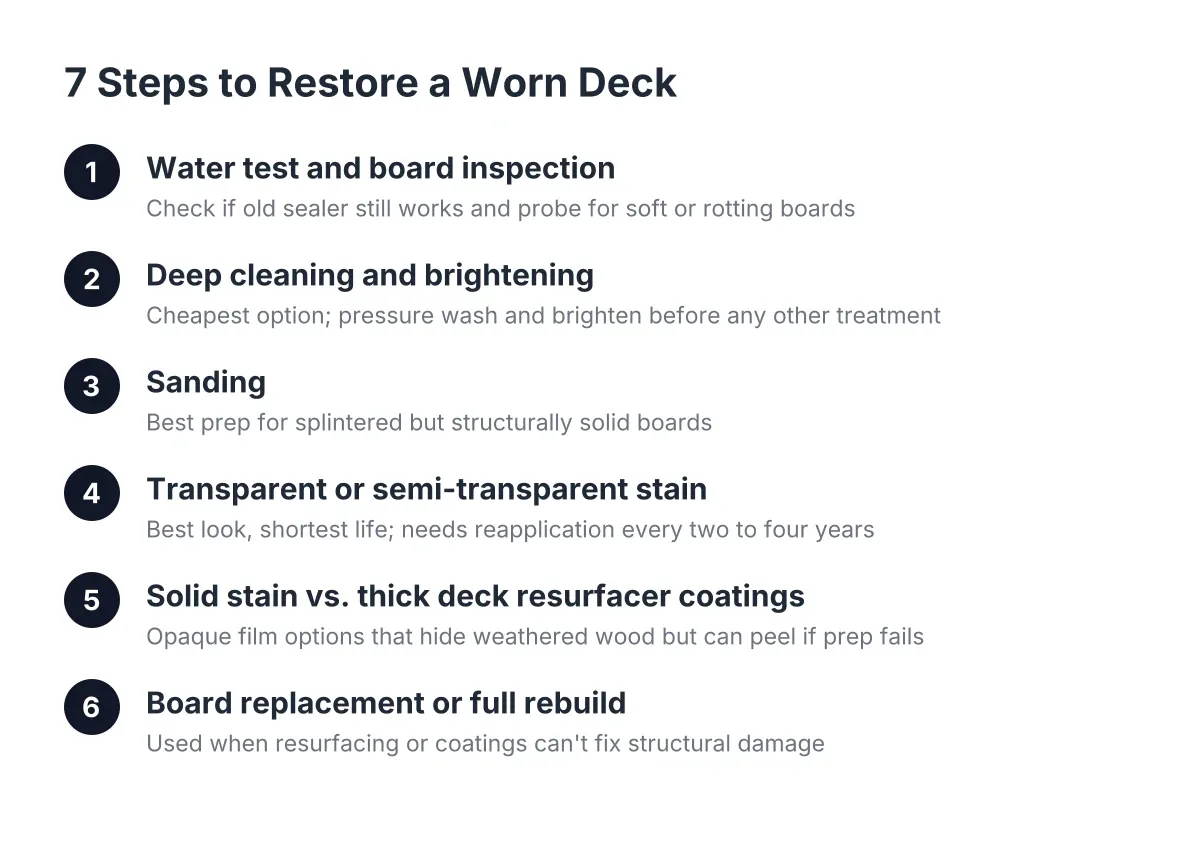
- Skin bad, skeleton good: resurface. You strip the old boards and railing, rehab the exposed framing, and install new decking on the existing structure. This is often the right call for a deck built solidly 15 to 20 years ago with cheap surface boards that wore out first.
- Skeleton bad anywhere that matters: rebuild. Once the ledger, multiple joists, posts, or footings are compromised, resurfacing just puts new money on top of a failing structure. Deck demolition and replacement is the honest answer.
- Skin bad, skeleton mostly good with isolated damage: targeted deck repair plus resurfacing. One rotted joist or a single bad post can often be sistered or replaced during a resurfacing project without triggering a full rebuild.
A contractor who quotes you a full rebuild without crawling under the deck and probing the framing has not earned that number. Likewise, a contractor who quotes a cheap resurfacing without checking the ledger has not earned yours either.
How to Inspect Your Own Deck Before Anyone Quotes You
You do not need to be a builder to run a first-pass inspection. You need an afternoon, a flashlight, and a screwdriver. Go board by board rather than judging the whole deck at a glance; individual boards can rot while the rest of the deck stays sound, and the reverse is true too.
Work through this list:
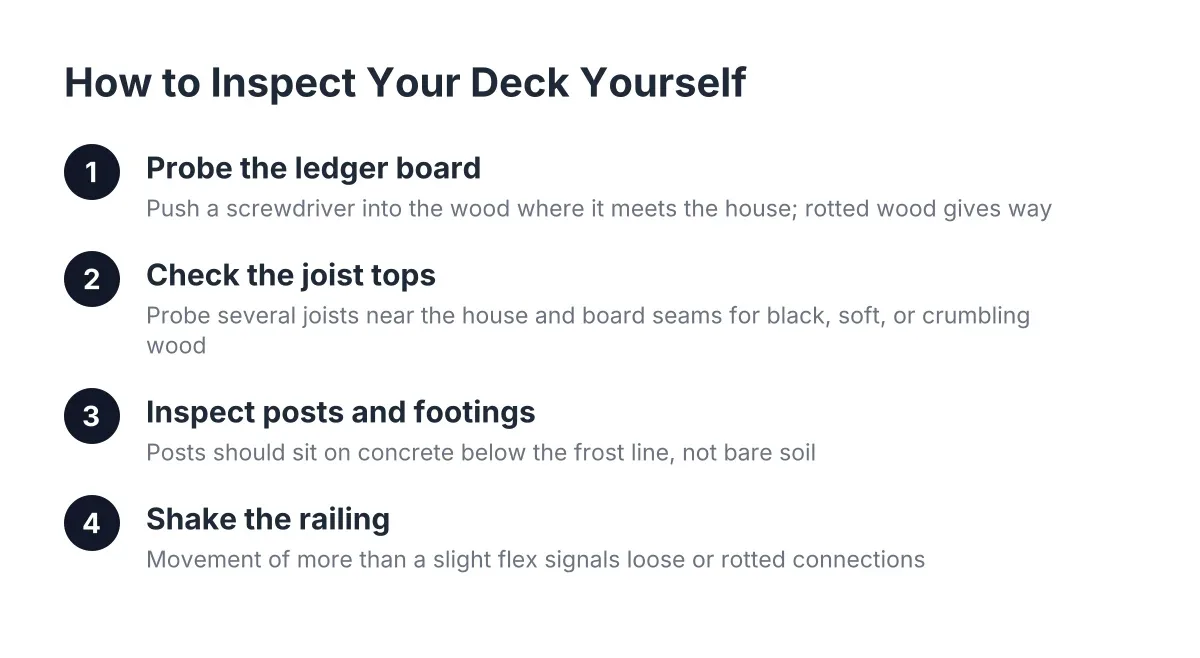
- Probe the ledger board. Get under the deck where it meets the house. Push the screwdriver tip into the wood. Solid wood resists; rotted wood gives way like a stale sponge. Look for flashing above the ledger. No flashing on an older deck is a warning sign even if the wood feels firm today.
- Check the joist tops. Water sits on the top edge of every joist under the gaps between deck boards. Probe several joists, especially near the house and at board seams. Blackened, soft, or crumbling joist tops mean the skeleton is going.
- Look at the posts and footings. Posts should sit on concrete footings, not bare soil, and the footings should sit below the frost line. Decks.com notes that structural footings must be dug below the local frost line rather than relying on shallow rules of thumb, and in Ohio that is deep enough that many older DIY decks fall short. Heaved, cracked, or tilting footings point toward rebuild.
- Shake the railing. Grab a post and push hard. Movement of more than a slight flex means loose or rotted connections. A loose railing alone is a repair, not a rebuild, but it tells you where to look next.
- Walk every board. Mark soft, springy, or cracked boards with chalk. A handful of bad boards is a repair. Softness across large areas usually means the joists underneath are wet too.
- Judge the craftsmanship underneath. Even without training you can spot sloppy work: joists at uneven spacing, missing joist hangers, beams held up by nails instead of proper post caps, or long spans with no support. Poor original framing pushes the answer toward rebuild regardless of how the boards look.
Pay extra attention to rim joists and any framing left exposed on the deck's exterior. Those members take more weathering than anything else on the structure and are the first to cup, twist, and delaminate.
If your ledger probe finds soft wood, stop using the deck and get a professional assessment. Ledger failure is the collapse scenario, and it is not a judgment call to make from a blog post.
Understanding Deck Repair Costs: What Moves the Price in Repairs, Resurfacing, and Rebuilds
Deck repair cost is driven by scope, not square footage alone, which is why online calculators and per-square-foot averages mislead so many homeowners. Replacing five boards, resurfacing 300 square feet, and rebuilding the same 300 square feet from the footings up are three different projects with three different price logics.
Here is what actually moves the number in each tier:
Targeted deck repair. The cost drivers are access and how far the damage spread. Swapping surface boards is quick work; the job gets bigger when the crew pulls a board and finds the joist below needs rehab before a new board can go down. Board replacement really has three phases: remove the old board, repair or protect the exposed joist, and install the new one. The middle phase is where small quotes grow.
Deck resurfacing. Here the drivers are deck size, material choice, and framing condition. Treated wood decking costs the least up front. Composite decking such as Trex or TimberTech costs more per board but ends the sanding-and-staining cycle for good. Framing rehab sits in the middle of every resurfacing budget: good builders replace any compromised joists and often add waterproofing tape over the joist tops before the new boards go down, a moisture measure TimberTech describes as standard practice among professional deck builders even over pressure-treated lumber. Reusing old deck boards to save money is a false economy; years of weathering leave them structurally weaker than new stock.
Full rebuild. Now you are paying for demolition and haul-away, new footings dug below the Ohio frost line, a full frame, decking, railing, stairs, and the Hamilton County or city permit and inspection process. Deck replacement cost per square foot runs well above resurfacing for the same footprint because you are buying the skeleton, not just the skin. Design changes, a multi-level deck layout, or a deck and patio combination add scope on top.
As a rough illustrative frame, and these are estimates rather than quotes, resurfacing an average deck often lands in a range where a comparable full rebuild costs roughly two to three times more. That gap is exactly why the skin-versus-skeleton question matters so much. Skipping a needed rebuild wastes the resurfacing money; buying an unneeded rebuild wastes the difference.
Selling Your House? How the Repair-or-Rebuild Math Changes
If your realtor or a pre-listing inspection flagged the deck, the decision shifts from "what do I want to live with" to "what does the sale need." Those are different questions with different right answers.
Buyers and their inspectors care about two things: safety and appearance. A structurally sound deck with fresh boards, solid deck railing, and a clean finish photographs well and passes inspection. A gorgeous new custom deck does more than that, but you will not live there to enjoy it, and the resale math rarely justifies a premium build on a sale deadline.
The return numbers back this up. The 2025 Cost vs. Value Report from Remodeling Magazine and Zonda shows a wood deck recoups about 95 percent of its cost at resale nationally, with composite at about 89 percent. Strong numbers, but still under 100 percent, which means a deck project before listing should solve the inspection problem at the lowest sound cost rather than chase a showpiece. Meanwhile the National Association of Realtors' Remodeling Impact Report gave decks a joy score of 9.8 out of 10, which explains why buyers respond to a good one; you are selling that feeling, not owning it.
For example, suppose a homeowner in Anderson Township is listing in ten weeks. The inspector's note says "deck boards deteriorated, railing loose, evaluate structure." A skeleton check finds solid joists and a properly flashed ledger, with one soft joist near the stairs. In that scenario, resurfacing with treated wood decking, sistering the one bad joist, and installing new code-compliant deck railing clears the inspection note, sharpens the listing photos, and fits a pre-listing budget. A full composite rebuild would cost multiples more and add weeks of design and permit time the sale calendar does not have.
However, flip the findings and the answer flips too. If that same inspection had found a rotted ledger or heaved footings, listing the house with a patched-over structural problem invites a worse outcome: a buyer's inspector finds it, the deal gets renegotiated late, and the seller loses leverage along with time. Rebuild first or price the house accordingly, but do not resurface over a failing skeleton and hope.
Where Deck Refinishing Fits, and When It Is Enough
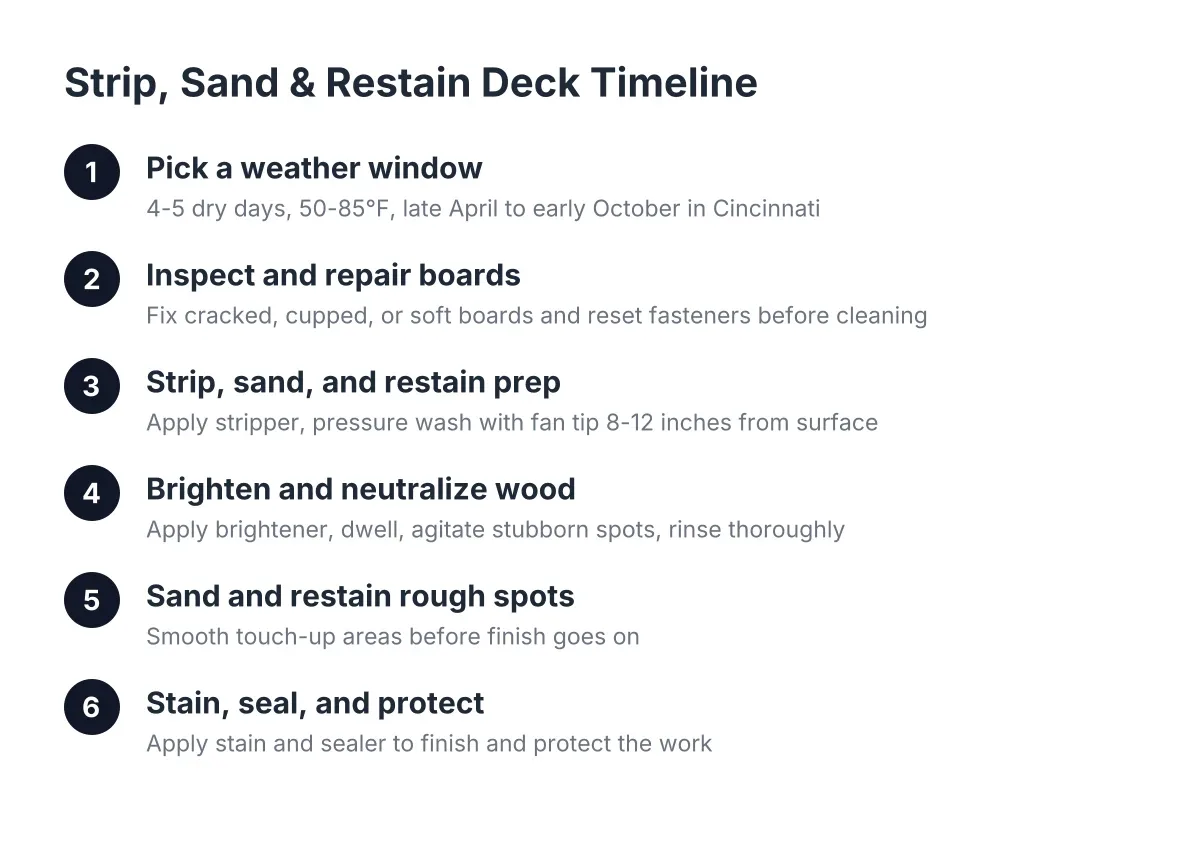
Sometimes the answer is neither resurfacing nor rebuilding. If the boards are structurally sound and simply look tired, deck refinishing can restore a deck for a fraction of either. That means cleaning, replacing any individual damaged boards, and applying new stain and sealer.
Order of operations matters here. Inspect every board and make repairs before the deep cleaning, since board swaps and fastener fixes are easier on a dry, dirty deck than a freshly washed one. If the old finish has failed extensively, pressure washing is usually the only practical way to strip it; sanding an entire deck by hand is a job nobody finishes.
Refinish deck cost sits far below resurfacing because you are buying labor and finish products, not new material across the whole surface. The trade-off is honesty about lifespan. Refinishing a 20-year-old wood deck buys you a few good seasons, not a new deck. On a pre-listing timeline that may be exactly the right purchase. For a homeowner planning ten more years of family cookouts, resurfacing with composite decking often makes more sense than restaining the same aging boards every two or three years.
One more limitation worth naming: refinishing does nothing for the skeleton. Run the same framing inspection before spending on stain, because a beautiful finish on a compromised structure is the most dangerous kind of deck, the one that looks fine.
Reading a Quote: How to Spot an Upsell and a Corner-Cut
You now know enough to evaluate what a deck builder tells you. Use it. A trustworthy assessment in 2026 should include a few specific things, whoever provides it:
- Evidence from under the deck. The estimator should be able to tell you the condition of the ledger, joists, and footings specifically, not just "the frame's shot" or "it's fine."
- A reason tied to structure. "Rebuild" should come with which structural members failed and why. "Resurface" should come with confirmation that the ledger and footings passed.
- Scope for framing rehab. A resurfacing quote with zero allowance for joist repair either assumes a perfect frame or plans to surprise you mid-project.
- The permit path. In Hamilton County and Cincinnati-area municipalities, a full rebuild typically means permits and inspections, and new footings must reach frost depth. A rebuild quote that never mentions permits is a corner about to be cut.
- Material options at more than one price. Treated wood and composite serve different budgets and timelines. A quote that only offers the premium option was not written for your situation.
The persona this article was written for has usually heard the opposite: a number with no explanation. You do not have to accept that. The gap between resurfacing and rebuilding is large enough that you deserve to see the reasoning, and any deck contractor confident in their assessment will walk you through it.
The Bottom Line for an Aging Cincinnati Deck
Start with the skeleton. Probe the ledger, check the joist tops, and look at the footings before you think about boards, colors, or brands. That one afternoon of inspection tells you which conversation you are in: a refinishing conversation, a deck resurfacing and rebuilding conversation, or a full demolition and replacement conversation. Each has a legitimate place, and each has a wildly different price.
Then match the fix to your timeline. Selling this spring points toward the least expensive structurally honest option, often refinishing or resurfacing with treated wood. Staying ten years points toward resurfacing with composite or rebuilding right, with frost-depth footings and flashing done properly so you never repeat this decision.
Above all, do not let anyone, including your own optimism, put new boards over a failing frame. Deck repair cost stings once. A deck failure with people on it is a different category of problem entirely. Get the skeleton answered first, in writing, with specifics, and the rest of the decision gets much easier.
If you need deck building and installation, Cincinnati Deck Pros can help.
Prefer to talk it through? Call (513) 613-3364 — a quick call is usually the fastest way to get a straight answer for your situation.